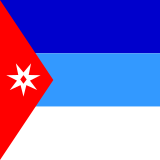
Vassulu is an Islamic empire that resisted French colonialism in West Africa from 1882 to 1898.
| empire | |||
| Vassulu | |||
|---|---|---|---|
| |||
 | |||
←   → →1878 - 1898 | |||
| Capital | |||
| Form of government | monarchy | ||
| Official language | |||
| the emperor | |||
| • 1882 - 1898 | Samory | ||
History
In 1864, Al-Haj Omar , the founder of a state called Tijaniya Omar al-Hajj , who dominated the upper reaches of the Niger River, was killed. Since his empire immediately began to disintegrate after this, the military leaders and local rulers fought among themselves in an attempt to create their own states.
By 1867, Samori was a powerful military leader; his army was based in Sanankoro , on the Guinean Highlands , near the Upper Milo River, a tributary of the Niger River . Samori understood that he needed to do two things: create an effective and dedicated army equipped with firearms, and build his own stable state. In 1882, he founded an empire called Vassulu, which was located on the territory of the modern state of Mali [1] .
War with the French
In 1887, Samory possessed a disciplined army of 30,000-35,000 infantrymen, united in platoons and regiments according to the European model, as well as 3,000 cavalrymen from several squadrons of 50 horsemen each. However, the French were determined not to give Samory time to strengthen their position. Taking advantage of the rebellions against Samory of several tribes professing animism, the French continued to extend their power to the western part of its territories, forcing Samory to sign a series of agreements on territorial concessions to them between 1886 and 1889 [2] .
In March 1891, French troops led by Colonel Louis Arshinar launched an offensive on Kankar. Knowing that his fortifications could not stop the French artillery, Samory began a maneuver war. Despite his separate victories over small and fragmented French troops (for example, near Dabadougou in September 1891), Samori was unable to expel the French from his state. In June 1892, Colonel Gustave Humber, temporarily replaced by Arshinar, with small, but selected and well-armed forces, took the capital of Zamori, Bissandoug. Another blow for Samory was that the British stopped selling weapons to him in accordance with the Brussels Convention of 1890 [2] .
Samori moved his main base to the east of the country, towards Bandam and Komoe. He used scorched earth tactics in the war, devastating every area left before it was captured by the French. Although this maneuver cut off Samory from his last source of modern weapons - Liberia - he also delayed the French advance.
Nevertheless, the defeat of other opposing armies, especially the leader Babemba Traore in Sikaso , allowed the French to approach the victory in the war and focus their efforts on the capture of Samory. He was captured on September 29, 1898 by the French captain Henri Gouraud and exiled to Gabon [2] .
Notes
- ↑ Nikolai Sychev. The book of dynasties. - AST, East-West. - T. 2005 .-- 960 s. - 2500 copies. - ISBN 5170324960 , 5478001813.
- ↑ 1 2 3 Boahen, A. Adu. African Perspective on Colonialism. - Baltimore: Johns Hopkins University Press, 1989 .-- P. 144 pages. - ISBN 0-80183-931-9 .