Nikolai Nikolaevich Fleisher (1846 - 1909) - Russian military leader, lieutenant general . Member of the Russian-Turkish war of 1877-1878, the campaign of 1885 in Central Asia, the campaign in China 1900-1901 , the Russo-Japanese war of 1904-1905 .
| Nikolai Nikolaevich Fleisher | ||||||||
|---|---|---|---|---|---|---|---|---|
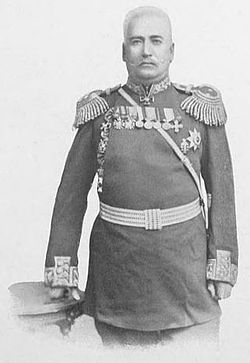 General Fleisher. China, Yingkou, 1900. | ||||||||
| Date of Birth | November 26, 1846 | |||||||
| Place of Birth | Ryazan | |||||||
| Date of death | December 11, 1909 (63 years old) | |||||||
| Place of death | ||||||||
| Affiliation |  Russian empire Russian empire | |||||||
| Rank | lieutenant general | |||||||
| Battles / wars | Chinese Campaign (1900-1901) | |||||||
| Awards and prizes |
| |||||||


Content
Biography
From a family of Russified Germans . The son of Major General Nikolai Mikhailovich Fleisher and his first wife Natalia Mikhailovna Petrovskaya. The brother of Major General A.N. Fleischer , Lieutenant General R.N. Fleisher , General S.N. Fleischer .
He graduated from the 1st Moscow Cadet Corps (1863), the 3rd Military Alexander School (1865).
Second Lieutenant of the 38th Tobolsk Infantry Regiment. In 1867, he was transferred to the Life Guards Lithuanian Regiment. In 1872, he was seconded to the 3rd Alexander Military School as a junior officer. In 1876 he returned to the regiment, as part of which he participated in the war of 1877-1878, commanding the 10th company. In 1878 - 1879 sent to the disposal of the head of civil affairs in Bulgaria. In 1882, he was appointed Baku district chief. In 1883, he was the commander of the 5th Trans-Caspian Rifle Battalion (from 1885 it was renamed the 1st). Lieutenant Colonel (1878). Colonel (1884). In 1885, he was on a campaign, as part of the Serakh detachment in the Trans-Caspian region as the head of this detachment and was awarded the Order of St. Vladimir of the 3rd degree for occupying Zyulfagar. Since 1890 - commander of the 3rd Novogeorgievsky fortress infantry battalion. Since 1891 - commander of the 5th Infantry Regiment. From January 25, 1893 to July 24, 1896 - commander of the 72nd Tula Infantry Regiment . From July 24, 1896 to March 1, 1899 - commander of the 105th Infantry Regiment . Since March 1, 1899 - the head of the 1st East Siberian Rifle Brigade. Major General (1899).
During the Chinese campaign of 1900-1901. in July 1900, Major General Fleisher was appointed head of the South Manchurian detachment. After a 3-day battle, on July 28, 29 and 30, 1900, despite the intense heat, the troops of the South Manchu detachment defeated the Chinese (who had up to 4 thousand troops, 1 thousand rebels and 8 guns), and occupied Haicheng , taking during the battle 6 guns. The Chinese retreated to Liaoyang . After the fall of Beijing , on August 14, 1900, the South Manchu detachment was ordered to attack Mukden -Liaoyang, this operation was assigned to Lieutenant General Subbotich , with the subordination of all troops in southern Manchuria to him. On September 11, he moved in three columns - on the left, Major General Fleisher, in the center, Colonel Artamonov , on the right, Colonel Mishchenko . Chinese forces are located in two groups: 6,000 from Nyuzhuan and 16,000 from Aisandzan. On September 11, 1900, the avant-garde speaker, under the command of Major General Fleischer, after a small skirmish, occupied the city of Old Niuzhuan. On September 15, 1900, the front units of General Fleischer’s column were captured by Liaoyang . On September 18, the attack on Mukden continued and on September 19, 1900, Mukden was taken. At the request of Subbotich to dismiss him on a long vacation, Major General Tserpitsky was appointed head of the South Manchurian detachment on October 26, 1900. In August 1901, Lieutenant General Tserpitsky again surrendered the South Manchurian detachment to Major General Fleischer.
Since 1902, at the disposal of the chief of the General Staff. Lieutenant General (1902). From February 10, 1903 to August 10, 1904 - Head of the 20th Infantry Division .
Since 1904, at the disposal of the governor in the Far East. Since August 18, 1905 - the commander of the 1st combined infantry corps.
From December 27, 1906 to July 1907 - commander of the 3rd Siberian Army Corps .
He was buried in the Jerusalem cemetery of Irkutsk .
Rewards
- St. Anna 3 tbsp. with swords and a bow - for affairs under Mountain Dubnyak and Telish.
- St. Stanislav 2 tbsp. with swords - for crossing the Balkans.
- St. Vladimir 4 tbsp. with swords and a bow - for the battle of Philippopolis.
- Golden weapon (1901)
- Order of the Double Dragon (04/23/1902) - for his contribution to the restoration of calm in Manchuria after the defeat of the Boxer Uprising of 1898-1901
Sources
- Fleisher Nikolai Nikolaevich // List to the generals by seniority. Done on July 4, 1907. - SPb. : Military Printing House, 1907. - S. 164.