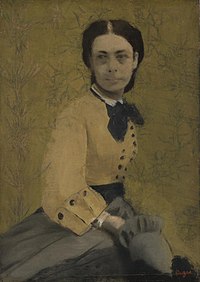
Princess Pauline Clementine von Metternich ( German: Pauline Clémentine von Metternich-Winneburg zu Beilstein ; February 26, 1836 , Vienna - September 28, 1921 , Vienna ), nee. Sandor ( Hungarian. Sándor de Slawnitza ) is a socialite , a brilliant representative of the courtyards of Napoleon III in Paris and Franz Joseph in Vienna. The wife of the Austrian ambassador in Paris, , is the granddaughter and daughter-in-law of Chancellor Metternich , a friend of the Empress of France, Eugenia .
Paulina's father is the last Hungarian count Sandor , mother is Leontin von Metternich, daughter of the chancellor. In 1856, the wedding of Paulina and her mother’s half-brother, , took place. Three years later, he was appointed Austrian ambassador to Paris . Having quickly settled down in the French capital, the princess became a close friend of the Empress Eugenia and opened a prestigious salon in her house. According to Baron N.E. Wrangel , her popularity in Paris and Vienna, her influence on state affairs were enormous [1] .
Under her influence, “frivolous and desperate-bold love etiquette came into fashion, which at the beginning of the second half of the last century supplanted the unbearably melancholy stiffness in the upper circles” [1] . She taught French women how to smoke cigars and skate, and introduced them to outfits from Worth and Wagner's music.
In view of the strained Franco-German relations, shortened versions of Wagnerian operas were staged right in her salon, and the princess herself was not averse to performing the opera part. Under her pressure, in 1861 she managed to get permission for the French production of Tannhäuser , but the opera was removed from the poster after a stormy scandal and only three performances. Another composer, who owes her fame to Princess Metternich in Europe, is her compatriot Bedřich Smetana .
After the capture of Paris by the Prussian forces in 1870, Prince Metternich was recalled to Austria, and the princess managed to remove the jewels of Empress Eugenia from the country in a bag of diplomatic mail . In the Vienna Metternich Palace, she renewed her salon, however, without her former success.
She had red hair, and she was rather ugly, but very charming and a grand lady to the tip of her nails. Clever, sharp on the tongue, caustic, kind, incredibly gifted and brilliant in government matters. Despite all this, she was, in the full sense of the word, a crazy woman who said everything that came to her mind and did everything to seem like a woman from the street, or maybe it was the women of the street trying to imitate as much as they could her, but, unfortunately, they did not succeed. Only one person was able to imitate her - Princess Metternich herself.
- N.E. Wrangel [1]
Her later years were overshadowed by troubles in the family life of three daughters. The middle one died at the hands of the alcoholic husband of Count Waldstein in the Duhtsovsky castle , the youngest was disfigured as a child by the bites of a dog and vowed celibacy.
After the death of Princess Metternich in 1921, two books of her memoirs were published. In 1926, the princess's youngest daughter, Princess Clementine (1870-1963), adopted her great-nephew, Prince Hogenloe-Schillingsfürst (1920-2009; later - the 4th Duke of Ratiborsky and the 4th Prince of Corvey ), deciding to give him the glorious surname Metternich .
Notes
- ↑ 1 2 3 Wrangel N.E. Memories: from serfdom to the Bolsheviks.
Links
- Wikimedia Commons has media related to Princess Metternich
- Bezirksmuseum Landstraße - Fürstin Pauline Metternich-Sandor (German) . Date of treatment January 23, 2012. Archived May 18, 2012.
- Metternich-Sándor Pauline Fürstin (German) . Österreichisches Biographisches Lexikon 1815-1950 . Date of treatment January 23, 2012. Archived May 18, 2012.