Mecklenburg-Western Pomeranian dialects ( German: Mecklenburgisch-Vorpommersch ; in the dialect - Mękelborgsch und Vörpommersch ) - this group of dialects of the Low German language , included in the East Low German dialect group . Distributed mainly in the modern German federal state of Mecklenburg-Vorpommern . All dialects of the group are very similar to each other and do not have strictly defined boundaries that would allow to determine the transition zone.
| Mecklenburg-Western Pomeranian dialects | |
|---|---|
| Self name | Mękelborgsch-Vörpommersch |
| Country | Germany |
| Regions | Mecklenburg-Vorpommern |
| Classification | |
| Category | Languages of Eurasia Indo-European family
|
| |
| Writing | latin |
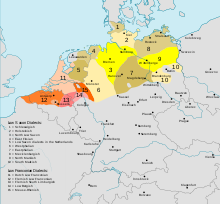
A characteristic feature of East Low German dialects is the absence of the -t ending from the Old Saxon for verbs in the plural. Instead, the verb gets the ending - (e) n , which brings it closer to the High German .
Content
Distribution Territory
- Mecklenburg ( Mecklenburgisch )
- Mecklenburg-Schwerin ( Mecklenburg-Schwerinerisch ) - near the cities of Schwerin , Rostock , Wismar , Guestrow
- Mecklenburg-Strelitz ( Mecklenburg-Strelitzsch ) - near the cities of Neustrelitz , Neubrandenburg
- Western Pomeranian ( Vorpommersch ) - in the area of Stralsund , Greifswald and Anklam
- West Mecklenburg / East Holstein ( Westmecklenburgisch / Ostholsteinisch )
In the west, Mecklenburg passes into Holstein . It has certain similarities with Mecklenburg, which in Holstein (depending on the region) mix with the North-Lower Saxon dialect . In the region of Ratzeburg , which is also ranked as the Mecklenburg dialect zone, there is a transition where there are altered features of Mecklenburg and Holstein, within the limits of individual dialects that mix. So, west of Schwerin, the ending -t for plural verbs is known.
Phonetic features
The diphthongization of open / oː / and / eː /, which is common for the Low German, (their transition to / oʊ / and / eɪ / , respectively) is manifested in Mecklenburg to an even greater extent ( / o может / can also go to / aʊ / ). The same rule applies to umlauts ( / øʏ / goes to / œʏ / or / ɔɪ / ). However, with words in which the diphthong “au” was present in Pragerman, the pure sound “o” will sound in Mecklenburg and vice versa (the Pragerman * augo (eye) turned into oge , but bōks (book) into bauk ).
In Mecklenburg-Western Pomeranian dialects several sounds are used atypical for other Low German dialects. For their transmission, the special letters Æ (Œ) and Ę are used, as well as the letter Å common to the entire Low German range.
Å
Å / å , used primarily in the Pomeranian range, is used to denote the sound / oː / in front of the vocalized r , where the letter a would be written in the common German. For example, the Lower German word Jor (year), corresponding to the literary German Jahr, can be written as Jår [1] .
Ę
Ę / ę stands for long sound E [/ ɛ: /] [2] . It is used in those words in which the original ancient Saxon long sound I turned into E ( ancient Sax. G i van and mekl. G ę ven (geben - to give)).
Æ
Æ / æ or Œ / œ denotes the sound [/ ɶː /], which is the umlaut A, which, however, differs from the literary German Ä, and is the average between the long Ä and Ö [3] . This sound is also often referred to as Ä .
Apostrophe
An apostrophe is used in the Mecklenburg-Western Pomeranian dialects, which disappeared at the end of E and indicates that the consonant at the end of the word is not deafened.
See also
- Pomeranian dialects
Notes
- ↑ Ernst Moritz Arndt : Mährchen und Jugenderinnerungen. 1 Ausgabe. Realschulbuchhandlung Berlin. 1818.
- ↑ Albert Schwarz: Vollständiges Wörterbuch zu Fritz Reuters Werken: mit einem Nachwort: die Sprache Fritz Reuters; Separatabdruck aus Fritz Reuters sämtlichen Werken herausgegeben von Hermann Jahnke und Albert Schwarz. A. Weichert, Berlin 1900, S. 30.
- ↑ Albert Schwarz: Vollständiges Wörterbuch zu Fritz Reuters Werken: mit einem Nachwort: die Sprache Fritz Reuters; Separatabdruck aus Fritz Reuters sämtlichen Werken herausgegeben von Hermann Jahnke und Albert Schwarz. A. Weichert, Berlin 1900, S. 9.
Links
- Plattmakers-Wöörbook (lower.) . Date of treatment January 3, 2012. Archived May 18, 2012.