Sinus tachycardia (ST) is a form of supraventricular tachyarrhythmia, characterized by an accelerated sinus rhythm (i.e., the rhythm of the sinus node ) with a heart rate of more than 100 per minute (in adults). The heart is not fully filled with blood, there is a violation of blood flow. [one]
| Sinus tachycardia | |
|---|---|
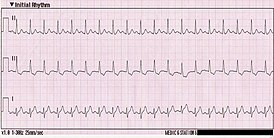 ECG with sinus tachycardia. Heart rate is about 150. | |
| ICD-9 | 427.81 |
| Diseasesdb | 12135 |
| Mesh | D013616 |
Content
- 1 Etiology
- 2 ECG signs
- 3 Treatment
- 4 See also
- 5 notes
Etiology
Distinguish between physiological and pathological sinus tachycardia. The diagnostic and prognostic value of sinus tachycardia is determined by the specific situation in which it occurs.
Physiological CT occurs in response to physical activity, stress. So, sinus tachycardia is a normal response of the cardiovascular system to physical exertion, psycho-emotional stress, the use of caffeine (strong tea, coffee, energy drinks). In these cases, sinus tachycardia is temporary and, as a rule, is not accompanied by unpleasant sensations. Recovery to normal heart rate occurs shortly after the cessation of factors causing tachycardia.
Of clinical importance is sinus tachycardia, which remains at rest. Often it is accompanied by unpleasant sensations of a “heartbeat”, a feeling of lack of air, although some patients may not notice an increase in heart rate. The causes of such tachycardia can be both extracardiac factors, and actually heart disease.
The cause of pathological CT can be:
- Hypoxia ( blood loss , anemia )
- Hypotension
- Hypovolemia
- Fever (systemic infection, inflammation )
- Adrenergic drugs
- Thyrotoxicosis
- Cardiomyopathy with impaired left ventricular function
Extracardiac factors causing sinus tachycardia include:
- hyperthyroidism ;
- fever
- acute vascular insufficiency ;
- respiratory failure ;
- anemia
- some variants of neurocirculatory dystonia , accompanied by activation of the sympathoadrenal system;
- the use of certain medications (sympathomimetics, aminophylline, caffeine, peripheral vasodilators, slow calcium channel blockers , etc.).
Intracardial factors . The occurrence of sinus tachycardia in patients with heart disease in most cases (although not always) indicates the presence of heart failure or left ventricular dysfunction. In these cases, the prognostic value of sinus tachycardia can be quite serious, because it reflects the reaction of the cardiovascular system to a decrease in ejection fraction or clinically significant intracardiac hemodynamics.
The most common causes of an intracardial form of sinus tachycardia are:
- chronic heart failure ;
- myocardial infarction ;
- severe attack of angina pectoris in patients with coronary heart disease ;
- acute myocarditis ;
- cardiomyopathies and others [2]
ECG signs
For sinus tachycardia is characteristic:
- an increase in heart rate of more than 100 per min
- maintaining the correct sinus rhythm;
- positive P wave in leads I, II, aVF, V4-V6;
- with severe CT:
- there is a shortening of the PQ (R) interval (but not less than 0.12 s) and the duration of the QT interval,
- increase in amplitude P in leads I, II, aVF,
- increase or decrease in the amplitude of the T wave,
- Oblique depression of the RS-T segment (but not more than 1.0 mm below the contour) [2]
Treatment
Most often, diagnosis and treatment of the disease that caused sinus tachycardia is required. Stopping the CT itself is indicated only when signs of myocardial ischemia or acute coronary syndrome appear. At the same time, the heart rate is slowed down by β-blockers.
See also
- Heart pacemaker
- Sinus bradycardia
- Tachycardia
Notes
- ↑ Sinus tachycardia (Russian) (neopr.) ? (August 8, 2018). Date of treatment February 5, 2019.
- ↑ 1 2 Roitberg, G.E. (Grigory Efimovich). Internal diseases: cardiovascular system . - Binom, 2007 .-- ISBN 9785951800305 , 5951800307.