The Great Pied Kingfisher [1] [2] , or the Spotted Kingfisher [1] ( lat. Megaceryle lugubris ) is one of the largest kingfishers on the Asian continent.
| Great Pinto |
 |
| Scientific classification |
|---|
| No rank : | Bilateral symmetric |
| Rod: | Great Pinto Kingfisher |
|
| International Scientific Name |
|---|
Megaceryle lugubris Temminck , 1834 |
| Area |
|---|
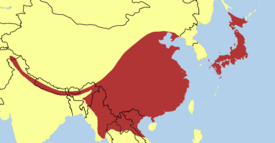
|
| Security status |
|---|
Least concernIUCN 3.1 Least Concern : 22683620 |
|
Content
The great piebald kingfisher reaches a length of 43 cm. A crest is visible on the head. Plumage with gray-white specks. The chest and neck are white. The male has a thin red strip around his neck. The large pied kingfisher prefers to settle along the banks of fast mountain rivers with a rocky bottom and numerous rapids. Like other kingfishers, it feeds mainly on fry and small fish. Couples arrange nests in holes that are dug in steep banks.
A large pied kingfisher lives on the Japanese islands, in Korea, in Central China, to the Himalayas. Mountain streams are a typical habitat. Since the 1960s, a large pied kingfisher began to nest on the island of Kunashir (in the amount of about 20 pairs), which is its only habitat in Russia [3] .
The bird feeds on fish and crustaceans.
- ↑ 1 2 Birds of Russia and adjacent regions: Owl, Goat-like, Swift-like, Rakshaobrazny, Udodoobraznye, Woodpecker / otv. Ed .: S. G. Priklonsky, V.P. Ivanchev, V.A. Zubakin . - M .: Partnership of scientific publications KMK, 2005. - p. 199-204. - 487 p. - ISBN 5-87317-198-X
- ↑ Boehme RL , Flint V. Ye. The five-language dictionary of animal names. Birds. Latin, Russian, English, German, French / Under total. ed. Acad. V.E. Sokolova . - M .: Rus. lang., "RUSSO", 1994. - S. 175. - 2030 copies. - ISBN 5-200-00643-0 .
- ↑ 10 features of the Kuril Islands - Victoria Chernysheva - Russian newspaper
- C. Hilary Fry, Kathie Fry: Kingfishers, Bee-Eaters, & Rollers. Princeton, New Jersey 1992, 1999, ISBN 0-691-04879-7