Mühlenberg Swamp Turtle [1] ( lat. Glyptemys muhlenbergii ) - a species of turtles from the family of American freshwater turtles , which is endemic to the eastern United States . It was first scientifically written in 1801 in the state of Pennsylvania . The tortoise is 10 centimeters long and 4 centimeters wide. Spends most of the time in the mud in the swamps, hibernates in winter . It feeds mainly on small invertebrates .
| Muehlenberg Swamp Turtle | |||||||||||||||||||||||||||||||||||||
 | |||||||||||||||||||||||||||||||||||||
| Scientific classification | |||||||||||||||||||||||||||||||||||||
|---|---|---|---|---|---|---|---|---|---|---|---|---|---|---|---|---|---|---|---|---|---|---|---|---|---|---|---|---|---|---|---|---|---|---|---|---|---|
| |||||||||||||||||||||||||||||||||||||
| International scientific name | |||||||||||||||||||||||||||||||||||||
Glyptemys muhlenbergii Schöpf , 1801 | |||||||||||||||||||||||||||||||||||||
| Synonyms | |||||||||||||||||||||||||||||||||||||
Testudo muhlenbergii Schöpf , 1801 | |||||||||||||||||||||||||||||||||||||
| Area | |||||||||||||||||||||||||||||||||||||
 Muenberg Swamp Turtle Habitat | |||||||||||||||||||||||||||||||||||||
| Security status | |||||||||||||||||||||||||||||||||||||
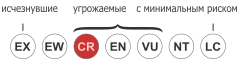
An adult weighs 110 grams. The skin is dark brown with a large orange spot on the neck. They are an endangered species protected by US law. It is in great demand in illegal animal markets, with which the government is fighting hard.
The productivity of turtles is low; the female lays eggs once a year, an average of 3 eggs. They reach puberty by 10 years. They live on average 20-30 years.
Taxonomy
The species was first described by the American botanist Heinrich Ernst Mühlenberg in the 18th century. Mühlenberg discovered and described more than 150 plant species. Studying the flora of Pennsylvania , he discovered a previously unknown species of tortoise. German biologist Johann David Schöpf named the turtle in honor of its discoverer - Testudo muhlenbergii [2] [3] .
In 1829, Richard Harlan renamed the name of the species to Emys muhlenbergii . The name of the species was later renamed in 1857 by Rodolf Agassis to Calemys muhlenbergii , then in 1906 by Henry Watson to Clemmys muhlenbergii . Also synonymous are the name Emys biguttata , given by biologist Thomas Say in 1824, and Clemmys nuchalis , given by Emmett Ray Dan in 1917. In both cases, biologists could not identify the turtle, and decided that it was a new, previously unknown species. [4] [5] .
In 2001, the species was included in the genus Glyptemys , which also included some other turtles that were previously in different genera. DNA analysis showed their close relationship [6] [7] .
Description
The Mühlenberg Swamp Turtle is the smallest tortoise in North America, with a length of only 10 centimeters and a width of 4 centimeters [8] . Adults weigh only 110 grams [9] [3] . Their head is dark brown, and on the neck an orange, yellow or red spot [10] . Paws are black. Their carapace is rectangular, tapering to the head, low, flattened and smooth [11] [12] . Often in the shell there are small circles and oblong lines [13] [3] . Due to the bright red spot on the neck, the Mühlenberg Swamp Turtle is very easy to distinguish from other species [14] .
In turtles of this species, sexual dimorphism is clearly visible. The body length of males is 9.4 centimeters, and females - 8.9 centimeters. [11] [15] The width of the body is greater in females. [16] The tail of males is wider and thicker [17] On the plastron there is a recess that contributes to better fixation of the male on the female during mating.
Habitat and distribution
Mühlenberg Swamp Turtle is endemic to the eastern United States [18] , most often form a colony of 20 individuals [19] . They prefer wetlands and damp places, meadows at the edge of the forest [16] [20] . Turtles use the swamp as a shelter from predators.
In these swamps you can find moss , cattail , alder , willow and some other shrubs and trees. An important condition for turtles to live is open terrain, because turtles spend most of their time basking in the sun. Egg maturation also requires solar heat and humidity [21] .
Due to human activities, turtles are forced to leave their habitat [21] .
Evolution
In total, 2 fossils of the swamp turtle Mühlenberg were discovered. The first time they were discovered by paleontologist Alan Holman in the Cumberland Cave , Maryland . Their approximate age is 300,000-1.8 million years. Then discovered in South Carolina in 1998 [22] .
Species karyotype consists of 50 chromosomes . Mitochondrial DNA of representatives of different colonies has a similar structure, which is rarely found in colonial organisms. Typically, the isolation of colonies leads to a change in the genome of its representatives, which contributes to the emergence of new species [23] .
Biology and Ecology
Lifestyle
Mühlenberg's marsh turtle leads an active lifestyle, in the afternoon it basks in the sun, after which it begins to search for food, sleeps at night [24] . When cold weather sets in, the turtle spends most of its time in the mud [25] [26] . Moreover, while in the mud, it can do without oxygen for a long time [27] . On warmer days, turtles spend most of the day warming themselves in the sun, but prefer to be in the shade when searching for food [28] . They dig into the mud at night [29] .
From late September to early April, turtles are in hibernation [28] . A place for hibernation is chosen in advance, most often these are places with dense soil near trees [12] , or burrows of other animals [30] . Hibernation begins when the average daily temperature drops below 16 ° C [27] .
Muhlenberg's marsh turtle is a territorial animal. Males attack each other if the distance between them is less than 15 centimeters [15] . Typically, such skirmishes last only a few minutes [27] . Females attack each other only if one of them comes very close to the nest of the other. Usually this distance is 1.2 meters [27] .
Notes
- ↑ Darevsky I.S. , Orlov N.L. Rare and endangered animals. Amphibians and reptiles: Ref. allowance / ed. V. E. Sokolova . - M .: Higher school, 1988. - S. 126. - 463 p., [16] p. silt - 100,000 copies. - ISBN 5-06-001429-0 .
- ↑ Schoepff, JD Historia testudinum iconibus illustrata . - Sumtibus Ioannis Iacobi Palm, 1801.
- ↑ 1 2 3 Ernst, 2009 , p. 263
- ↑ US Fish and Wildlife Service. Bog Turtle ( Clemmys muhlenbergii ), Northern Population, Recovery Plan . - Hadley, Massachusetts, 2001 .-- P. 2.
- ↑ Bloomer, 2004 .
- ↑ Holman, JA; Fritz, U. A new emydine species from the Middle Miocene (Barstovian) of Nebraska, USA with a new generic arrangement for the species of Clemmys sensu McDowell (1964) (Reptilia: Testudines: Emydidae) (English) // Zoologische Abhandlungen Staatliches Museum für Tierkunde Dresden: journal. - 2001. - Vol. 51 . - P. 331—354 .
- ↑ Bickham, JWT; Lamb, T .; Minx, P .; Patton, JC Molecular systematics of the genus Clemmys and the intergeneric relationships of emydid turtles (Eng.) // Herpetologica: journal. - 1996. - Vol. 52 , no. 1 . - P. 89—97 .
- ↑ Smith, 2006 .
- ↑ Bog Turtle . Department of Environmental Protection . State of Connecticut (2002). Archived on September 7, 2012.
- ↑ Bloomer, 2004 , pp. 1-2
- ↑ 1 2 Bloomer, 2004 , p. 2
- ↑ 1 2 Bog Turtle (PDF). Massachusetts Division of Fisheries & Wildlife Natural Heritage & Endangered Species Program. Archived December 9, 2012.
- ↑ Bog Turtle Fact Sheet . New York State Department of Environmental Conservation (2009). Archived on September 7, 2012.
- ↑ Shiels, 2007 , p. 23.
- ↑ 1 2 Lovich, JE; Ernst, CH; Zappaloriti, RT; Herman, DW Geographic variation in growth and sexual size dimorphism of bog turtles ( Clemmys muhlenbergii ) (English) // American Midland Naturalist: journal. - 1998. - Vol. 139 , no. 1 . - P. 69-78 . - ISSN 0003-0031 . - DOI : 10.1674 / 0003-0031 (1998) 139 [0069: GVIGAS] 2.0.CO; 2 .
- ↑ 1 2 Bog Turtle, Clemmys muhlenbergii (PDF) (link not available) . New Jersey Endangered and Nongame Species Program. Archived December 15, 2004.
- ↑ Walton, 2006 , p. 32.
- ↑ Bloomer, 2004 , p. 3
- ↑ Walton, 2006 , p. 23.
- ↑ Carter, Shawn L .; Haas, Carola A .; Mitchell, Joseph C. Home range and habitat selection of bog turtles in southwestern Virginia (Eng.) // Journal of Wildlife Management: journal. - 1999. - Vol. 63 , no. 3 . - P. 853-860 . - DOI : 10.2307 / 3802798 . (inaccessible link)
- ↑ 1 2 Shiels, 2007 , p. 24.
- ↑ Ernst, 2009 , p. 264
- ↑ Rosenbaum, 2007 , p. 331.
- ↑ Ernst, 2009 , p. 265
- ↑ Bog Turtle - Fact Sheet , North Carolina Wildlife Resource Commission.
- ↑ Smith, 2006 , p. one.
- ↑ 1 2 3 4 Ernst, 2009 , p. 267
- ↑ 1 2 Ernst, 2009 , p. 266
- ↑ Bloomer, 2004 , p. five
- ↑ Smith, 2006 , p. 2.
Literature
- Bloomer, Tom J. The Bog Turtle, Glyptemys muhlenbergii ... A Natural History . - Gainesville, Florida : LongWing Press, 2004. Archived August 30, 2010.
- Ernst, CH; Lovich, JE Turtles of the United States and Canada . - 2nd. - JHU Press, 2009. - P. 263–271. - ISBN 978-0-8018-9121-2 .
- Palmer, William; Braswell, Alvin L. Reptiles of North Carolina. - Chapel Hill, North Carolina: The University of North Carolina Press, 1995. - P. 49-52. - ISBN 0-8078-2158-6 .
- Pittman, Shannon E .; Dorcas, Michael E. Movements, Habitat Use, and Thermal Ecology of an Isolated Population of Bog Turtles ( Glyptemys muhlenbergii ) (Eng.) // Copeia: journal. - Lawrence, KS: American Society of Ichthyologists and Herpetologists, 2009. - Vol. 2009 , no. 4 . - P. 781-790 . - ISSN 0045-8511 . - DOI : 10.1643 / CE-08-140 . Archived August 30, 2010.
- Rosenbaum, Peter A .; Robertson, Jeanne M .; Zamudio, Kelly R. Unexpectedly low genetic divergences among populations of the threatened bog turtle ( Glyptemys muhlenbergii ) (Eng.) // Conservation Genetics: journal. - Springer Netherlands, 2007. - Vol. 8 , no. 2 . - P. 331—342 . - ISSN 1566-0621 . - DOI : 10.1007 / s10592-006-9172-3 .
- Shiels, Andrew L. Bog Turtles Slipping Away . Nongame and Endangered Species Unit . Commonwealth of Pennsylvania, Fish and Boat Commission (2007). Date of treatment September 18, 2009. Archived August 30, 2010.
- Smith, Erika Bog Turtle . National Resources Conservation Service (2006). Date of treatment January 9, 2010. (unavailable link)
- Walton, Elizabeth M. (2006). “II. Literature Review ”. Using Remote Sensing and Geographical Information Science to Predict and Delineate Critical Habitat for the Bog Turtle, Glyptemys muhlenbergii (PDF) (MA thesis). University of North Carolina at Greensboro . Date of treatment 2010-04-09 .