Binom of Newton - a formula for decomposing into separate terms a non-negative integer power of the sum of two variables, having the form

Where - binomial coefficients , Is a non-negative integer .
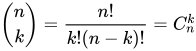
In this form, this formula was still known to Indian and Islamic mathematicians; Newton derived the Newton binomial formula for the more general case when the exponent is an arbitrary real (or even complex ) number. In this case, the bin is an infinite series (see below).
Proof
Let us prove the Newton binomial formula by induction on n :
Induction Base:

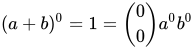
Induction step: Let the statement for 
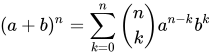
Then we need to prove the statement for 
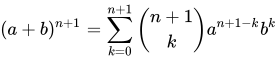
Let's start the proof:

We extract from the first sum the term for

We extract from the second sum the term for
Now add the converted amounts:
Q.E.D. ■
Generalizations
The Newton binomial formula is a special case of the expansion of a function in Taylor's row :
- ,
where r can be a complex number (in particular, negative or real). The coefficients of this expansion are found by the formula:
Moreover, a number
- .
converges at .
In particular, when and it turns out the identity
Passing to the limit at and using the second wonderful limit , we deduce the identity
which in this way was first obtained by Euler .
Multinomial Theorem
Newton’s binomial can be generalized to the Newton polynomial — raising to a power the sum of an arbitrary number of terms:
Where - multinomial coefficients . The sum is taken over all non-negative integer indices. whose sum is equal to n (that is, over all compositions of the number n of length m ). When using the Newton polynomial, it is considered that the expressions , even .
The multinomial theorem is easily proved either by induction on n , or from combinatorial considerations and the combinatorial meaning of the multinomial coefficient.
At expressing , we get the Newton bin.
Complete Bell
Let be and then the complete Bell polynomials have binomial decomposition:
History
For a long time it was believed that Blaise Pascal , who described it in the 17th century , invented this formula, as well as the triangle , which allows finding the coefficients. However, historians of science found that the formula was known even to the Chinese mathematician Yang Hui , Who lived in the XIII century , as well as Islamic mathematicians at-Tusi (XIII century) and al-Kashi (XV century). In the mid- sixteenth century, Michael Stifel described binomial coefficients and also compiled a table of them to degree 18.
Isaac Newton around 1677 generalized the formula for an arbitrary exponent (fractional, negative, etc.). From the binomial decomposition, Newton, and later Euler , derived the whole theory of infinite series.
In Fiction
In fiction, “Newton’s binomial” appears in several memorable contexts where it is about something complicated. [one]
- In A. Conan Doyle ’s short story “Holmes’s Last Affair, ” Holmes talks about mathematics by Professor Moriarty :
When he was twenty-one, he wrote a treatise on Newton’s binomial, which won him European fame. After that, he got a chair of mathematics at one of our provincial universities, and, in all likelihood, he had a brilliant career.
Original textThe Final Problem At the age of twenty-one he wrote a treatise upon the binomial theorem, which has had a European vogue. On the strength of it he won the mathematical chair at one of our smaller universities, and had, to all appearances, a most brilliant career before him.
- In the novel "The Master and Margarita " by M. A. Bulgakov :
- “Think, Newton’s binomial! "He will die nine months later, in February next year, from liver cancer in the clinic of the First Moscow State University, in the fourth ward."
- Later, the same expression, "Think of Newton’s binom!" mentioned in the film " Stalker " by A. A. Tarkovsky .
- Roman E.N. Wilmont received the name "Transience, or Just Think, Newton’s Bin!"
See also
- Abbreviated polynomial multiplication formulas are the most frequent special cases of Newton's binomial
- Binomial distribution
- Binomial coefficient
- Pascal's Triangle
Notes
- ↑ Uspensky V. A. Preface for readers of the “New Literary Review” to the semiotic messages of Andrei Nikolaevich Kolmogorov // New Literary Review . - 1997. - No. 24 .
Literature
- Newton’s binomial // Brockhaus and Efron Encyclopedic Dictionary : 86 t. (82 t. And 4 ext.). - SPb. , 1890-1907.
Links
- Newton’s binomial // Great Soviet Encyclopedia : [in 30 vol.] / Ch. ed. A.M. Prokhorov . - 3rd ed. - M .: Soviet Encyclopedia, 1969-1978.