The Hohenzollern Bridge ( German: Hohenzollernbrücke ) is a steel arch railway bridge across the Rhine River, located at a distance of 688.5 km from the source in the largest city of North Rhine-Westphalia - Cologne ( Germany ). Together with the Cologne and Cologne – Messe / Deutz train stations located at different ends of the bridge, it is one of the most important railway junctions in Europe . More than 1200 trains pass over the bridge per day [1] .
The Hohenzollern Bridge is located in close proximity to the famous Cologne Cathedral and, along with it, is the hallmark of the city.
| Hohenzollern Bridge | |
|---|---|
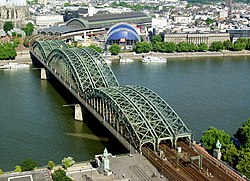 Hohenzollernbrücke | |
| Application area | railway, bicycle |
| Crosses | The rhine |
| Location | Cologne , North Rhine-Westphalia |
| Design | |
| Type of construction | arch bridge |
| Material | and |
| Main span | 167.75 m |
| total length | 409.19 m |
| Bridge width | 29.5 m |
| Exploitation | |
| Constructor, architect | |
| Opening | May 1911 |


Content
History
Simultaneously with the opening of the Cologne station in 1859, the Cathedral Bridge was opened. In 1907, the Cathedral Bridge , which could not cope with the increased traffic, was demolished and in June of the same year the construction of a new bridge began. And although at that time the feasibility of building a bridge, as well as the existence of the station itself, were disputed next to Cologne Cathedral, nevertheless, a decision was made to build a bridge in the same place. In 1911, a bridge with four railway tracks was opened.
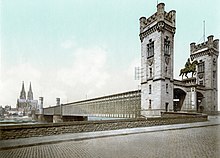
The entrance to the bridge was decorated with neo-Romanesque towers, designed by the Berlin architect Franz Schwechten . The Neo-Romanesque style of the towers contrasted with the Gothic architecture of Cologne Cathedral. Equestrian statues of the Prussian kings and German emperors from the Hohenzollern dynasty were installed on both sides of the bridge: Friedrich Wilhelm IV (sculptor - Gustav Hermann Blezer , Wilhelm I (sculptor Friedrich Drack ), Frederick III and Wilhelm II (both works by sculptor Louis Tuyon ).
During the Second World War, the Hohenzollern Bridge was the busiest railway bridge in Germany. During the 262 bombing of Cologne by British aircraft , the main of which took place on May 30-31, 1942 , the bridge was badly damaged, and on March 6, 1945 the bridge was completely destroyed as a result of the destruction of its supports by American sappers.
Immediately after the war, the restoration of the bridge began. Traffic on the bridge was resumed on May 8, 1948 on two railway tracks. The towers at the entrance to the bridge were not restored and in 1958 were completely demolished. The full restoration of the four-track bridge was completed in 1959 . Steel structures of the bridge were manufactured by Krupp Maschinen- und Stahlbau [2] , reinforced concrete by Philipp Holzmann AG [3] .
On March 8, 1985, work began on expanding the Hohenzollern bridge. During the modernization, 2 railway tracks were added and pedestrian-bicycle paths with a width of 3.5 m were equipped [4] . Construction work was completed in 1989 . With the expansion of the bridge, the architectural appearance of the bridge was completely preserved, although the construction technologies were noticeably different. The differences in technology are clearly visible when looking at the bridge from below.
Technical Data [5]
- Canvas Bridge - Steel
- Supports - Reinforced Concrete
- Total length - 409.19 m
- Flight span - 118.88 - 167.75 - 122.56 m
- Number of railroad tracks - 2 (in 1948), 4 (in 1959), 6 (in 1989)
- Width of the railway part of the bridge - 26.2 m
- The total width of the bridge - 29.5 m
- Construction cost - 14 million marks
See also
List of Rhine bridges
Notes
- ↑ Official site of Deutsche Bahn AG (German)
- ↑ International Database and Gallery of Structures
- ↑ International Database and Gallery of Structures
- ↑ Meldung Erweiterung der Hohenzollernbrücke in Köln für S-Bahn . Eisenbahntechnische Rundschau , No. 34, 1985, p. 356. (German)
- ↑ Page of the Hohenzollern Bridge at the International Database and Gallery of Structures (English)