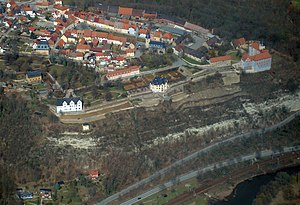
Dornburg Palaces ( German: Dornburger Schlösser ) is an architectural ensemble located in the city of Dornburg north of Jena in Thuringia . It consists of three palaces: the Old Castle, the Renaissance castle and the Rococo .
| palace | |
| Dornburg palaces | |
|---|---|
| Dornburger schlösser | |
 View of the Dornburg palaces from the east, 2008 | |
| A country |  Germany Germany |
| City | Dornburg-Camburg |
| Type of building | palaces |
| Architectural style | renaissance, rococo |
| Website | thueringerschloesser.de |
Background
According to archaeological finds, Dornburg fields have been inhabited since the early Stone Age . The most famous finds include a grave hill and a bronze sickle. In addition, numerous finds related to the Iron Age , the times of the Great Migration of Peoples up to the Slavic settlement (after 550 CE), allow us to assert the constant use of this land.
Following a series of indirect evidence, it can be assumed that Dornburg was founded by the Franks . Although the name itself is not found in written sources of the 9th century, it was part of the territory of the Empire of Charlemagne . As previously thought, the lack of archaeological evidence is explained by the fact that the remains of fortifications should be in the foundation of the Old Palace, but in recent years this assumption has been refuted.
With the advent of the Ottons to power, Dornburg gains the status of civitas (fortified settlement or palatinate ), the first written mention of it falls on the year 937. At that time there was a royal castle; in the same year 937, the second royal castle was mentioned, 10 km south of it: on Mount Hausberg near Jena , which did not yet exist. These two castles are unique. Firstly, it was a stone fortress, which at that time in Germany was a rarity. Secondly, they were royal . In addition, these were the very first German fortresses in the area and one of the first, lying on the River Hall or east of it. At that time, this river was still borderline: to the east of it lived the Slavs ( Sorbians ), whose conquest began in 919, when Henry I (919–936) ascended the throne.
Old Castle
The rightmost castle, viewed from below. During the internecine war of 1342–1345, the castle was besieged for five weeks, and it was not possible to take it. In the Saxon fraternal war (1446-1451), the fortress was captured with the use of recently invented cannons (in the same war the Lobdeburg fortress was destroyed). From the ruins of the former royal fortress in 1485-1522 the Gothic Old Castle was built in its modern form. Here from 1612 to 1643 the Altenburg Duchess Anna Maria lived. In 1631, during the Thirty Years War (1618–1648), the castle was attacked by Croatian soldiers. Since then, the castle has been little used, and since 1731 a spinning workshop was located in one of its wings.
From 1898 to 1950, there was a pension in the castle, in which numerous writers from Jena lived [1] . In 1954-1980, a nursing home was located here. Since 2004, the building belongs to the University of Jena , which periodically holds various meetings in it.
Renaissance castle
The leftmost castle, when viewed from below. In 1539, the noble family of von Watzdorf began on the mountain the construction of a Renaissance palace, which was probably completed before 1546. Due to debts, they already sold it to the Duke, the owner of the Old Castle, in 1571. He circa 1600 passed it to the family of the local governor of the city, in whose possession he remained 4 generations. In the future, the castle changed owners many more times, until in 1824, during Goethe, he transferred to the Duke Karl Augustus (see the history of the Rococo Palace). Now the castle is used as a Goethe museum. On the portal of the building are the 16th century Latin dystikhon: “Gaudeat ingredientsiens, leatatur et aede recedens, / His qui praetereunt det bona cuncta Deus”, which made a great impression on Goethe. He translated it into German in verse. In Russian, he means: “Let the one who rejoices rejoices, and rejoices and leaves the house. To those who pass by, God grant all blessings. "
Similar renaissance castles in Thuringia are also in Saalfeld near the castle ruin, in Beichlingen , on the market square in Weimar (Cranach's house), very picturesque in Wolfersdorf (Jagdschloss Fröhliche Wiederkunft in Wolfersdorf bei Stadtroda), in Greits , Greise in burgke and others
Rococo Palace
Located in the middle. In 1736-1747, Duke Ernst Augustus I , who owned the Old Castle, built a small palace in the Rococo style . For its construction, 22 residential buildings had to be demolished (the city then totaled no more than 370 people), which were then built on the site of the modern city. The construction of a palace on a mountain in an era when palaces and parks were usually erected in vast meadows was a rare exception. Its architect was the famous Gottfried Krone (Gottfried Heinrich Krohne), a native of Dresden , who had recently completed construction for the same Duke of the Belvedere Summer Palace near Weimar (1724-1744). His other famous works are the city castle in Eisenach , the city church in Ilmenau , the castle in Gotha and several other castles, churches and bridges.
A few months after the construction was completed, the duke died. His heirs had no interest in the palace, and he fell into a dream. Goethe, who was the minister of this duchy, “discovered it” again, having been here for the first time in 1779. In the next 56 years, he was here more than 20 times, in 1789 he even sailed here by boat from Jena [2] . Especially known for his 66-day stay in this palace in 1828, where he retired after the death of his friend Duke Carl Augustus (grandson of the castle builder).
Renaissance castles in Thuringia
Ranis Castle
Hunters castle in Wolfersdorf
Castle in Beichlingen
Schloisingen Castle
Castle in Burgka
Eichsfeld Castle
See also
- Dorndorf-Stoidnitz
- Bad Kösen
- Pforta School of Land
- Zalek
- Rudelsburg
- Lobdeburg
- Fuksturm
- Lobeda
Notes
- ↑ Ignasiak (2008), S. 66–72.
- ↑ Ignasiak (2008), S. 39.
Literature
- Ignasiak, Detlef: Dornburg an der Saale. Die Schlösser, die Stadt und die Umgebung, 2008.
- Ignasiak, Detlef: An der Saale und im Holzland. Ein kulturhistorischer Führer, 1997, S. 209-267.
- Peschel K. ua: Ein Grabhügel mit Schnurkeramik von Dornburg, in: Sonderdruck aus Praehistorische Zeitschrift, hg. v. W. Unverzagt, Band 41, Berlin 1963, S. 83-171.