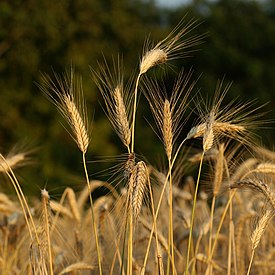
Annual herbaceous plants 100-150 cm tall. The stems are few, bare, smooth, made or hollow. Leaves broadly linear, flat, up to 2 cm wide, glabrous or pubescent [2] .
Inflorescence is a complex spike . Ears are linear, square or more or less compressed, linear, more or less dense, the axis of ears in ripe fruits and in a dry state remains flexible and does not break into individual ears [3] .
Spikelets with 3-5 flowers, of which 2-3 are fertile; the spikelet along the ribs is densely hairy or almost naked, the axis of ears at the base of spikelet scales with corpus callosum [3] .
Spikelet scales 25–32 mm long, broadly lanceolate, leathery-membranous, hairy or hairless, with 9–13 clear veins and a winged keel turning into a slightly bent pointed point; usually spikelet scales are slightly longer than the lower flowering scales [2] .
Lower floral scales 15–20 mm long, lanceolate, with spine 5–15 cm long, or boneless. The upper floral scales of the lower flower are almost half shorter than the outer ones, leathery-membranous, with fruits not split, finely winged or wide-winged on keels (the widest part of the wing 0.3-0.6 mm wide) [3] .
The grains are long, in shape resembling a rye grain, but larger, translucent, freely located in the scales, easily threshed [2] .
Tetraploid , 2n = 28 [3] .
Flowering in June - July.