Alessandro Natta ( Italian: Alessandro Natta ; July 7, 1918, Onella , Provinces of the Empire , Liguria - May 23, 2001, Empire , Liguria [1] ) - Italian politician, general secretary of the Italian Communist Party in 1984-1988.
| Alessandro Natta | |
|---|---|
| ital. Alessandro natta | |
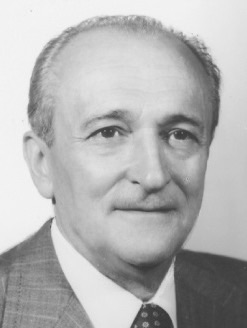 | |
| Date of Birth | July 7, 1918 |
| Place of Birth | Onella in the province of Empire , Liguria |
| Date of death | May 23, 2001 (82 years old) |
| Place of death | Empire |
| Citizenship |  Italy Italy |
| Occupation | party general secretary |
| Education | Higher Normal School (Pisa) |
| The consignment | Italian Communist Party |
| Awards |  |
Content
Biography
He entered the Higher Normal School (Pisa) , where he studied with Carlo Champi , the future president of Italy. Here he attended the courses of L. Russo , G. Calogero , D. Cantimori and Vittorio Aranjo Ruiz.
In the late 1930s, as a student, he began anti-fascist activity, being influenced by the ideas of “liberal socialism” G. Calogero and A. Capitini . In 1940 he organized a student anti-fascist group. He was a member of the University of Fascist Groups (GUF) of Pisa and published several articles in the journal of this movement until 1943.
In July 1941 he was drafted into the army. After completing a sergeant school in Milan , at the end of winter 1941 he was sent to Bra , in August 1942 - to Aquila ; in November, the rank of artillery lieutenant was transferred to Greece . In the chaos after the armistice between Italy and the Allies, he participated in the defense of the Gaddurà ( Rhodes ) airport from German attacks. He was wounded, captured, refused to cooperate with the Germans and the Social Republic, and was interned in a prison camp on the island. In March 1944 he was deported to Germany (to Mühlberg an der Elbe , then transferred to Kustrin , Zandbostel and, finally, to Witzendorf ), where he remained until his release; organized the resistance movement among the interned Italian officers.
He returned to Italy only in August 1945, began to work as a teacher, and joined the Italian Communist Party in the Empire . He was a member of the council of the commune , where he headed the press and propaganda section. In 1946 he left teaching, devoting himself to party work; elected deputy secretary of the party organization of the province of Empire . In the same year he was elected communal adviser to the province of Empire. C 1948 - Member of Parliament ; from May 25, 1972 to July 4, 1979 - the leader of the party faction in parliament.
After studying at a party school in Frattochchi in 1949 he became secretary of the federation of the Communist Party of the province of the Empire (held this post until 1954). Decision IV of the national party conference (January 1955) was appointed director of the Institute. Grammy at the Central Committee of the IKP. After the VIII Congress of the Party (December 8-14, 1956) he was appointed head of the section of party schools, and after the IX Congress (January 30 - February 4, 1960) he was appointed head of the press and propaganda section. From March to December 1962 he headed the department of culture. December 21, 1962 was appointed deputy director of " Marxist criticism ." After the 10th Party Congress (December 2–8, 1962), he joined the party secretariat, headed by E. Burlinguer , first as deputy secretary, and from December 1963, as secretary.
Together with L. Longo in 1964 in Yalta he met with N. S. Khrushchev , A. N. Kosygin , N. V. Podgorny [2] .
He was a rapporteur on the election commission of the XI Party Congress (January 25-31, 1966); from January 1966 he was appointed head of the organizational department; after the XII Congress (January 8-15, 1969) - head of the press and propaganda department of the Party Central Committee. After the XV Congress (March 30 - April 3, 1979) he was elected Secretary-Coordinator.
June 26, 1984, after the death of E. Burlinguer , was elected Secretary General of the Italian Communist Party , re-elected by the XVII Congress (April 9-13, 1986). He continued the European communist course of his predecessor, but tried to normalize relations with the CPSU by visiting the USSR.
On April 30, 1988, he suffered a myocardial infarction , after which he left the post of Secretary General on June 10, 1988. At the XVIII Congress (March 18-22, 1989) he was elected president of the party. He opposed the plans of Akille Okketto , his successor as secretary general, to rename the Communist Party and transform it into a social democratic force. At the XIX Congress (March 7–10, 1990) he supported the second proposal, which opposed the dissolution of the IKP. However, after the liquidation of the IKP, together with most of its leadership members, I joined the Party of Democratic Left Forces (the center-left successor party), deciding not to join the new political entity that retained the communist attitudes - the Party of the Communist Revival - as it was skeptical about its prospects.
In 1984-1989 he was also a member of the European Parliament .
In private life he devoted himself to historical research, printing monographs and articles.
Selected Works
- Natta A. L'altra Resistenza: i militari italiani internati in Germania. - Torino: Einaudi, 1997 .-- 141 p. - ISBN 88-06-14314-X . [3]
- Spriano P., Ragionieri E., Natta A., Pajetta GC, Amendola G., Ingrao P. Problemi di storia del PCI. - Roma: Editori Riuniti; Istituto Gramsci, 1971. [4]
- Una svolta da Chernobyl / Ed .: O. Cecchi; Introduzione: Alessandro Natta. - Editrice l'Unità, 1986. - ISBN 007771824. [5]
Books by A. Natta in Russian were not published [6] .
Rewards
- Order of the October Revolution (6.01.1988) [7]
Notes
- ↑ A brief biography on the Persons website indicates the place of death of Rome (Retrieved December 20, 2011)
- ↑ Mokshin S. Yalta note by P. Tolyatti: a look from the past (Russian) // Observer. - 1994. - No. 9 . (Retrieved December 20, 2011)
- ↑ Catalog der Deutschen Nationalbibliothek (Retrieved December 20, 2011)
- ↑ Monographs of the Gramsci Institute 1955-1980 (inaccessible link) (Retrieved December 20, 2011)
- ↑ British Library Catalog (Retrieved December 20, 2011)
- ↑ There are no works by A. Natta in the electronic catalog of the RSL and electronic catalogs of the RSL . (Retrieved December 20, 2011)
- ↑ Andrey Gromyko and Alessandro Natta - photo Archived on December 13, 2012. (Retrieved December 20, 2011)
Links
- Alessandro Natta in the Gramsci Institute Foundation Identity Archive (inaccessible link) (Italian) (Retrieved December 20, 2011)
- article of L. Karavanov in the table calendar for 1988