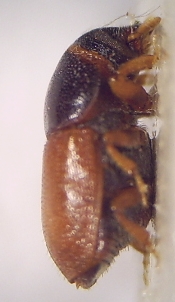
Oak sapwood ( Latin Scolytus intricatus ) is a species of weevil beetles from the subfamily of bark beetles . Distributed throughout Europe , in the European part of Russia , in the Caucasus [2] .
| Sapwood oak |
 |
| Scientific classification |
|---|
| No rank : | Bilateral symmetrical |
| Subtype : | Tracheo-breathing |
| Infraclass : | Winged insects |
| Treasure : | Fully Transformed Insects |
| Superfamily : | Curculionoid |
|
| International scientific name |
|---|
Scolytus intricatus ( Ratzeburg , 1837 ) |
| Synonyms |
|---|
- Scolytus carpini Redtenbacher, 1858 [1]
- Scolytus lenkoranus Eggers, 1942 [1]
- Scolytus penicillatus Reitter, 1913 [1]
- Scolytus pygmaeus Gyllenhal, 1813 [1]
- Scolytus simmeli Eggers, 1923 [1]
|
|
The body length of adult insects is 2.5–4 mm [2] . The body is wide, short-oval, dark brown, sometimes almost black, with red-brown elytra , legs, anterior margin, and sometimes the middle of the pronotum . Antennae and paws yellow [2] .
They live in areas where oaks grow - in areas with pine forest, on floodplain oak forests , and can also be found in forests where oaks do not grow. Mostly they develop on various types of oaks, but also other trees - common hornbeam , sagittal birch , willow , European beech, oriental beech , Castanea vesca , common chestnut , Ulmus campestris , Ulmus effusa , white poplar , aspen , common hop-horn , dzelkva small town [2] . Mostly young trees are populated, with a trunk diameter of 17-19 cm, less often old, weakened, even less mature, healthy trees [2] .
