Gavurkala ( azerb. Gavurqala ; arm. Գյավուրկալա ) is a settlement and a necropolis dating back to the 3rd – 10th centuries. [1] located in the territory of the modern village of [2] . The word gavurkala is translated as “the city of the infidels ( giaurs )”
| Hillfort | |
| Gyavurkala | |
|---|---|
| azerb. Gavurqala | |
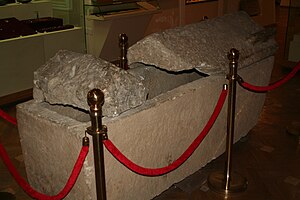 Stone sarcophagus from Gyavurkal. Museum of the History of Azerbaijan ( Baku ) | |
| A country | Azerbaijan / NKR |
| Village | Boyahmedli , Agdam district |
| Established | III century [1] |
| Key dates | |
| late 1950s - archaeological site | |
| Building | |
| The remains of a one-nave Christian temple | |
Area about 40 hectares. According to the Azerbaijan Soviet Encyclopedia, Gyavurkala is the ruins of the city of Aluen, the summer residence of the rulers of Caucasian Albania [1] . According to Sedrak Barkhudaryan , according to the reports of the 7th century historian Sebeos and the description of modern travelers, these ruins are the remains of the ancient city of Tigranakert [3] . Rahim Vaidov , based on exploration and analysis of written source information, rejects the opinion about the localization of the city of Tigranakert on the site of Gyavurkal and localizes it near Agdam [4] .
Content
Archaeological finds
According to the Azerbaijan Soviet encyclopedia, the settlement was surrounded by a wall of adobe bricks (V — VII centuries). With ceramic pipes, spring water came into the city. During archaeological excavations, beads, sewing items, houses made of stone and with remains of a hearth, a pagan and Christian temple, cemetery, etc. were found. Among the finds there is a glass bottle made in Syria , a coin of the Byzantine emperor Anastasius I (491-518), etc. . [1]
In the late 1950s. archaeologist R. M. Vaidov during excavations of the settlement revealed a one-nave monumental Christian church, as well as burials in stone boxes and sarcophagi of the VIII-X centuries. [5] One of the covers of the limestone sarcophagus was a gable tombstone, split into two parts with an Armenian inscription (epitaph) in four lines [3] [6] . Epigraphist S. Barkhudaryan studied the inscription and determined that the sarcophagus belonged to the younger brother of Prince Hamam [3] [7] , who, according to M. Kagankatvatsi , “resumed the abolished kingdom of Aluank ” [8] . Today this sarcophagus with a tombstone is kept in the Museum of the History of Azerbaijan [3] .
The temple itself had a large hall with an area of 62 m² for worship and an office building, which adjoined the hall from the north-eastern side. In the eastern side of the hall there was an altar elevation and a semicircular absida . The floors of the room and the altar are paved with rectangular rectangular, well-treated slabs up to 1 m² in size. Some plates contain magic images in the form of geometric figures [7] .
See also
- Shahbulag
- Tigranakert (Artsakh)
Notes
- ↑ 1 2 3 4 Kovurgala // Azerbaijan Soviet Encyclopedia . / ASE Main Edition. - B. , 1982. - T. IV . - S. 100 . (azerb.)
Gyavurkala - ancient settlement and cemetery of the 3rd-10th centuries. in s. Boyahmedli of the Agdam region of Azerbaijan. SSR. Area about 40 hectares. It is believed that Gyavurkala is the ruins of the city of Aluen, the summer residence of the rulers of Albania. A part of the city, surrounded by a wall of adobe bricks (5th – 7th centuries), is on a hill. With ceramic pipes, spring water came into the city. During archaeological excavations, beads, sewing items, houses made of stone and with the remains of a fireplace, a pagan and Christian church, cemetery, etc. were found. Among the finds there is a glass bottle made in Syria, a coin of the Byzantine emperor Anastasius I (491-518), etc. .
Original text (azerb.)Kovurgala - Azәrb. SSR Aғdam r-Nunun Boјәһmәdli K. әrazisindә 3-10 әsrlәrид aid shәһәr јeri vә gәbiristan. Saһ. 40 һa-a јakhyndyr. Ҝ.-now Albanyјa (Gafgaz) һөkmdarlarynyn јaј igamәtҝaһy, Aluen sh.-nin kharabalyғy oldduғu һtimal olunur. Shәһәrin әtrafina Chiј kәrpiҹdәn һasar chәkilmish (5-7 әsrlәrә) naryngala һissәsy tәpә үzәrindәdir. Shәһәrә sahsah tүnҝlәrlә bulag suјu chәkilmishdir. Archaeologists of Gazyntyar attracted munug, tohuҹulug altәlәri, dashdan tikilmish vә orthasinda ҹag-kүrә dүzүdilmis evlәr, bүtpәәәst vә christianlara mәhsus mә'bәd, gәbiristan wә. ashkar edilmishdir. Tapyntylar ichәrisindә Suriјada һazyrlanmysh shүshәdәn әtirgaby, Bizans emperor I Anastasinin [492-518] pool v. wardir. - ↑ According to the administrative-territorial division of the unrecognized Nagorno-Karabakh Republic , which controls the settlement, it is located in the Askeran region of NKR , according to the administrative-territorial division of Azerbaijan - in the Agdam region of Azerbaijan
- ↑ 1 2 3 4 Barkhudaryan, 1964 , p. 64.
- ↑ Waidov, 1965 , p. 180-181.
- ↑ Vaidov R.M. , Narimanov I.G. Development of archaeological science in Soviet Azerbaijan // Soviet Archeology . - 1967. - No. 4 . - S. 59 .
- ↑ Waidov, 1965 , p. 181: “Even before the excavations began a few meters from the altar of the temple, the collective farmers discovered a gable cover from a stone limestone sarcophagus. An Armenian inscription in four lines is carved on one plane. ”
- ↑ 1 2 Vaids, 1965 , p. 181.
- ↑ Shaginyan A. Transcaucasia as part of the Arab Caliphate. - SPb. : Publishing House of St. Petersburg University, 1998. - S. 76.
Literature
- Vaidov R. M. Archaeological site in Gyaur-Kala // Material Culture of Azerbaijan. - 1965. - T. IV . (azerb.)
- Barkhudaryan C. G. Epitaph on Prince Hamam // News of Social Sciences. - Publishing House of the Academy of Sciences of the Armenian SSR, 1964. - S. 61-64 . (armenian)
- Azerbaijan Soviet Encyclopedia. Kovurgala / ASE Main Edition. - 1982. - T. 6. - S. 100. - 608 p. (azerb.)
- Gyavurkala on the website about Artsakh Tigranakert