
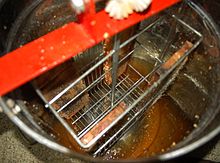

Honey honey is a part of apiary stock used to obtain honey by centrifugation . Honeycombs sealed by bees are first printed with a special beekeeping knife or fork, which are currently more common, then inserted into the honey extractor cartridges and rotated. Under the action of centrifugal force, honey flows out of the cells of honeycombs and, under the action of gravity, flows down the walls of the honey separator into the tank. There is a hole in the bottom of the tank to drain the honey obtained into the container (milk jars are usually used).
Honey separators are classified by the location of the cartridges into which the printed honeycombs are inserted:
- radial (cassettes are located along the radius of the honey separator circle), use the feature of the non-horizontal arrangement of cells in the cell;
- hordial (cassettes - usually 2–4 - are located along the chords of the honey separator circle), the type most common in private apiaries.
The cordial honey separators, in turn, can be divided into flip-flops or flip-flops (with movable “turning over” cassettes) and non-flip or non-flip (frames have to be removed from the cassettes each time and inserted by the other side).
There are honey racers with self-reversing cartridges (reversible), in which the cartridges are installed radially after stopping rotation, and when rotating in the opposite direction, they turn the other side.
In a chordal honey separator, the first side has to be pumped out at a lower speed so as not to break the honeycomb with the weight of the full reverse side.
Honeymoons are divided into manual and motor (electric) drives. During wandering, batteries are mainly used as energy sources for electric honey separators , and the use of small power plants and solar panels can also be found.
Honey is commonly used to lubricate the moving parts of a manual honey extractor drive.
Literature
- Minkov S.G., Plotnikov I.S. Directory of the beekeeper. - 3rd ed., Revised. and add. - Alma-Ata: Kaynar, 1983.- 336 p. - 50,000 copies.