
The Battle of Chiari ( German: Schlacht bei Chiari ) - a battle that took place on September 1, 1701 near the town of Chiari in Northern Italy during the war for the Spanish inheritance between the French and Austrian armies. The French army, under the command of Marshal Villrois, attacked the Austrian army, under the command of Prince Eugene of Savoy , located in fortified positions. Having suffered heavy losses in the attack from rifle and artillery fire of the enemy, the French army was forced to flee the battlefield.
Background
After crossing the Ech River (Adige) and the battle of Carpi , the French army gradually retreated beyond the Mincio River. Prince Eugene of Savoy moved from his camp at San Pietro di Lignago , via Onisano and Buttapietra , up Echu to the city of Villafranca to connect with General Guttenstein's corps, which remained to observe the enemy located on Montebaldo . After the arrival of this corps to Villafranca, preparations were made immediately for crossing the Mincio. The prince managed by his orders to confuse the enemy regarding the crossing point he had chosen, so that on July 28 in the middle of the day a bridge was built at Salionets without any resistance from the French, and in the evening the whole army stood in battle on the right bank of the river. From Mincio, Eugene slowly moved along Lake Garda and along the ledges of the Brescia Mountains to the upper Ollo , thus continuously threatening the left wing of the enemy army, while he himself remained in controlled communication with Tyrol via Brescia and Rocco d'Anfo.
Marshal Katina , constantly worried by the partisans who were separating from the left wing of the Austrians and causing considerable harm to the French, crossed over to Ollo, for he feared that by spending a long time on this bank of the river he might be driven back by his enterprising adversary to the lower reaches of the Po river and thus be cut off his communication with France. Remaining in a defensive position beyond the Ollo River, he wanted to wait for reinforcements and then, due to circumstances, start offensive operations or by all means prevent the passage of Prince Eugene across the river. This plan of an experienced commander, however, was not fulfilled. The court of Versailles, dissatisfied with the unsuccessful start of the campaign, instead of the prudent Katin, appointed the fiery and arrogant Vilrois commander of the French troops in Italy, giving him the order to attack immediately Eugene of Savoy.
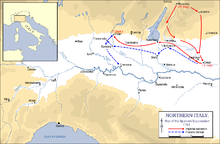
The prince, learning that Villeroix had arrived at the enemy camp between Antonyate and Fontanella on August 24 and began to take actions that clearly indicated an unplanned offensive, concentrated his army under Chiara and ordered the sent troops to closely monitor the enemy’s actions. Having received reliable news on August 31 that the enemy had crossed Ollo near Rudiano and was heading for Castrenatto , the prince arranged his troops in an order that deserves attention for its skillful application to the area and its excellent tactical location.
Two streams flow between Chiari and Ollo: Bayonne and Trenzano, flowing into Ollo. All the surroundings are indented with canals and moats in various directions. Behind one of these moats, which runs along the road from Chiari to Urago, Prince Eugene ordered a rampart that rests on the left flank in Chiari and the right in the Trenzano stream. Along the rampart, he located the first line of the imperial army, consisting of 15 battalions. The guns were partly placed on this line, partly so that they could very heavily shell it. 13 battalions were in the second line. Behind her was a cavalry: three regiments in the first line, 2 in the second, one on the flank parallel to the Trenzano creek and therefore at right angles to the general arrangement. Further, aside, at a rather considerable distance, the remaining 4 cavalry regiments stood along Trenzano. The space between them and the main cavalry corps was occupied by separate squadrons. Three battalions with several companies of grenadiers were placed in front of Chiari, to reinforce the infantry posts that occupied various casinos and mills to the south of the city. The city and the citadel were guarded by two battalions. On the far left wing, between the streams of Vedra di Chiari and Serio da Nuona, there was a large mill, also occupied by the battalion. To the right of it were 12 squadrons (1000 men) in one, and on the left 1 dragoon and 1 cuirassier regiments in two lines. In the casino, located between the mill and the city there was an infantry post, and a cavalry detachment to reinforce it. All bridges through many canals and ditches near the city were removed.
Battle Progress
On September 1, Villeroix made a reconnaissance of this position and, despite protests by Katina, decided to attack her. At 14:00, 17 battalions opposed the aforementioned casinos and the left flank of the Austrian trenches, while the rest of the French army, built in several lines, followed the battalions, dodging their left wing. After long and strong resistance, the Austrian outposts were forced to leave the casino and retreat to the units serving as their reinforcements. The French moved forward with great determination, despite the many moats that slowed their movement. The Austrians, letting them to a distance of 50 steps, opened such murderous rifle fire and firing with buckshot that in a few seconds whole lines of the French were destroyed. In vain did the generals and officers try to tidy upset the ranks of their soldiers - the difficulty of location and the firing fire of completely hidden Austrians made all attempts futile. At the same time, the grenadier and infantry battalions located near Chiari rushed so hard at the enemy that he was forced to abandon the casinos he had taken, and most of their defenders were killed. 4 banners of the Normandy brigade were captured by the Austrians, many soldiers and officers were captured. The enemy, cast off from everywhere and subject to intense fire, retreated with such haste that he stopped no earlier than a few miles from the battlefield. The damage of the French amounted to 3,000 killed and wounded, among them 200 officers. Very few were taken prisoner, because the area did not allow active persecution, and the Imperials, as usual, adopted by them in the Turkish wars, did not give mercy during the battle. The damage of the Austrians did not exceed 200 people.
Literature
- Military encyclopedic lexicon (in 14 volumes). The second revised edition under the general guidance of M. I. Bogdanovich. St. Petersburg, 1852-1858. Volume 7