Dysphánia ambrosioídes (lat.) - herbaceous plant ; species of the genus Dysphania of the Amaranth family ( Amaranthaceae ).
| Mary Ambroside | |||||||||||||||||||||||||
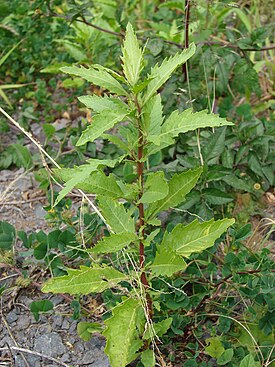 General view of the plant | |||||||||||||||||||||||||
| Scientific classification | |||||||||||||||||||||||||
|---|---|---|---|---|---|---|---|---|---|---|---|---|---|---|---|---|---|---|---|---|---|---|---|---|---|
| |||||||||||||||||||||||||
| International scientific name | |||||||||||||||||||||||||
Dysphania ambrosioides ( L. ) Mosyakin & Clemants , 2002 | |||||||||||||||||||||||||
| Synonyms | |||||||||||||||||||||||||
| |||||||||||||||||||||||||
Content
Title
The common names for the plant in Spanish are Herba Sancti Mariæ , Paico , Epazote (from the word epazōtl in Nahuatl ).
In Russian, the names of the plant are “fragrant gauze” [4] , “Mexican tea” and “Jesuit tea”.
Distribution and habitat
The original range is Central and South America , including the south of Mexico ; later, the plant spread to some other regions of the globe. Now it also grows in areas with a warm to moderate climate: in the subtropical regions of Europe and the USA ; can be considered an invasive (that is, “carried”) weed .
In Russia, found in the south of the European part in weedy places. It was cultivated as a medicinal.
Biological Description
An annual or perennial plant with a lifespan of several years, a height of up to 1.2 m, incorrectly branching.
The leaf arrangement is alternate. The leaves are oblong-lanceolate up to 12 cm long and 2-3 cm wide, covered with golden yellow sessile glands.
The flowers are small green, forming glomeruli (apical or axillary) with bracts several times their length. Flowers are bisexual and same-sex (female). It blooms in June - September.
Seeds are rounded, 0.5-0.7 mm in diameter, black-brown, smooth, shiny, dressed in a thin light yellow pericarp .
Chemical Composition
Fruits and especially pericarp contain essential henopodia oil, the main component of which (up to 80%) is ascaridol (oil yield from dry inflorescences - up to 2.3%, from herbaceous parts - up to 1%). All plant organs contain saponins [4] .
Economic Significance and Application
It is used in cooking (mainly as a seasoning for vegetables). An essential ingredient for Requiem pesticide .
Chenopodia oil is an effective anthelmintic with ascariasis and pinworms [4] .
Botanical classification
Synonyms
According to The Plant List for 2013, the synonymy of the species includes [5] :
- Ambrina ambrosioides ( L. ) spach
- Ambrina anthelmintica (L.) Spach
- Ambrina incisa Moq.
- Ambrina parvula Phil.
- Ambrina spathulata Moq.
- Atriplex ambrosioides (L.) Crantz
- Atriplex anthelmintica (L.) Crantz
- Blitum ambrosioides (L.) Beck
- Botrys ambrosioides (L.) Nieuwl.
- Botrys anthelmintica (L.) Nieuwl.
- Chenopodium amboanum ( Murr ) Aellen
- Chenopodium ambrosioides L.
- Chenopodium angustifolium Pav. ex Moq.
- Chenopodium anthelminticum L.
- Chenopodium citriodorum Steud.
- Chenopodium cuneifolium Vent. ex Moq.
- Chenopodium integrifolium Vorosch.
- Chenopodium querciforme Murr
- Chenopodium sancta-maria Vell.
- Chenopodium santamaria Vell.
- Chenopodium spathulatum (Moq.) Sieber ex Moq.
- Chenopodium suffruticosum Willd.
- Chenopodium vagans Standl.
- Chenopodium variegatum gouan
- Dysphania anthelmintica (L.) Mosyakin & Clemants
- Orthosporum ambrosioides (L.) Kostel.
- Orthosporum anthelminticum Kostel.
- Orthosporum suffruticosum Kostel.
- Roubieva anthelmintica (L.) Hook. & Arn.
- Teloxys ambrosioides (L.) WAWeber
- Vulvaria ambrosioides (L.) Bubani
Notes
- ↑ For the conventionality of specifying the class of dicotyledons as a superior taxon for the plant group described in this article, see the APG Systems section of the Dicotyledonous article .
- ↑ In many classifications, Marevye are considered as an independent family. APG classification systems based on molecular analysis of DNA include it in the Amaranth family.
- ↑ Dysphania anthelmintica (English) : information on the name of a taxon on The Plant List (version 1.1, 2013) 12/12/2011.
- ↑ 1 2 3 Gubanov I.A. et al. Wild useful plants of the USSR / ed. ed. T.A. Rabotnov . - M .: Thought , 1976. - S. 112-113. - 360 p. - ( Reference guides to the geographer and traveler ).
- ↑ Dysphania ambrosioides (L.) Mosyakin & Clemants is an accepted name . The Plant List (2013). Version 1.1. Published on the Internet; http://www.theplantlist.org/ . Royal Botanic Gardens, Kew and the Missouri Botanical Garden (2013).
Literature
Links
- Dysphania ambrosioides : Information on the taxon in the Plantarium project (identifier of plants and an illustrated atlas of species). (Retrieved March 21, 2016)