Sint Estatius ( Dutch: Sint Eustatius , IFA : [sɪnt øːˈstaːcʏs] ) - an island in the Caribbean in the Windward Islands group ( Lesser Antilles archipelago), located 60 km south of Saint-Martin and 27 km southeast of Saba .
| St. Eustatius | |||||
|---|---|---|---|---|---|
| niderl. Sint eustatius | |||||
| |||||
| The national anthem of Sint Eustatius | |||||
  | |||||
| Independence date | October 10, 2010 (from the Netherlands Antilles ) | ||||
| Official language | Dutch Regional or local official language: English | ||||
| Capital | Oranjestad | ||||
| Largest cities | Oranjestad | ||||
| Form of government | A constitutional monarchy | ||||
| King | Willem-Alexander | ||||
| Governor | Herald baker | ||||
| Territory | |||||
| • Total | 21 km² | ||||
| Population | |||||
| • Evaluation (2010) | 3583 people | ||||
| • density | 170.62 people / km² | ||||
| Currency | U.S. dollar | ||||
| Telephone code | +599 | ||||
| Time Zones | UTC-4 | ||||

Named after the great martyr Eustathius . It borders in the southeast by sea with the state of Saint Kitts and Nevis .
Area - 21 km², dimensions: 8 km in length and 3 km in width. It is a special community of the Netherlands , which, however, does not belong to any of the Dutch provinces , and together with two other communities in the Lesser Antilles is the Dutch possession of Bonaire, Sint Eustatius and Saba , also called the Caribbean Netherlands. The administrative center and the only city of the island is Oranjestad .
Content
- 1 Official Symbols
- 2 Geography
- 3 History
- 4 population
- 5 Economics
- 6 notes
Official Symbols
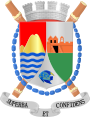
Flag and Coat of Arms of St. Eustatius .
Geography
The relief of Sint Eustatius is typical of the islands of the region - at its base lies an ancient extinct volcano, whose cones are easily visible in the form of the island's main landmarks - the two-headed Quill mountain (600 m) in the southeast and the Signal Hill massif (about 240 m) on north. Almost the entire coast of the island is rocky - the cliffs fall right to the coastline, so there are very few good beaches. The central part of the island is occupied by a small plain, in the place of access to the sea and the island’s only city is Oranjestad . Most of the island's territory is arid, and the vegetation is limited to a dozen species, but on the slopes and in the Quill Crater, which collect enough rain, a real tropical forest grows (18 orchids alone), inhabited by 25 species of birds, snakes, lizards and tree frogs (along with with goats, cows and donkeys).
History
The island was discovered and mapped by Columbus in 1493. Soon after, the Caribbean Indians inhabiting it were partially destroyed, partially died from diseases introduced by Europeans. In 1636, an uninhabited island at that time was captured by the Dutch. According to French sources, the French founded a small fortress there in 1629, but left the island due to a lack of natural water sources. In the next 150 years, the island changed hands 22 times. The Dutch erected a new fort Oranje (existing today) and solved the water problem by building tanks to collect rainwater. In the XVII — XVIII centuries. the island has become a thriving port, commonly known as the Golden Rock. St. Eustatius was the most profitable possession of the Dutch West Indies company and a transit port for the trade of African slaves. So in 1779, more than 3,000 ships from Europe, America and Africa arrived in Oranjestad. Sometimes more than 20 vessels moored per day, 200 ships could simultaneously be on the port roads. Sugarcane , tobacco, and indigo plantations were planted on the island.
Population
The population is 3,583 people (2010) [1] [2] . 27% of the population are Methodists , 25% belong to the Roman Catholic Church , 21% are Seventh-day Adventists .
Economics
The main source of income for Sint Eustatius is tourism.
There is an airport named after F. D. Roosevelt on the island ( ICAO code is TNCE, IATA code is EUX, coordinates 17 ° 29′47 ″ N, 062 ° 58′45 ″ W).