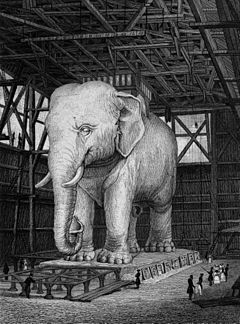

The Bastille Elephant is an elephant monument erected in Paris from 1813 to 1846. The idea was proposed by Napoleon in 1808. The statue was planned to be made of bronze and installed in the Place de la Bastille , but only a full-size plaster model was created. The 24-meter-high model of the elephant was such a memorable structure that Victor Hugo immortalized it in the novel Les Miserables , where this statue serves as a haven for Gavrosh . The base of the monument has survived to the present, although the elephant itself was replaced by the July column .
Content
Design
After the capture of the Bastille in July 1789, disputes began over whether the Bastille should be demolished or if it should be left as a monument. However, it was soon dismantled by stones, some of which were used in the construction of the Concorde Bridge , and some were sold for souvenirs. In 1792, the place where the fortress was located was renamed Bastille Square, and only traces remained of the castle itself. In 1793, an Egyptian-style fountain was erected on the square, representing a woman with water flowing from her breasts. He bore the name "Fountain of the Renaissance."
Napoleon planned to carry out work on the restoration and arrangement of Paris. In addition, he loved to build monuments glorifying military victories. Napoleon decided to build an impressive monument glorifying his military skills. This monument was supposed to be a 24-meter bronze elephant. The bronze for the monument should have been obtained from re- captured captured weapons. On one of the elephant's legs was a staircase along which visitors could climb to the observation platform on their backs.
Construction
The construction of the monument was supervised by Dominic Vivan , the architect was Jacques Celerier . Under his leadership, from 1810 to 1812 preparatory work was carried out - underground utilities and pipes for supplying water to the fountain were built.
In 1812, the project had a new architect, Jean-Antoine Alavuan , who completed the construction of the fountain. The architect needed to show what the final result would look like, and he decided to create a full-size model of stone with a wooden frame. The construction of the model was completed in 1814. Construction was stopped after Napoleon's defeat at the Battle of Waterloo in 1815. However, the architect was looking for opportunities to complete the construction in 1833.
In 1841 and 1843, the city council considered options for use in the construction of bronze , iron or copper , however, none of the options were accepted.
Demolition
In the late 1820s, complaints began to come from residents of neighboring houses that a huge number of rats live in the monument, who raid their homes in search of food. However, the monument was dismantled only in 1846 - due to significant wear and tear.
Legacy
The round base of the monument has been preserved to this day, now the July column is installed on it. The description of the Bastille elephant can be found in Victor Hugo's novel Les Miserables:
| Foreigners rarely inspected this building, passersby did not look at it at all. The elephant collapsed every year; loose pieces of plaster left disgusting ulcers on its sides. "Edil", as expressed in the elegant argo salons, forgot about it since 1814. He stood here, in his corner, sullen, sick, crumbling, surrounded by a decayed hedge, fouled by drunken coachmen; cracks plowed his belly, a rod protruded from the tail from the tail, tall grass grew between his legs. Since the level of the area for thirty years grew around him - thanks to the slow and continuous layering of the earth, which quietly raises the soil of large cities - he found himself in a hollow, as if the earth had settled under it. He stood polluted, unrecognized, repulsive and arrogant - ugly at the sight of the bourgeois, sad at the sight of the thinker. It was somewhat reminiscent of a pile of garbage that would soon be swept out, and at the same time something full of grandeur that would soon be debunked. Victor Hugo, Les Miserables , 1862 |
Other images
Watercolor, architect Jean-Antoine Alavoine
The fountain scheme made in 1828 by Louis Bruyère
Illustration for the Les Miserables 1865
1834 year, engraving by an unknown artist.
Figure 1844 depicting rats running around a statue.