Mexican fly-eater [1] ( lat. Xenotriccus mexicanus ) is a bird from the tyrannous family.
| Mexican fly-eater |
|---|
 |
|
| No rank : | Bilateral symmetrical |
| Suborder : | Screaming passerines |
| Infrastructure : | Tyrannides |
| Gender: | Brown-chested fly-eaters |
|
|
Xenotriccus mexicanus ( Zimmer , 1938 ) |
|
|
|
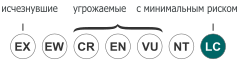
Least ConcernedIUCN 3.1 Least Concern : 22699776 |
|
The Mexican fly-eater reaches a length of about 13.5 to 14.5 cm. The upper part of the beak is black, while the lower part is pink-orange. The legs are dark gray. The color of the plumage of the head and upper body varies from brown to gray-olive color. There is a crest on the head. The periocular ring , as well as the area between the beak and the eye, are whitish. The wings and tail are dark. The throat is white.
The Mexican fly-eater is widespread in Mexico from the states of Michoacan and Morelos to Oaxaca . In summer, it can be found near Monte Alban . In winter, he migrates to warmer plains in the Balsas River Valley. This species lives in a dry and dense mountain shrub at an altitude of 900 to 2,000 m above sea level, especially often in bushes of plants of the genus Prosopis . Bird prefers thorny forests.
The bird moves along the lower branches of shrubs and scares insects, which it then catches on the fly. She builds a nest in the lower tier of the thorny thicket, using grass and other plant fibers for its construction, which she ties with the help of a bowl-shaped web. In clutch from 2 to 3 eggs. Eggs are light brown with specks of red-brown or gray.
- ↑ Boehme R. L. , Flint V. E. The Bilingual Dictionary of Animal Names. Birds. Latin, Russian, English, German, French / Ed. ed. Acad. V. E. Sokolova . - M .: Rus. lang., "RUSSO", 1994. - S. 237. - 2030 copies. - ISBN 5-200-00643-0 .
- Steve NG Howell, Sophie Webb: A Guide to the Birds of Mexico and Northern Central America , Oxford University Press, 1995, Seite 490ff, ISBN 978-0-19-854012-0
- Ernest Preston Edwards, Edward Murrell Butler: A Field Guide to the Birds of Mexico and Adjacent Areas: Belize, Guatemala, and El Salvador, Third Edition: Belize, Guatemala and El Salvador , University of Texas Press, 1998, Seite 101, ISBN 978 -0-292-72091-6