
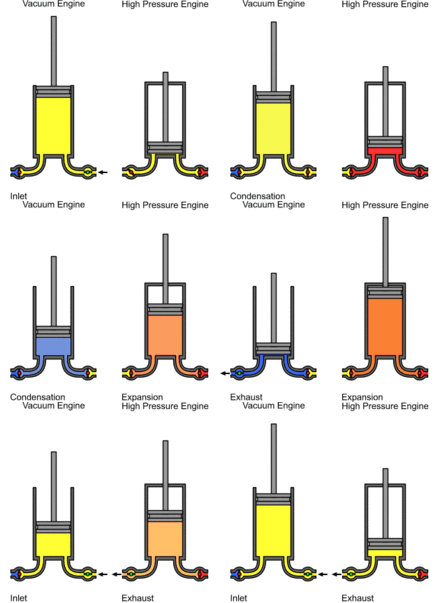

Detander (from the French. Détendre - to weaken ) - a device that converts the potential energy of a gas into mechanical energy . At the same time, the gas, doing work, is cooled . Used in the production cycle of liquid gases such as oxygen , hydrogen and helium . The most common piston expanders and turbo expanders .
Content
Application
Turboexpander found its main application in technological processes for the production of liquid hydrogen , oxygen, air, nitrogen and other cryogenic gases, as well as LNG . However, today turbo-expanders are beginning to be used in the processes of utilization of the energy of throttled natural gas at gas distribution stations and hydraulic fracturing in the distribution of gas transported through gas pipelines . Also, a turboexpander is a turbo-refrigerator, TX is an important component of the air conditioning system of any high-altitude jet or turboprop aircraft. [one]
There are great prospects for the use of turbo-expanders in technological processes of production using steam as the main energy carrier ( oil refineries and chemical plants), as well as in gas and oil fields.
Reasons for the development of turboexpander, relevance
At the beginning of the 20th century, searches were made for ways to increase the temperature in the blast furnaces , and thereby simplify the smelting of pig iron . For this, it was supposed to use blowing into the blast furnace of oxygen-enriched air. Oxygen is obtained from liquid air by fractional distillation . Accordingly, there was a problem of obtaining liquid air on an industrial scale. The cooling method that existed at that time ( throttling through a thin tube) was very energy-consuming and not efficient enough, which did not allow the use of oxygen in metallurgy. Attempts to use piston expanders failed, as they quickly failed, clogged with water ice. For the use of piston expanders, the air had to be drained by passing through special chemical mixtures, which again made the process extremely complicated and expensive.
The development of a turboexpander allowed the use of oxygen in blast furnaces and converters . This not only simplified the smelting of cast iron, but also simplified the conversion of cast iron to iron ( steel ). The resulting steel was of higher quality than before, as it contained less nitrogen dissolved in it. The use of pure oxygen instead of air also significantly increases the temperature in the converter, which allows it to re-melt a significantly larger amount of scrap metal.
Academician Kapitsa played a leading role in the development of expanders since 1936, in particular, he proposed an improved design of a turboexpander, which made it possible to raise its efficiency from 0.52-0.58 to 0.79-0.83 [2] , that is, 3 times reduce losses (compared to the best in the world turbine expanders of the German company Linde ).
Notes
Literature
- Fastovsky V.G., Petrovsky Yu.V., Rovinsky A.S. Cryogenic technology. - M .: 1967.
Links
- Expander - article from the Great Soviet Encyclopedia