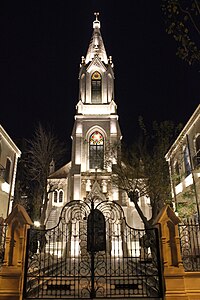
Christianity in Azerbaijan ( Azerb. Azərbaycanda Xristianlıq ) is the second religion in terms of the number of followers (after Islam ).
Church of Caucasian Albania
In the IV century , when St. Gregory the Illuminator of Armenia baptized the Albanian king Urnayr [1] [2] and ordained Grigoris [2] as bishop of his grandson
Being in the closest canonical relationship with the Armenian Church, the Albanian Church opposed the Council of Chalcedon . Albanians were also present at the Vagharshapat (491 year) and Dvina (527 year) cathedrals of the Armenian Apostolic Church, condemning both the Council of Chalcedon, Nestorius and Eutyhius and approving the Armenian confession. The Chalcedonites declared the Armenians and their allies (Caucasian Albanians and Georgians) Monophysites , the same regarded the Council of Chalcedon as a return to Nestorianism.
When in 590, the Byzantine emperor Mauritius , having captured a significant part of Armenia, established an alternative Chalcedonian Armenian Catholicosate in Avan, the Armenian Apostolic Church found itself in a difficult situation. For this reason, the Albanian Church announced its autocephaly, and the Albanian First Hierarch, declared Catholicos, began to be consecrated on the spot. Thus, the first Catholicos [3] of the Albanian church was Abas ( 551 - 595 ). However, already in 795, the Albanian Church returned to dependence on the Armenian Apostolic Church, finally becoming its part [4] [5] [6] .
Albanian-Udian Christian Community
On May 28, 2003, an Albanian-Udian Christian community was created in Azerbaijan [7] , chaired by Robert Mobili [8] . In 2010, the Udi Christian community of Oguz was registered [9] .
Orthodoxy
Orthodoxy in Azerbaijan is the second largest denomination in the Republic of Azerbaijan (after Islam ). According to statistics, Orthodox in Azerbaijan 2.3% (209.7 thousand people). The territory of Azerbaijan is under the jurisdiction of the Baku-Azerbaijan Diocese of the Russian Orthodox Church .
In 1815, the first Orthodox church appeared in Baku , and even under Nicholas I, Orthodoxy was separated from Monophysitism.
In 1905, the Baku Diocese of the Russian Orthodox Church was formed. In Soviet times, authorities repressed the clergy of the Baku diocese, but already in 1944 2 churches were opened.
In 1998, the Baku-Caspian Diocese of the Russian Orthodox Church was formed . On March 22, 2011, by the decision of the Holy Synod of the Russian Orthodox Church, the Baku-Caspian Diocese was renamed the Baku-Azerbaijan Diocese [10] .
In 2011, there are 5 Christian Orthodox churches in the country, 3 of which are located in Baku . [eleven]
Catholicism
Catholicism in Azerbaijan or the Catholic Church in Azerbaijan is part of the worldwide Roman Catholic Church.
History
The history of the presence of the Roman Catholic Church in Azerbaijan begins in the 14th century. From the beginning of the XIV century, missionaries from monastic orders of Dominicans , Carmelites , Augustinians and Franciscans began to arrive in the territory of present-day Azerbaijan. At this time, the efforts of the monks created Catholic missions, educational institutions and monasteries in Baku , Nakhchivan , Ganja . A special role in the missionary work of the Catholic Church at that time was played by the French king Louis XIV , who addressed the Persian Sheikh Sultan Hussein with a message to support the Christians who lived in Persia . Pope Clement XI also repeatedly appealed to the Sheikh with a request not to oppress the Christians. Between France and Persia in 1708 and 1715 Agreements were signed in which Persia took Catholic missionaries under its guardianship and allowed them to operate on the territory of Persia. Towards the end of the 18th century, the missionary activities of the monks gradually faded and ceased.
After Azerbaijan joined the Russian Empire , Christians of various denominations began to arrive in Azerbaijan. In the 19th century, oil fields were discovered in Azerbaijan and workers and engineers from other European parts of the Russian Empire began to come here, among whom were Catholics from Poland and Lithuania . Since the 60s of the XIX century, a Catholic community existed in Baku, which in 1894 built the Catholic chapel of the Immaculate Conception of the Blessed Virgin Mary.
XX century
In 1909, construction of a Catholic church was started in Baku. In 1912, the construction of this temple was completed. The Catholic community in Baku at the beginning of the 20th century numbered about 2550 people [12] . After the October Revolution and the establishment of Soviet power in Azerbaijan, oppression of the Catholic Church began. In the early 30s of the XX century, the Catholic clergy, who served in the Baku parish and numerous believers, were repressed. In 1931, the Catholic Church in Baku was completely destroyed.
Since 1991, after Azerbaijan gained independence, attempts were made in Baku by local Catholics to revive the Catholic community. In 1997, the first Catholic priest arrived in Baku, who began to deal with the revival of the Catholic community. In November 2000, the Holy See established the sui iuris mission in Azerbaijan, which was led by a monk from the monastic order of Salesians .
21st Century
Currently, a sui iuris mission is operating in Azerbaijan. The only Catholic church of the Immaculate Conception of the Blessed Virgin Mary in Azerbaijan is located in Baku. About 200 people are its parishioners. In total, approximately 2,000 Catholics live in Azerbaijan.
Azerbaijan and the Vatican establish diplomatic relations. On July 6, 2011, after ratification by the Vatican, an agreement with the Azerbaijani government on state registration of the Catholic community in the country entered into force. [13]
Protestantism
The first Protestants appeared in Azerbaijan at the beginning of the 19th century - they were German colonists professing Lutheranism . The first Baptist church was formed in Baku in 1880 by the former Molokan V.V. Ivanov-Klyshnikov. At the turn of the 19th and 20th centuries, Adventist communities are formed in the region. During the years of Soviet rule, Pentecostal communities appeared in the Azerbaijan SSR.
Currently, up to 20,000 Protestants live in Azerbaijan [14] . The Union of Baptists of Azerbaijan unites 22 communities with 3 thousand members [15] . Various Pentecostal churches number up to 4.4 thousand parishioners (2010) [16] . At the same time, the largest Pentecostal association is the Word of Life Church (4 communities, 1.8 thousand believers) [16] . According to its own data, the Seventh-day Adventist Church in 2014 totaled 5 communities and more than 500 church members in the country [17] . There are also Lutherans , evangelical Christians , followers of the New Apostolic Church , etc.
Notes
- ↑ V.E.Suslenkov. Gregory the Illuminator // Orthodox Encyclopedia . - M .: Church Scientific Center "Orthodox Encyclopedia" , 2006. - T. XIII: " Gregory Palamas - Daniel-Rops ." - S. 41-47. - 752 s. - 39,000 copies. - ISBN 5-89572-022-6 .
- ↑ 1 2 Albania - article from Encyclopædia Iranica . ML Chaumont:
Towards the beginning of the 4th century, at a date which is still under discussion, the Arsacid king of Armenia, Tiridates III, officially adopted Christianity, having been converted by St. Gregory. According to Movsēs Kałankatuacʿi (or Dasxuvancʿi, History of the Albanians, ed. J. Emin, Moscow, 1860; repr. Tiflis, 1912; and ed. Chahnazarian, Paris, 1960, 1.11; tr. JF Dowsett, The History of the Caucasian Albanians by Movsēs Dasxuranċi, Oxford, 1961, pp. 11-12), Uṙnayr the king of Albania soon arrived in Armenia with his dignitaries for the purpose of being baptized by St. Gregory. Christianity spread in Albania only gradually. Grigoris, a grandson of St. Gregory, consecrated bishop of Iberia and Albania, came to Albania, built a church, and established priests in the city-fortress of Tri (or Tsri), but the inhabitants killed the priests and revolted against the king of Albania, with the help of the king of Persia. The city was taken by the Argesaċikʿ Persians (Movsēs, History 1.14, tr. Pp. 22-23; cf. H. Manandian, Beiträge zur albanischen Geschichte, Jena, 1897, p. 25).
- ↑ Petrushevsky I.P. Essays on the history of feudal relations in Azerbaijan and Armenia in the 16th - early 19th centuries - L. , 1949. - S. 28 .:
The title of Catholicos of Albanian has been known since 552. e.
- ↑ Error in footnotes ? : Invalid
<ref>; no text for footnotesКузнецов - ↑ Trever K.V. Essays on the History and Culture of Caucasian Albania of the 4th Century BC e. - VII century n e. (sources and literature). - M. - L. , 1959. - S. 295 .:
After the 7th century Albanian writing, as you can see, is out of use, which is largely due to the fact that in Transcaucasia, in the struggle between the Monophysites (followers of the Armenian church) and Chalkedonite diaphysites (followers of the Georgian church), the former used the Old Armenian, the latter - the ancient Georgian language, they became the canonized languages of these churches. Since that time, the Albanian church began to be considered as part of the Armenian church , and the Old Armenian language becomes its language of worship.
- ↑ T.A. Maysak. To the publication of the caucasian-Albanian palimpsests from the Sinai monastery Questions of linguistics. 2010. No. 6. p. 2:
When at the beginning of the VIII century. Transcaucasia came under the rule of an Arab caliphate, whose patronage was enjoyed by the Armenian Church, the Church of Caucasian Albania finally lost its independence, and its Catholics began to be ordained the Armenian throne.
- ↑ Albanian-Udinian religious community created in Azerbaijan
- ↑ Chairman of the Albanian-Udinian Christian Religious Community: “Hundreds of Albanian temples were either destroyed or appropriated by the Armenians” (unavailable link) . Date of treatment March 26, 2013. Archived March 29, 2013.
- ↑ The head of the Albanian-Udian Christian community: “Udin - Arkady Vladimirovich from Kirovobad is a fiction of the Armenian propaganda”
- ↑ News of the Baku-Azerbaijan Diocese
- ↑ Over 1.8 thousand mosques, 5 Orthodox churches and 6 synagogues function in Azerbaijan (inaccessible link)
- ↑ Catholic Encyclopedia, vol. 1, p. 107
- ↑ Catholic community of Azerbaijan received state registration
- ↑ Global Christianity . The Pew Forum on Religion & Public Life (December 19, 2011). Date of treatment May 13, 2013. Archived May 22, 2013.
- ↑ Statistics . Baptist World Alliance (2013). Date of treatment March 15, 2014. Archived June 27, 2012.
- ↑ 1 2 Jason Mandryk. Azerbaijan // Operation World: The Definitive Prayer Guide to Every Nation. - InterVarsity Press, 2010 .-- 978 p. - (Operation World Set). - ISBN 0-8308-5724-9 .
- ↑ Office of Archives, Statistics, and Research. Azerbaijan Mission (2008-Present ) . Adventist World Statistics / General Conference of Seventh-day Adventists (2014). Date of treatment November 28, 2015.