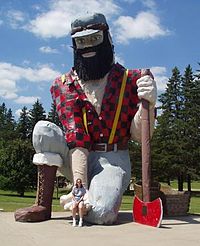
Paul Bunyan ( eng. Paul Bunyan ) - a fictional giant woodcutter , a character in American folklore. The earliest printed work about Banyan, which is now known, was created by James McGillivrey in 1910 (according to other sources, in 1906). A few years later, in 1916, William Loghead came up with an advertisement and decided to use the image of Banyan, making him a giant.
Content
Origin of Banyan Field
James Stevens wrote a book called Paul Bunyan in 1925. This book says that French Canadians created stories about Paul Bunyan during the Papino uprising of 1837, when they fought against England. This explains why Paul Banyan's last name is Banyan, since Banyan sounds like the French Canadian slang term Bonyenne, meaning surprise, in the same way that the English would say “My God” or “My God.” People told each other stories about Banyan, and these stories, of course, changed somewhat, passing from person to person. Often Paul Bunyan is depicted in pictures with a giant blue bull named Babe ("baby"). Historians believe that the Kid was created only in the XX century for advertising.
The Legends of Paul Banyan
According to legend, when Banyan was born, it took five storks to bring him (in some stories, storks bring babies and put them at their parents' homes). When he got older, he ruined all the windows in the house, when clapping his hands and laughing. When he was seven months old, he sawed off the legs at the bedside of his parents in the middle of the night. Paul and his friend Babe Blue Bull created the Grand Canyon, when Paul was traveling, carrying his ax. Babe, Banyan's friend, is a big and very strong animal.
Many different settlements claim that they are the “home” of Banyan. Some of these towns are located in the states of Minnesota , Michigan and Wisconsin , although in other states such towns also exist.
In the city of Kellicher , Minnesota, there is a park called the Paul Bunyan Memorial Park, where there is a grave, which says that Paul Bunyan is buried here.
In art
- "Paul Bunyan" - Benjamin Britten Operetta on Wyten Hugh Oden's Libretto (1941)
- “Paul Bunyan” - The Clark Forest Film (1958)
- The Simpsons (Season 12, Episode 21) - The Tramp tells the Simpsons the legend of Paul Banyan. In this story, Paul has the appearance and character of Homer.
- Gravity Falls (Season 2, Episode 16) - Stanley Pines prays to Paul Banyan before his death.
- “The Empire of Corpses” (2015) named one of the giant computers named Paul Bunyan.
- "It" (Stephen King's novel) - Richie Tozier was attacked by the revived Banyan sculpture.
- "Paul Bunyan And The Blue Ox" - The Tony Danza Tapdance Extravaganza Composition From The Album 2012: Danza IIII: The Alpha - The Omega
- "Fargo" (1996) - the film takes place in part in the town of Brainerd - the birthplace of Paul Bunyan.
- "Gravity Falls" (intro) - the statue in the headband depicts Paul Banyan.
Links
- Inventory of the William B. Laughead Papers, 1897–1958 in the Forest History Society , Durham, NC
- Paul Bunyan History
- "The Story of Paul Bunyan" , Paul Bunyan Trail
- Roadside statues and other tributes to the Great Tree-Biter, Paul Bunyan , Roadside America
- Animated stories of Paul Bunyan
- Paul Bunyan's Northwoods Cook Shanty , Minocqua & Wisconsin Dells, Wisconsin
- St. Maries Paul Bunyan Days . stmarieschamber.org (July 6, 2012). The appeal date is October 7, 2012. Archived November 28, 2010.