The convexity of a preference relationship is a property that describes the consumer’s propensity for balanced consumption of existing goods. For example, if a consumer claims that the set made up of two identical packs of coffee and a set made up of two identical tea packs, and both sets are equally good (are in relation to indifference, ), then you can expect, then the average set made up of one pack of coffee and one pack of tea will be at least no worse ( ) In the case of complementary goods, this property is even more natural.


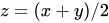

Let the space of goods is a convex set . For custom dialing consider the set sets that (weakly) prevail over . A preference relation is called convex if is convex, and is called strictly convex if is also strictly convex.




The convexity of the preference relation is important in the study of the existence and uniqueness of the solution to the problem of maximizing utility (the problem of choosing a consumer).
The indifference curves of a monotonous, continuous, and convex preference relation are downward and convex curves.
See also
- Attitude preference
- Monotone preference relation
- Continuous Preference Attitude
Literature
- Mas-Colell, Andreu; Whinston, Michael; & Green, Jerry Microeconomic Theory., Oxford: Oxford University Press, 1995. ISBN 0-19-507340-1 .
- Varian, Hal R. Intermediate Microeconomics, WW Norton & Company, 2005.