“Four degrees of cruelty” [1] (also “Four stages of cruelty” [2] , “Four scenes of cruelty” [1] , “Four fields of cruelty” [1] , “Degrees of cruelty” [3] ; English The Four Stages of Cruelty ) is a series of four prints published by British artist William Hogarth in 1751. Each of the engravings depicts a scene from the life of the fictional character Tom Nero.
In the "First Stage of Cruelty," young Nero tortures a dog ; in the "Second stage of cruelty", already an adult man, he beats his horse, and in "Perfect cruelty" he robs, seduces and kills. Finally, in The Compensation of Cruelty, his body after execution on the gallows is given to the surgeons who dissect him in the anatomical theater - Hogarth warns of the inevitability of retaliation for all who embarked on the path of crime.
Engravings are conceived as moralizing instructions; Hogarth was concerned about the brutality in the streets of London , which became commonplace. The series was printed on cheap paper and was intended primarily for the lower segments of the population. Hogarth, wanting to achieve the most powerful impact on the viewer, in this series of prints, unlike his other works, refused humorous softening of the plots. Nevertheless, like his other works, engravings contain many interesting details and subtle allusions.
Content
- 1 History
- 2 engravings
- 2.1 The first stage of cruelty
- 2.2 The second stage of cruelty
- 2.3 Perfect cruelty
- 2.4 Retribution of Cruelty
- 3 Criticism
- 4 notes
History
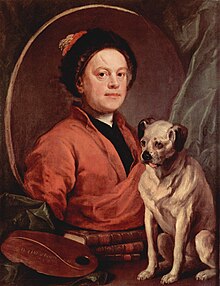
Like other engravings by Hogarth (for example, Beer Street ), The Four Stages of Cruelty was released for educational purposes. This series of engravings demonstrates the ease with which a cruel child turns into an inveterate criminal. Hogarth sought to draw attention to the barbaric treatment of animals, "the very sight of which on the streets of our capital is disturbed by every sensitive mind" ( English that barbarous treatment of animals, the very sight of which renders the streets of our metropolis so distressing to every feeling mind [ 4] ). Hogarth loved animals, in a self-portrait of 1745 he portrayed himself with his pug [5] , graves of his pets - dogs and birds [6] were arranged at the artist’s house in Chisik .
The artist intentionally refused excessive detailing of the image on the engravings, as he wanted them to be understood by “lower class people” [4] who would see them on the walls of workshops and taverns [7] . Fine design and printing of good quality would make engravings too expensive for those to whom they were intended in the first place. Hogarth believed that a bold, expressive line can be very expressive, noting that "greater accuracy of the drawing or fine drawing was not at all so necessary" [8] .
To make sure that prints would be affordable for ordinary people, Hogart first ordered a woodcut by J. Bell . The cost of the work turned out to be so high that only the last two of the four engravings were cut, and the prints were not sold [7] . Instead, Hogarth himself completed the engravings and advertised their publication (along with Beer Street and Gin Lane ) in the London Evening Post for three days, from February 14 to 16, 1751 [9] . Engravings came out on February 21, 1751 [10] ; each of them was accompanied by an instructive commentary written by Rev. James Townley, a friend of Hogarth [10] . Together with earlier engravings, such as Zeal and Laziness, prints on “plain” paper were sold at 1 shilling per sheet (£ 6.70 in 2011 prices), that is cheap enough for ordinary people to get these instructive works. High-quality prints were also issued for collectors on “excellent” paper at a price of 1 shilling 6 pence (about 10 pounds for 2011) [4] .
The prints made by Bell of the third and fourth engravings are marked with an earlier date - January 1, 1750 [4] . They were reprinted in 1790 by John Boydell, these prints are now a rarity [7] [a] .
After the creation of the series, Hogarth no longer turned to engraving [1] .
Engravings
The First Stage of Cruelty
| William Hogarth | ||
| The first stage of cruelty . 1751 | ||
| First stage of cruelty | ||
In the first of the engravings, Tom Nero, whose name is a reference to the Roman emperor or the desire for “not a hero” ( Nero - no hero ) [11] [12] , with the help of other boys, inserts an arrow into the rectum of the dog - this torture repeats the torture of the sinner in The Temptations of St. Anthony by Jacques Callot [9] . An initial badge on the shoulder of his faded and tattered coat indicates that he is attending a St. Giles charity school. This notorious slum district is the scene of many of Hogarth’s works, including Gin Lane and Half Day (from the Four Times of the Day series). The good boy, probably the owner of the dog [13] , offers Tom food and asks him to stop tormenting the animal in return. The role of a good boy is probably portrayed by young George III [14] . Later, the Princess of Wales, along with George, headed the subscription sheet of the Hogarth series “Elections” [15] . Unlike gloomy ugly bullies, the owner of the dog is handsome. Text accompanying the picture (non-literary translation is given):
While different types of playful trouble Watch it! Young man with a good heart Learn from this honest example - you, Original text While various Scenes of sportive Woe, Behold! a Youth of gentler Heart, Learn from this fair Example — You |
The two boys at the top right of Nero burn their eyes with a burning torch; the boys at the bottom of the engraving throw a rooster (this is probably a hint of enmity with the French, as well as an indication that the action takes place on a traditional day for such fun with roosters, on Fat Tuesday ) [14] . Another character ties a bone to the dog’s tail so that she cannot reach it; a pair of fighting cats hung by their tails, a group of boys teasing them. In the lower left corner, a dog was set on a cat, and in the background, another cat with bubbles attached to it is thrown out of the window on the top floor. The name of Tom Nero is written under the image of the hanged man (he is drawn in chalk by one of the boys) - this is a prediction of the fate of the main character. The absence of parish officers who should keep an eye on the children was reproached by Hogarth. The artist agreed with Henry Fielding that one of the reasons for the increase in crime was poor supervision of the poor: parish officers were too often interested in their position only because of the social status and money that it could bring [9] .
The authorship is indicated under the text: “Created by W. Hogarth, published in accordance with the Parliamentary Act. February 1, 1751 ”( Designed by W. Hogarth, Published according to Act of Parliament. Feb. 1. 1751 ). This act is the 1734 Engravings Copyright Act. Many of Hogarth's early works were printed in large quantities without his control or payment of royalties, so for the sake of his interests he called on friends from the British Parliament to pass a law on the protection of engravers. Hogarth was so persistent in passing the law through Parliament that he became known as the “ Hogarth Act ” [16] .
The Second Stage of Cruelty
| William Hogarth | ||
| The second stage of cruelty . 1751 | ||
| Second stage of cruelty | ||
The second engraving shows a scene by the Tavi Inn Gate (sometimes called with irony as the Thieves Inn Gate , “the gate at the thieves' den”), one of the hotels of the office where members of the London Bar Association stayed [17] . Tom Nero grew up and became a hired coachman. His horse, exhausted by years of hard work and abuse, fell, broke his leg, and broke a wagon. Tom beat the horse so hard that it knocked out her eye. Hogarth portrays four obese lawyers trying to get out of the wagon. This is probably a caricature of well-known lawyers at that time, but it is not possible to identify them. Here you can observe how a shepherd slaughter a lamb to death, an overloaded donkey is beaten on a croup, and an angry bull throws up one of its tormentors. Some episodes are described in the accompanying text (non-literary translation is given):
Tired Glorious Old Rossinant The tender lamb is pounded and weak Inhuman Scoundrel! tell me where it comes from Original text The generous Steed in hoary Age, The tender Lamb o'er drove and faint, Inhuman Wretch! say whence proceeds |
Cruelty to animals is replaced by cruelty to people; the driver is sleeping, not noticing that beer is being poured from his barrel on the pavement, and his playing boy is crushing his supply. Posters in the background advertise cockfights and boxing, further emphasizing the atmosphere of hopelessness. According to the inscription on one of the posters, the boxing match should take place in the Broughton amphitheater, a place known for rude entertainment. It was founded by the “father of fisticuffs”, Jack Broughton. According to the rules of that time, the participants in the battles fought with the left foot tied to the floor. The winner is the one whose wounds were recognized as less serious [18] . The poster shows the names of the participants in boxing fights - James Field, who was hanged two weeks before the release of the engravings (he appears in the final picture of the series), and George "The Beaver" Taylor. The latter, a former champion of England, was defeated by Broughton and retired in 1750. After Taylor's death in 1757, Hogarth made a series of drawings depicting his struggle with death - probably for a tombstone [19] [20] [b] .
Just as in the first engraving, only one person is affected by the kind of torment of the animal. To the left of Nero is a passerby recording the number of the cab driver to report on his behavior [14] .
Perfect Cruelty
| William Hogarth | ||
| Sheer cruelty . 1750 | ||
| Cruelty in perfection | ||
By the time of the third scene, Tom Nero had gone from animal cruelty to theft and murder. He knocked out his pregnant mistress Ann Gill to rob her mistress and run away. Having met Ann, Nero kills her with particular cruelty: the victim’s wrist and index finger are almost torn off, her neck is deeply cut. Her chest [c] and her stolen goods are lying next to the girl on the ground. On the book, which, along with the prayer book, fell out of the chest, it says "God avenges murder," Ann's almost torn finger points to these words [21] . A woman searching Nero’s pockets discovers pistols and many pocket watches - evidence that he has turned into a robber (like Tom Idle in “Zeal and Laziness” [22] ), and a letter from Ann that reads:
| Dear Tommy, My mistress was the best of women for me, and my conscience often hits me in the face when I think that I cheated on her; and yet I decided to trust my body and soul to do everything the way you wanted from me, so don’t miss the meeting with me that you spoke about, since I will bring with me all the things that I can capture. That's all for now; but I remain yours until death. Anne Gill. Original text Dear tommy My mistress has been the best of women to me, and my conscience flies in my face as often as I think of wronging her; yet I am resolved to venture body and soul to do as you would have me, so do not fail to meet me as you said you would, for I will bring along with me all the things I can lay my hands on. So no more at present; but I remain yours till death. Ann Gill. |
Spelling is perfect, which is perhaps unrealistic for a girl of that time and from such an environment, but Hogarth deliberately avoids everything that might seem ridiculous in the scene [14] . The letter is addressed to "To Tho s Nero at Pinne ...". Ronald Paulson sees parallels between the dead-slaughtered lamb in the second of the engravings and the defenseless girl killed here [9] . Under the stage is a text according to which Nero, if he does not repent, is, in any case, amazed at his actions (a non-literary translation is given):
For the lawless love that once betrayed So know, Seducer! even the night Wounds gaping, steel bloodied Original text To lawless Love when once betray'd. Soon Crime to Crime succeeds: Yet learn, seducing Man! nor Night, The gaping Wounds and bloodstain'd steel, |
Various details of the engraving are designed to enhance the gloomy atmosphere: the murder took place in a cemetery, possibly in St. Pancras, or, according to John Ireland, in Marylebone [14] ; an owl and a bat fly by ; the moon illuminates the scene of the crime; the clock beats the witching hour. The composition is similar to the "Arrest of Christ" by Anthony Van Dyck [23] . Among those who surround Tom, there is again a lonely good Samaritan : with an expression of pity on his face, he turns to heaven.
In the engraving of Bella, Tom is shown with free hands. There are differences in the text of the letter [4] ; some objects, such as a lantern and a book, are larger and depicted much easier; the bushes are not trimmed, there is no character to the left of Tom [24] .
Cruelty
| William Hogarth | ||
| Retribution of cruelty | ||
| The reward of cruelty | ||
Convicted Nero, found guilty of murder, was hanged, and his body was subjected to the shameful process of public dissection. According to the Law on the Killers, adopted a year after the publication of the engravings (1752), the organs of the criminal could be provided to surgeons for examination. It was believed that this circumstance, together with the refusal of burial, would be an additional deterrent [25] . At the time when Hogarth was working on a series of engravings, the transfer of killer organs was not fixed by law, but surgeons sometimes received bodies for research [9] .
Tom Nero can be recognized by the tattoo on his arm. A rope that still hangs around the neck indicates a method of execution. The projectors, whose hearts have been tempered by many years of working with corpses, are as indifferent to Nero as he was indifferent to his victims. They take out their eyes from Nero, which in engraving is a reminder that the horse lost his eyes through his fault, and the dog eats his heart - this is a retribution for the cruelty that he showed as a boy [9] . Nero's face is distorted in pain. Hogarth added this implausible detail to impress the viewer. Tom’s finger is bent just like Annie’s finger in the previous scene; he points to boiling bones - such a fate is also destined for the body of Nero.
While surgeons work with the body under the supervision of a scientist in a square academic cap , doctors who can be identified by wigs and canes, not paying attention to the process, lively talk to each other [26] . The man sitting in a chair in the center of the picture is John Frecke, who was then president of the Royal Royal College of Surgery [14] [d] . It is known that in 1749 Freke opposed the autopsy of the convicted conspirator Bosavern Penlez [9] .
Except for the overly enthusiastic process of dissecting the body and in-situ boiling bones, the picture conveys the actual course of such a procedure [27] .
To the left and right in the background are two skeletons. The inscriptions above them indicate that one of them is the skeleton of James Field, a boxer whose name can be seen on the second engraving of the series, and the other is the skeleton of MacLane, the infamous robber. Both of them were hanged shortly before the publication of prints (MacLane in 1750, and Field in 1751). The skeletons seem to point to each other. The inscription above Field’s skeleton on the left could be changed at the last minute to GENTL HARRY (Young Gentleman Harry), nicknamed Henry Simms. He was convicted of robbery and executed in 1747 [19] . The motive of a lonely kind person is preserved in this last engraving - one of the scientists points to the skeleton of James Field: this is the inevitable end of someone who embarks on the path of cruelty [9] .
The composition of the scene is a shepherd based on an illustration from the frontispiece of a textbook by Andreas Vesalius “ On the Structure of the Human Body ” and, possibly, Quack Physicians' Hall (circa 1730) by Dutch artist Egbert van Hehemskerk who lived in England. Hogarth admired the works of the latter [26] . Perhaps the source of inspiration could be the 1495 engraving of Fasciculus Medicinae by Johannes de Katham, which is simpler in composition but resembles the engraving of Hogarth [23] .
The following words are located under the fingerprint:
Here is the grave demise of the Scoundrel! That evil Tongue is uprooted His heart is being studied by prying eyes Original text Behold the Villain's dire disgrace! Torn from the Root, that wicked Tongue, His Heart expos'd to prying Eyes, |
Criticism
Hogarth was very pleased with the result. European Magazine reported that he told a merchant from Cornhill (Mr. Sibyl, Sewell ) [9] :
| There is no part of my work that I would be proud of and that would feel the same happiness as with the Four Stages of Cruelty series, because I believe that its release will be restrained by the devilish spirit of barbarism to simple beast, which, unfortunately, I was once so common in this country. Original text ... there is no part of my works of which I am so proud, and in which I now feel so happy, as in the series of The Four Stages of Cruelty because I believe the publication of theme has checked the diabolical spirit of barbarity to the brute creation which, I am sorry to say, was once so prevalent in this country. European Magazine , June 1801 |
In his unfinished work, Apology for Painters, Hogarth noted:
| I would prefer if cruelty could be stopped by four engravings, be the creator of them, rather than cardboard [Raphael], otherwise I would live in a Roman Catholic country. Original text I had rather, if cruelty has been prevented by the four prints, be the maker of them than the [Raphael] cartoons, unless I lived in a Roman Catholic country. [28] |
According to Mikhail German , these words are self-consolation, since Hogarth did not have much success on the "Raphael" path [1] .
In his book “Shakespeare and His Times” (1817), Nathan Drake explains the inclusion of the cock-throwing scene in the first engraving by the artist’s desire to change the public’s attitude to this fun, which was usual in those times, and to encourage officials to take a tougher stance against her lovers. Most critics took the series coolly. Charles Lam considered the series to be caricatured, not worthy of being accepted into a number of Hogarth’s works and claiming only to be the title of a work with “wayward humor”, usually not typical of the artist [29] . Art critic Allan Cunningham spoke sharply about the series [30] :
| I wish she was never painted. Of course, there is great skill in composition and a deep knowledge of characters; but the whole result is rude, cruel and disgusting. A wild boy turns into a savage, and makes a career in cruelty and abuse of cruel murder, for which he was hanged and dismembered. Original text I wish it had never been painted. There is indeed great skill in the grouping, and profound knowledge of character; but the whole effect is gross, brutal and revolting. A savage boy grows into a savage man, and concludes a career of cruelty and outrage by an atrocious murder, for which he is hanged and dissected. |
According to Jenny Aglow, the figure of a boy from Joseph Wright ’s painting “ An Experiment with a Bird in an Air Pump ” echoes the figure from the last of the engravings of “The Four Stages of Cruelty” (a boy pointing to the skeleton on the left) [31] .
The slaughter of killers ceased with the adoption of the Law on Anatomy of 1832, most torture of animals was prohibited by the Law on Cruelty to Animals of 1835. From the middle of the 19th century, “The Four Stages of Cruelty” was considered as an image of episodes from the past, although it has a rather strong emotional impact on the viewer [32] , which is also typical of the modern public [27] .
Notes
- Comments
a. ^ A pair of original prints from Bella's board was purchased for £ 1,600 by the Hunter Museum and Art Gallery of the University of Glasgow in 2005 [33] .
b. ^ There is some confusion about George Traylor's career dates and deaths. In his early work, Paulson refers to him as a student of Broughton, who was killed in battle with him in 1750, and the Tate Gallery dates Hogarth’s sketches around 1750 [34] . At Hogarth's Prostitute, he claims that Taylor retired in 1750, but in 1757 came to the last battle in which he was severely beaten and died from his injuries a few months later. Most records date Taylor's championship to the mid-1730s.
c. ^ The initials on the chest are usually read as “A. G. ”, that is,“ Anne Gill, ”but G resembles D, which hints that the chest could also have been stolen.
d. ^ John Ireland recognizes the chairman as "Mr. Frick, Master North, who had a student of Mr. Potts." Since Ireland identifies him as the master of Nors, this definitely means John Frecke, a friend of Hogarth and a surgeon at St. Bartholomew’s Hospital in 1729–1755 and Governor between 1736–1756. The dissection can take place at St. Bartholomew’s hospital, where all three surgeons worked, but the place also has the features of the Coutlerian Theater of the Royal College of Physicians near Newgate (in particular, the throne) and the niche of the Barber and Barber’s hall (which was not used for opening after the surgeons separated, establishing the Company of Surgeons in 1745).
- Sources
- ↑ 1 2 3 4 5 Michael German. Fighter. Preacher. Philosopher // William Hogarth and his time. - Art, 1977. - S. 180-181. - 226 p. - 25,000 copies.
- ↑ History of torture . - Olma Media Group. - S. 184. - ISBN 9785224033232 .
- ↑ Gogarth // Brockhaus and Efron Encyclopedic Dictionary : in 86 volumes (82 volumes and 4 additional). - SPb. , 1890-1907.
- ↑ 1 2 3 4 5 William Hogarth. Remarks on various prints // Anecdotes of William Hogarth, Written by Himself: With Essays on His Life and Genius, and Criticisms on his Work . - J. B. Nichols and Son, 1833. - P. 64-65, 233-238, 336.
- ↑ "Self-portrait with the dog Trump", 1745 London, Tate Gallery.
- ↑ Jenny Uglow. Hogarth: a life and a world. - Faber and Faber, 1997. - P. 501. - ISBN 0-571-16996-1 .
- ↑ 1 2 3 Art of William Hogarth (link not available) . Haley and Steele (2003). Date of treatment January 15, 2007. Archived on April 6, 2005.
- ↑ Quoted from Uglow, p. 506.
- ↑ 1 2 3 4 5 6 7 8 9 Ronald Paulson. Hogarth: Art and Politics, 1750-64 Vol 3. - Lutterworth Press, 1993 .-- P. 596. - ISBN 0-7188-2875-5 .
- ↑ 1 2 IRF Gordon. The Four Stages of Cruelty (link not available) . The Literary Encyclopedia (November 5, 2003). Date of treatment January 15, 2007. Archived January 18, 2012.
- ↑ Jonathan Jones. A Georgian invention (Inaccessible link) . Guardian (November 22, 2004). Date of treatment January 28, 2007. Archived on May 3, 2008.
- ↑ Roy Porter. Dr Doubledose: a taste of one's own medicine // British Medical Journal. - December 24, 1994. - Vol. 309. - Vol. 6970 . - P. 1714-1718. - DOI : 10.1136 / bmj.309.6970.1714 . - PMID 7819999 .
- ↑ Sean Shesgreen. Engravings by Hogarth: 101 Prints. - New York: Dover Publications, Inc., 1974. - ISBN 0-486-22479-1 .
- ↑ 1 2 3 4 5 6 John Ireland. Four stages of cruelty // Anecdotes of William Hogarth, Written by Himself: With Essays on His Life and Genius, and Criticisms on his Work . - J. B. Nichols and Son, 1833. - P. 233-240.
- ↑ Michael German. Notes // William Hogarth and His Time. - Art, 1977. - S. 220. - 226 p. - 25,000 copies.
- ↑ IRF Gordon. A Rake's Progress (inaccessible link) . The Literary Encyclopedia (19 July 2003). Date of treatment January 15, 2007. Archived January 17, 2012.
- ↑ The Inn of Chancery . Date of treatment February 27, 2007. Archived October 2, 2006.
- ↑ Uglow, p. 503.
- ↑ 1 2 Ronald Paulson. Hogarth's Graphic Works. - New Haven & London: Yale University Press, 1965. - ISBN 0-9514808-0-4 .
- ↑ Ronald Paulson. Hogarth's "Harlot": Sacred Parody in Enlightenment England. - Johns Hopkins University Press, 2003 .-- P. 424. - ISBN 0-8018-7391-6 .
- ↑ Uglow, p. 504.
- ↑ It has been suggested that Tom became a robber out of desperation, losing his coachman position due to beating a horse and other misconduct.
As a hackney-coachman, his barbarity did not pass unnoticed; his treatment of his horses became publicly known, and was attended with a discharge from his place: being therefore at a loss for a maintenance, his wicked turn of mind soon led him upon the road, which is shewn by this pistols and watches found upon him Samuel Ireland. William Hogarth, Marriage A La Mode And other Engravings. - Lear Publishers .
- ↑ 1 2 Bernd Krysmanski. Hogarth's Enthusiasm Delineated: Borrowing from the Old Masters as a Weapon in the War between an English Artist and self-styled Connoisseurs. — New York: Georg Olms, 1996. — ISBN 3-487-10233-1 .
- ↑ Ronald Paulson. Hogarth. — James Clarke & Co., 1992. — P. 35. — ISBN 0-7188-2875-5 .
- ↑ Criminal Punishment at the Old Bailey . The Old Bailey Proceedings Online (2003). Дата обращения 12 января 2007. Архивировано 12 декабря 2006 года.
- ↑ 1 2 Fiona Haslam. From Hogarth to Rowlandson: Medicine in Art in Eighteenth-century Britain. — Liverpool: Liverpool University Press, 1996. — P. 264—5. — ISBN 0-85323-630-5 .
- ↑ 1 2 Finlay Foster. William Hogarth and the Doctors // Bulletin of the Medical Library Association. — 1 июля 1944. — Vol. 32. — Вып. 3 . — P. 356—68. — PMID 16016656 .
- ↑ Lawrence Gowing. Hogarth. — The Tate Gallery, 1972. — ISBN 8435-6035-5.
- ↑ Charles Lamb. On the genius and character of Hogarth: with some remarks on a passage in the writings of the late Mr. Barry // The Reflector. — 1811. — Vol. 2. — Вып. 3 . — P. 61—77.
- ↑ Allan Cunningham. William Hogarth // The Lives of the Most Eminent British Painters and Sculptors. — J and J Harper, 1831. — P. 57.
- ↑ Jenny Uglow. The Lunar Men. — London: Faber and Faber, 2002. — P. 123. — ISBN 0-571-19647-0 .
- ↑ John Casell. Art Treasures Exhibition. — W. Kent and Co., 1858.
- ↑ National Fund for Acquisitions Grants Paid 2005—2006 (недоступная ссылка) . National Museums of Scotland (2006). Дата обращения 25 января 2007. Архивировано 6 октября 2014 года.
- ↑ George Taylor Triumphing over Death (недоступная ссылка) . Tate Collection (2004). Дата обращения 25 января 2007. Архивировано 13 января 2012 года.