Project 204 small anti-submarine ships of the MPK-15 type ( NATO classification : Poti corvette class ) are small anti-submarine ships armed with the naval forces of the USSR, Bulgaria and Romania.
| Project 204 small anti-submarine ships | |
|---|---|
| Small anti-submarine ships of project 204 type MPK-15 Poti class corvette | |
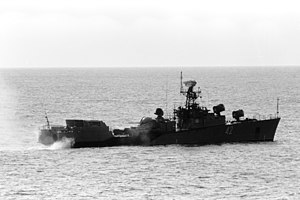 Small anti-submarine ship of project 204 No. 42 “Bditelni” of the Bulgarian Navy | |
| Project | |
| A country |
|
| Manufacturers |
|
| Operators |
|
| Years of construction | 1960 (first) |
| Main characteristics | |
| Displacement | 439 t (standard) 555 t (full) |
| Length | 58.3 m (56 m line) |
| Width | 8.1 m (7.85 m CL) |
| Draft | 3.09 m |
| Engines | DGTU GTK-D2: two D-2K gas turbo-compressors and two M-504 diesel engines |
| Power | 36600 h.p. |
| Mover | two shafts and propellers in supercharged pipes |
| Speed | 35 knots (maximum) 14 knots (economical) |
| Sailing range | 2,500 nautical miles (at 14 knots) |
| Autonomy of swimming | 7 days |
| Crew | 54 people (5 officers) |
| Armament | |
| Radar weapons | General Detection : MR-302 “Felling” NRLS : Vaigach (Don-2 or Spin Trough) GAS : "Hercules-2M" fire control : MP-103 "Bars" (Muff Cob) |
| Electronic weapons | Bizan-4B (2 Watch Dog) |
| Artillery | twin 57-mm AK-725 (or ZIF-31 B [1] ) |
| Anti-submarine weapons | RBU-6000 “Smerch-2” (or RBU-2500 [1] ) |
| Mine torpedo armament | 4 x 400 mm torpedo tubes OTA-40-204 (4 torpedoes SET-40) up to 18 min |


History
Project Creation
Small anti-submarine ships of project 204 are the result of the modification and further development of similar ships of project 201 . The task for the development of such a vessel was issued in 1956 to the Zelenodolsk Design Bureau. A.V. Kunakhovich was appointed as the chief designer, and captain of the second rank N.D. Kondratenko was appointed the main observer from the Navy. The standard displacement increased to 440 tons, but at the same time the armament of the anti-submarine ship was significantly increased. After the final tests, the creators were awarded the Lenin Prize.
Power plant
The power plant was original: it included propellers placed in pipes with nozzles. The screws were rotated by M-504 diesels, and in the pipes, D-2K gas turbochargers forced air, creating additional traction and increasing the speed by half. A similar type of installation was implemented on project 35 watchdogs , but there was no expected increase in speed, and the installation did not fit in many other parameters. Nevertheless, anti-submarine ships with a similar installation were built at least 60 units.
Initially, B.K. Ilyinsky was considered the author of the installation, but after the collapse of the USSR, it turned out that K.A. Putilov was actually the creator: in 1946, after a meeting with I.V. Stalin on improving the driving performance of submarine hunters, scientists began development of a new power plant (all the more it turned out that the first nuclear submarines were being built in the United States. Moreover, the first nuclear submarine in the United States was laid down only in 1952). Help in finding a solution was provided by the NKVD , which helped find at the Department of Physics of the Moscow Aviation Institute , led by K.A. Putilov, a group led by A.V. Volkov, who worked on the creation of jet engines for ships. For ten days, a laboratory was organized, headed by Professor K.A. Putilov, but a quick result was not achieved. Only in the early 1950s, the first field tests were carried out and it became possible to begin work on a power plant for ships. In 1951, Central Research Institute named after Krylov, as the head organization of the Ministry of Industry and Industry in matters of scientific support for shipbuilding, managed to hold his representative B.K. Ilyinsky, who succeeded K.A. Putilov after his death, at one of the leading posts and was able to bring the research to its logical conclusion.
Armament
Anti-submarine weapons included four single-tube 400-mm torpedo tubes for firing SET-40 anti-submarine torpedoes and two RBU-6000 mounts (the old RBU-2500s were installed on the first two hulls). The artillery weapons consisted only of a AK-725 twin automatic turret 57-mm gun mount located in the middle part of the ship (the first two are ZIF-31 open mounts) with the Bars control radar. The placement was unsuccessful, but by and large there was no choice: RBU-6000 was on the bow, and in the stern were the air intakes of the main power plant. Coverage of the surface situation was carried out with the help of the “Rubka” radar, and underwater - with the help of the Hercules-2M GAS. There was also a Bizan-4B complex.
Construction
66 ships of this project were built at three plants: 31 at the Shipyard named after Gorky in Zelenodolsk, 24 at the Gulf Shipyard in Kerch and 11 at the Khabarovsk Shipyard. Six of them were transferred to the Bulgarian Navy (“Khrabri”, “Stroogi”, “Flying”, “Fearless”, “Bditelni” and “Assert” [2] ), three ships - to the Romanian Navy (built according to the export project 204-E, which provided for a simpler layout). And yet it turned out that the ships surrendered to the fleet during the period of rapid growth in the combat capabilities of submarines and aircraft and began to become obsolete during the construction process, so the Navy Commander instructed the Navy to begin developing a new ship with increased air defense capabilities and a more powerful ASG (“fleet workhorse ", The main anti-submarine ship in the coastal and near sea zones).
Service
Ships served on all four fleets of the USSR Navy: 17 on the Black Sea Fleet , 11 on the Pacific Fleet , 22 on the Baltic and 11 on the North . In the mid-1980s and early 1990s, all of them were decommissioned, some were turned into trial vessels, some into training ships.
Notes
- ↑ 1 2 Only on the first two ships: MPK-15 and MPK-16
- ↑ Malki anti-boat korabi project 204 (Bulgarian)