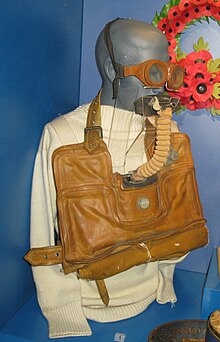
The Davis Submerged Escape Apparatus or short DSEA is one of the first oxygen rebreathers . This unit was invented in 1910 by Robert Davis , head of Siebe Gorman and Co. Ltd. , inspired by the Fluss system previously created by the company [1] [2] . Despite the fact that this device was invented for the tasks of rescuing submariners from sunken submarines, it was sometimes used for ordinary diving .
The Davis rescue vehicle is a rubber bag for breathing and providing positive buoyancy . This bag consists of a barium hydroxide canister to absorb exhaled carbon dioxide and, in a pocket at the very bottom of the bag, a high-pressure cylinder containing approximately 56 liters of oxygen under a pressure of 120 bar . The cylinder is equipped with a control valve and is connected to the breathing bag. When opening the valve, oxygen enters the bag and provides the necessary pressure to the surrounding water.
The canister with carbon dioxide absorbent in the breathing bag is connected to the mouthpiece of a flexible corrugated tube. In this case, breathing is carried out only by mouth. Scuba diving goggles were also usually included in the standard set of apparatus.
The breathing bag is also equipped with an air release valve so that when lifting, the pressure in the bag can be reduced. At the end of the ascent, the valve could be closed so that the breathing bag acted as a life jacket due to the air remaining in it. If all the air escaped from the bag before help arrived, it could be refilled with air through the mouthpiece.
Adopted by the British Navy in 1929, the Davis rescue vehicle saved life several times for submariners from sunken submarines, for example, HMS Poseidon in 1931, [3] HMS Thetis in 1939 [4] and HMS Perseus in 1941 [5] .
A simplified version of this unit ( English Amphibious Tank Escape Apparatus , abbr. ATEA) was used by tank crews on Duplex Drive floating tanks, for example, when performing Operation Neptune .
There have been cases during the Second World War , when the Davis apparatus was used for diving. Also, the unit was used by pilots of motorized diving canoes .
Apparatus Davis became one of the first rebreathers, released in large quantities.
See also
- Momsen's lungs
- Hood Steinke
Notes
- ↑ Davis, RH. Deep Diving and Submarine Operations. - 6th. - Tolworth, Surbiton, Surrey: Siebe Gorman & Company Ltd , 1955. - P. 693.
- ↑ Quick, D.Arrangement of the Closed Circuit Oxygen Underwater Breathing Apparatus (eng.) // Royal Australian Navy, School of Underwater Medicine. : journal. - 1970. - Vol. RANSUM —1—70 .
- ↑ Paul Kemp. The T-Class submarine - The Classic British Design. - Arms and Armor, 1990. - P. 105. - ISBN 0-85368-958-X .
- ↑ Thetis - close enough to touch . Cyberheritage . The date of circulation is December 2, 2006. Archived September 4, 2012.
- ↑ The great escape (inaccessible link) . Divernet . The date of circulation is December 2, 2006. Archived May 14, 2012.