The list contains all mammals included in the Red Book of the Republic of Karelia [1] 2007 edition . Compared with the 1995 Red Book of Karelia , the list of protected mammalian species has decreased from 26 to 23 species [2] . The common beaver , European mouse , arctic fox , badger and forest polecat are excluded ; a small mouse and porpoise are included [3] [4] . The columns of the table KK, KR and IUCN mean, respectively, the status of the indicated species in the Red Book of the Republic of Karelia, the Red Book of Russia and the IUCN Red List . If in one or another Red Book any of the described species is absent, that is, it is not assigned to any of the indicated categories, then the corresponding cell of the list is left blank. Assessment of the status of species and populations was carried out in categories combining both the categories of the Red Book of the Russian Federation and the categories of the International Union for Conservation of Nature , which are correlated as follows:
| Categories of the Red Book of Russia | IUCN Categories | Red Book Categories Republic of Karelia |
| 0 - probably disappeared | RE - probably disappeared in the region | 0 (RE) |
| 1 - endangered | CR - in critical condition (on the verge of extinction) | 1 (CR) |
| 2 - declining in number | EN - in dangerous condition (endangered) | 2 (EN) |
| 3 - rare | VU - vulnerable | 3 (VU) |
| NT - in a state close to threatened (potentially vulnerable) | 3 (NT) | |
| LC - Least Concerned | 3 (LC) | |
| 4 - undefined by status | DD - not well understood | 4 (DD) |
| 5 - restored and recovering | (missing) | five |
In the list below, the arrangement of taxa corresponds to that in the Red Book of the Republic of Karelia.
| No. | Latin name | Russian name and description | Picture | KRC | KKK | KKR | IUCN |
|---|---|---|---|---|---|---|---|
Linnaeus , 1758 [3] | An ordinary hedgehog is a species of hedgehog squad of insectivores . General distribution - the central and northern regions of Eurasia . At the beginning of the 20th century, it was very rare at the southernmost borders of Karelia. In the 40s and subsequent years, the distribution of the hedgehog expanded significantly due to the importation of man. The modern northern border of the range can be drawn from the village. Vyartsilya along the western and southern shores of Lake. Yanis-järvi, further to the coast of Lake Ladoga and along it, to the Leningrad Region. Isolated cases of encounters and capture of hedgehogs were recorded in the vicinity of Petrozavodsk, Olonets, Kondopoga, which is also explained by the importation of animals. Hedgehog is rare everywhere in Karelia [5] . |  | |||||
Zimmermann , 1780 [3] | A tiny shrew is a species of shrew insectivore . The smallest of mammals in Russia [6] [7] [8] , the length with a tail is not more than 8 centimeters. General distribution - the central and northern regions of Eurasia . | ||||||
Turov , 1924 [3] | An equal toothed shrew is a type of insectivorous shrew . | ||||||
( Boie , 1825) [3] | Pond nightlight - a type of leather bats squad. |  | |||||
( Kuhl , 1817) [3] | A whiskered nightlight is a type of leather bats squad. |  | |||||
( Kuhl , 1817) [3] | Watery nightlight is a type of leather bats squad. |  | |||||
Linnaeus , 1758 [3] | Brown Ushanka is a type of leather bats squad. |  | |||||
( Linnaeus , 1758) [3] | The common flying squirrel is a species of squirrel rodent squad. Body length - up to 20 centimeters, which is 1.5 times less than ordinary protein. Body weight reaches 160 grams. It occurs in Eurasia from the Scandinavian Peninsula to the Pacific coast of northern China [9] . Flying squirrel is found throughout Karelia, sometimes common, but not numerous [5] . |  | |||||
( Pallas , 1771) [3] | Baby mouse is a species of mouse rodent order. | 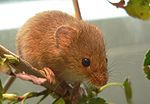 | |||||
( Melchior , 1834) [3] | The yellow-throated mouse is a species of mouse rodent order. |  | |||||
( Pallas , 1771) [3] | Field mouse is a species of rodent mouse detachment. |  | |||||
( Linnaeus , 1758) [3] | The black rat is a species of mouse rodent order. | 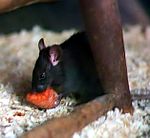 | |||||
( Lilljeborg , 1844) [3] | Forest lemming is a species of hamster rodent detachment. A small rodent similar to forest voles with a total length of up to 13 centimeters, of which only 2 centimeters per tail. It lives in the taiga zone of Eurasia and in the forest zone from Norway to eastern Siberia and south to the northern regions of Mongolia [10] . |  | |||||
( Linnaeus , 1766) [3] | Garden sleepyhead - a type of sleepy squad of rodents . |  | |||||
Pallas , 1758 [3] | A hare-hare is a type of hare detachment of rabbit - like . In Karelia, as far back as the 40s - at the beginning of the 50s of the last century, it was found in the south - in Ladoga and even in Zaonezhie. Traces of a Rusak are now observed almost every year in all the southern regions - Lahdenpohsky, the territory belonging to the city of Sortavala, in the Pitkäranta, Olonets and Pudozh regions [5] . |  | |||||
( Linnaeus , 1761) [3] | European mink is a species of predatory order of marten . |  | |||||
( Linnaeus , 1758) [3] | Wolverine is a species of predatory squid . One of the largest modern representatives of marten. The length with the tail is 90-110 cm, weight - up to 30 kg [11] [12] . Distributed in the taiga , forest-tundra and partly in the tundra of Eurasia and North America [11] [13] . In the north-west of Russia, wolverine is found on the Kola Peninsula and in Karelia. Back in the late 60s, the southern border of the species range passed through the northern regions of the Leningrad Region. However, already in the late 70s, only a few meetings of Wolverines were noted on the north and north-east coast of Lake Ladoga, and after another 10 years, traces of Wolverines in the north of the Leningrad Region and in the south of Karelia were recorded only in 1984 and 1988. Thus, over the past 30 years, the species receded by 50-70, and in some places by 100 km. The number of wolverines is decreasing from north to south. In the northern regions of Karelia, the relative number is 0.07 tracks per 10 km; in the middle zone - 0.04, in the south - 0.01 tracks per 10 km. The total number of species on the Kola Peninsula and in Karelia is 220-250 animals. Wolverine is a eurytopic species; its traces are fairly evenly found in all lands. There is a confinement of its distribution depending on the abundance of certain feeds by season. In winter, this animal is kept in biotopes, where the numbers of reindeer and elk are higher [5] . |  | |||||
( Linnaeus , 1758) [3] | An otter is a species of a predatory squad. A medium-sized animal with a flexible moving body (with a tail) 80-125 cm long and weighing up to 10-12 kg [14] . It lives along the shores of lakes and rivers throughout Eurasia and in northwestern Africa , with the exception of waterless regions and the tundra belt [15] . |  | |||||
Linnaeus , 1766 [3] | Weasel is a species of predatory squad. The smallest representative of the detachment [16] [17] . The length of adult animals with a tail is about 13-35 cm, weight - 30-250 grams [17] . The general range is quite extensive, the weasel is found in Eurasia , North America and northwest Africa from semi-desert to tundra regions [18] . |  | |||||
(subspecies ladogensis ) ( Schreber , 1775) [3] | Ladoga seal - a species of predatory order of marten . In Europe, in freshwater reservoirs it lives only in Ladoga and Saimaa (Finland) lakes. It is kept in coastal waters of the mainland and islands of Lake Ladoga in small groups of 7-15 animals each. Lives relatively settled. Relatively large concentrations of animals are observed in late April - early May on the coastal ices of the northern and northeastern parts of the lake. After the ice melts, the seals move closer to the shores of the lake, islands, luds, where they can often be seen resting on coastal stones. The total number does not exceed 3 thousand [5] . |  | |||||
( Linnaeus , 1758) [3] | European roe deer is a species of artiodactyl deer . Small graceful deer, up to 1.3-1.5 meters long, at the withers up to 75-80 cm high and weighing up to 30 kg [19] [20] . It is distributed almost everywhere in Europe and in parts of the territory of Asia Minor [21]. The northern border of the roe deer’s habitat runs much south of the territory of our republic - along the southern shores of the Gulf of Finland and Lake Ladoga. However, the appearance of these animals has been noted more than once in Karelia - in Lahdenpohsky, Sortavalsky, Suoyarvsky, Pitkyarantsky, Olonetsky, Pryazhinsky, Prionezhsky, Pudozhsky, Medvezhyegorsky and even Muezersky districts [5] . | 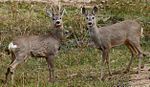 | |||||
(subspecies fennicus ) ( Linnaeus , 1758) [3] | Reindeer (forest subspecies) [22] is the forest form of the subspecies of the reindeer, a species of deer cloven - hoofed . Body length - 1.8-2.2 meters, height at the withers - 1-1.4 meters, weight - 100-300 kg [23] [24] . The common distribution is the Arctic tundra of Eurasia . In the past, it lived throughout Karelia, with the development of domestic reindeer husbandry in northern Karelia and the active extermination of wild animals by reindeer herders, it began to be found here sporadically in small scattered herds. In the south, the main reason for the reduction in the number and distribution of the deer was its pursuit by humans. As a result, already in the early 1930s and for the next 20 years, the area of the species' permanent habitat lay in a space limited by conditional lines: from the north - Kem-Kalevala, and from the south - Gimola - the northern shore of the lake. Segozero - the southern shore of the lake. Vodlozero. The number of "savage" in those years did not exceed a thousand animals. Subsequently, as a result of the ban on hunting and protection, the number of deer increased significantly. To a large extent, this was also facilitated by the replenishment of the population of wild deer with domesticated animals that fled from state farm herds. The latter became a mass phenomenon in the early 60s after the liquidation of the farm "Reindeer Herding". The population reached its maximum number in the late 70s, when there were 6,500 deer in Karelia. The area of distribution of animals has expanded. However, already in the late 80s, as a result of uncontrolled hunting, the number of deer began to decline catastrophically. At the beginning of the new millennium, it does not exceed 2500 individuals [5] . |  | |||||
( Linnaeus , 1758) [3] | Porpoise is a species of porpoise of the cetacean order. Length - up to 160 cm, weight - up to 60 kg (males, on average, are 15 cm smaller and weigh 10 kg less than females) [25] . |  | |||||
Linnaeus , 1758 [4] | An ordinary beaver is a species of beaver detachment of rodents . | 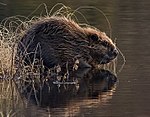 | |||||
( Linnaeus , 1758) [4] | The European mouse is a species of mouse rodent order. |  | |||||
( Linnaeus , 1758) [4] | Arctic fox is a species of canine predatory order. |  | |||||
( Linnaeus , 1758) [4] | Badger is a species of predatory squad. |  | |||||
Linnaeus , 1758 [4] | Forest ferret is a species of predatory order of marten . |  | |||||
Notes
- ↑ Order of November 29, 2007 No. 335 “On approval of the List of plant and animal life objects listed in the Red Book of the Republic of Karelia” . Ministry of Agriculture, Fisheries and Ecology of the Republic of Karelia. Archived on September 4, 2012.
- ↑ Danilov, 2009 .
- ↑ 1 2 3 4 5 6 7 8 9 10 11 12 13 14 15 16 17 18 19 20 21 22 23 24 Red Book of the Republic of Karelia, 2007 .
- ↑ 1 2 3 4 5 6 Red Book of Karelia, 1995 .
- ↑ 1 2 3 4 5 6 7 Ivanter, 2001 .
- ↑ Tiny shrew - Sorex minutissimus . Ecological center "Ecosystem". Date of treatment August 15, 2010. Archived on May 4, 2012.
- ↑ Tiny shrew (Sorex minutissimus) . "Zooclub" is a mega-encyclopedia about animals. Date of treatment August 15, 2010. Archived on May 4, 2012.
- ↑ Species: Sorex minutissimus = Tiny shrew, Chersky shrew . "Animal world". Archived on May 4, 2012.
- ↑ Pteromys volans: Information . Animal Diversity Web. Date of treatment August 5, 2010. Archived on May 4, 2012.
- ↑ Myopus schisticolor: Information . Animal Diversity Web. Date of treatment August 5, 2010. Archived on May 4, 2012.
- ↑ 1 2 Gulo gulo Linnaeus, 1758 - Wolverine . Institute of Ecology and Evolution A. N. Severtsova RAS. Date of treatment August 15, 2010. Archived on May 4, 2012.
- ↑ Gulo gulo: Information . Animal Diversity Web. Date of treatment August 15, 2010. Archived on May 4, 2012.
- ↑ Gulo gulo (English) . The IUCN Red List of Threatened Species. Date of treatment August 15, 2010. Archived on May 4, 2012.
- ↑ Lutra lutra Linnaeus, 1758 - River otter . Institute of Ecology and Evolution A. N. Severtsova RAS. Date of treatment August 15, 2010. Archived on May 4, 2012.
- ↑ Otter - Lutra lutra . Ecological center "Ecosystem". Date of treatment August 15, 2010. Archived on May 4, 2012.
- ↑ The Smithsonian Book of North American Mammals. - Washington and London: Smithsonian Institution Press, 1999. - P. 173–174. - ISBN 1-56098-845-2 .
- ↑ 1 2 Mustela nivalis Linnaeus, 1766 - Weasel . Institute of Ecology and Evolution A. N. Severtsova RAS. Date of treatment August 15, 2010. Archived on May 4, 2012.
- ↑ Mustela nivalis . The IUCN Red List of Threatened Species. Date of treatment August 15, 2010. Archived on May 4, 2012.
- ↑ EUROPEAN ROE ROLL: BIOLOGY AND ECOLOGY . Ecological center "Ecosystem". Date of treatment August 16, 2010. Archived on May 4, 2012.
- ↑ Capreolus capreolus: Information . Animal Diversity Web. Date of treatment August 16, 2010. Archived on May 4, 2012.
- ↑ Capreolus capreolus (English) . The IUCN Red List of Threatened Species. Date of treatment August 16, 2010. Archived on May 4, 2012.
- ↑ Only wild deer are protected
- ↑ Reindeer - Rangifer tarandus . Ecological center "Ecosystem". Date of treatment August 16, 2010. Archived on May 4, 2012.
- ↑ Reindeer - Rangifer larandus Linnaeus . Encyclopedia of mammals of the former USSR. Date of treatment August 16, 2010. Archived on May 4, 2012.
- ↑ Phocoena phocoena (English) . Convention on Migratory Species. Date of treatment August 11, 2010. Archived on May 4, 2012.
- The listed species in the Red Book of Russia
- ↑ Ringed seal, Ladoga subspecies . in the Red Book of Russia . Archived on September 4, 2012. (Retrieved January 18, 2012)
- ↑ Porpoise, North Atlantic subspecies . in the Red Book of Russia . Archived on May 4, 2012. (Retrieved January 18, 2012)
- Listed species in the IUCN Red List
- ↑ Erinaceus europaeus Linnaeus, 1758 . The IUCN Red List of Threatened Species . (Retrieved January 18, 2012)
- ↑ Sorex minutissimus Zimmermann, 1780 . The IUCN Red List of Threatened Species . (Retrieved January 18, 2012)
- ↑ Sorex isodon Turov, 1924 . The IUCN Red List of Threatened Species . (Retrieved January 18, 2012)
- ↑ Myotis dasycneme (Boie, 1825 ) . The IUCN Red List of Threatened Species . (Retrieved January 18, 2012)
- ↑ Myotis mystacinus (Kuhl, 1817 ) . The IUCN Red List of Threatened Species . (Retrieved January 18, 2012)
- ↑ Myotis daubentonii (Kuhl, 1817 ) . The IUCN Red List of Threatened Species . (Retrieved January 18, 2012)
- ↑ Plecotus auritus Linnaeus, 1758 . The IUCN Red List of Threatened Species . (Retrieved January 18, 2012)
- ↑ Pteromys volans (Linnaeus, 1758 ) . The IUCN Red List of Threatened Species . (Retrieved January 18, 2012)
- ↑ Micromys minutus (Pallas, 1771 ) . The IUCN Red List of Threatened Species . (Retrieved January 18, 2012)
- ↑ Apodemus flavicollis (Melchior, 1834 ) . The IUCN Red List of Threatened Species . (Retrieved January 18, 2012)
- ↑ Apodemus agrarius (Pallas, 1771 ) . The IUCN Red List of Threatened Species . (Retrieved January 18, 2012)
- ↑ Rattus rattus (Linnaeus, 1758 ) . The IUCN Red List of Threatened Species . (Retrieved January 18, 2012)
- ↑ Myopus schisticolor (Lilljeborg, 1844 ) . The IUCN Red List of Threatened Species . (Retrieved January 18, 2012)
- ↑ Eliomys quercinus (Linnaeus, 1766 ) . The IUCN Red List of Threatened Species . (Retrieved January 18, 2012)
- ↑ Lepus europaeus Pallas, 1778 . The IUCN Red List of Threatened Species . (Retrieved January 18, 2012)
- ↑ Mustela lutreola (Linnaeus, 1761 ) . The IUCN Red List of Threatened Species . (Retrieved January 18, 2012)
- ↑ Gulo gulo (Linnaeus, 1758 ) . The IUCN Red List of Threatened Species . (Retrieved January 18, 2012)
- ↑ Lutra lutra (Linnaeus, 1758 ) . The IUCN Red List of Threatened Species . (Retrieved January 18, 2012)
- ↑ Mustela nivalis Linnaeus, 1766 . The IUCN Red List of Threatened Species . (Retrieved January 18, 2012)
- ↑ Pusa hispida (Schreber, 1775 ) . The IUCN Red List of Threatened Species . (Retrieved January 18, 2012)
- ↑ Capreolus capreolus (Linnaeus, 1758 ) . The IUCN Red List of Threatened Species . (Retrieved January 18, 2012)
- ↑ Rangifer tarandus (Linnaeus, 1758 ) . The IUCN Red List of Threatened Species . (Retrieved January 18, 2012)
- ↑ Phocoena phocoena (Linnaeus, 1758 ) . The IUCN Red List of Threatened Species . (Retrieved January 18, 2012)
- ↑ Castor fiber Linnaeus, 1758 . The IUCN Red List of Threatened Species . (Retrieved January 18, 2012)
- ↑ Apodemus sylvaticus (Linnaeus, 1758 ) . The IUCN Red List of Threatened Species . (Retrieved January 18, 2012)
- ↑ Alopex lagopus (Linnaeus, 1758 ) . The IUCN Red List of Threatened Species . (Retrieved January 18, 2012)
- ↑ Meles meles (Linnaeus, 1758 ) . The IUCN Red List of Threatened Species . (Retrieved January 18, 2012)
- ↑ Mustela putorius Linnaeus, 1758 . The IUCN Red List of Threatened Species . (Retrieved January 18, 2012)
Literature
- Danilov P.I., Belkin V.V. Materials of the audit of the status of mammalian species included in the Red Book of the Republic of Karelia // Transactions of the Karelian Scientific Center of the Russian Academy of Sciences: journal. - 2009. - No. 1 . - S. 62-68 . - ISSN 1997-3217 .
- Ivanter E.V. Mammals. - 3rd ed., Rev. and add. - Petrozavodsk: Publishing House of PetrSU, 2001. - 208 p. - (Animal world). - 3000 copies. - ISBN 5-8021-0128-8 .
- The Red Book of Karelia / Ed. E.V. Ivantera, O.L. Kuznetsova. - Petrozavodsk: Karelia, 1995 .-- 286 p. - ISBN 5-7545-0688-0 .
- Red Book of the Republic of Karelia / Ed. E.V. Ivantera, O.L. Kuznetsova. - Petrozavodsk: Karelia, 2007 .-- 368 p. - 2500 copies. - ISBN 978-5-7545-1545-1 .