Greifswald Bay ( German: Greifswalder Bodden ) - a bay in the south of the Baltic Sea off the coast of Mecklenburg-Vorpommern , Germany . The bay has an area of 514 km² and is the largest on the German coast of the Baltic Sea [1] .
| Greifswald Bay | |
|---|---|
| him. Greifswalder bodden | |
 | |
| Characteristics | |
| Bay Type | The bay |
| Area | 514 km² |
| Deepest | 13.5 m |
| Average depth | 5,6 m |
| Flowing river | Rick |
| Location | |
| Upstream water area | Baltic Sea |
| A country |
|
| Earth | Mecklenburg-Vorpommern |

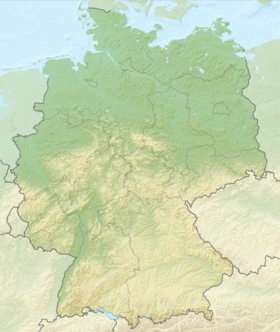


The bay is limited to the island of Rugen from the northwest, the mainland from the west and south, the island of Usedom from the southeast and the islands of Ruden and Greifswalder Oye from the east. The bay is also connected to the Baltic Sea by the narrow Strelazund Strait, which separates the island of Rügen from the mainland. The northern part of the bay is sometimes called the Rügischer Bay ( German: Rügischer Bodden ).
The bay itself has a very rugged coastline, forming small bays inside Greifswald. Cape Mönchgut (in the east of Rügen) and Tsudar (in the south of Rügen) - the first actually consists of several peninsulas - divide the bay into several smaller ones. In the eastern part of the bay are the islands of , , and the former island of , now a sandbank. The main port of the bay is Greifswald .
Greifswald Bay is rather shallow, with an average depth of 5.6 m and a maximum depth of 13.5 m [1] . Its water is rather brackish rather than salty due to the influx of fresh water from the rivers (salty water is found only at great depths). The average salinity is 7-8 PSU [2] , 5.3-12.2 ‰ [1] .
Before the unification of Germany in 1990, unlike most of the coast of East Germany, Greifswald Bay was a place for water sports. The local landscape made it possible to view the bay well, which prevented attempts to leave the country. The closest place to the bay outside the Warsaw Pact was, at a distance of more than 100 km, the Danish island of Bornholm .
Notes
- ↑ 1 2 3 Ulrich Schiewer. Ecology of Baltic coastal waters. - Springer, 2008. - P. 87. - ISBN 3-540-73523-2 .
- ↑ Reinhard Lampe in Hans Heinrich Blotevogel, Jürgen Ossenbrügge, Deutsche Gesellschaft für Geographie. lokal verankert, weltweit vernetzt ": [52. Deutscher Geographentag, Hamburg, 2.-9. Oktober 1999]: Tagungsbericht und wissenschaftliche Abhandlungen. - Franz Steiner Verlag, 2000. - P. 123. - ISBN 351507631.
Literature
- R. Lampe. Symposium in Greifswald: The Bodden Waters of the GDR - Natural Conditions and Problems of their Usage. - Geojournal 20.4. - 1990. - P. 428.