NRU "Moscow State Construction University" (National Research University) - until 1993, Moscow Engineering and Construction Institute. V.V. Kuybysheva ( IISS named after V.V. Kuybyshev ) is one of the leading technical universities and the main engineering and construction university in Russia , one of the industry universities under the program "Strategic Partnership of Architectural and Construction Educational Institutions of the Russian Federation" [2] .
| NRU "Moscow State University of Civil Engineering" ( NRU "MGSU" ) | |
|---|---|
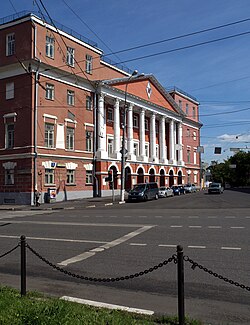 | |
| International name | Moscow State University of Civil Engineering, MSUCE or MGSU |
| Former names | MISI them. V.V. Kuybysheva |
| Motto | Learn to build the future |
| Year of foundation | 1921 |
| Reorganized | 1993 |
| Type of | state |
| Rector | Volkov Andrey Anatolevich |
| The president | Telichenko Valery Ivanovich |
| Students | about 25,000 [1] |
| The doctors | 151 |
| Teachers | 928 [1] |
| Location |  Russia , Russia ,  Moscow Moscow |
| Legal address | Yaroslavl highway, 26 |
| Site | mgsu.ru |
| Awards |  |
History
The first specialized architectural and construction school in Russia was created in 1749 by Prince D.V. Ukhtomsky . Such masters as Matvey Kazakov , Ivan Starov , Alexander Kokorinov studied at Ukhtomsky’s school.
In 1804, the Kremlin School was created, which later became the Moscow Palace Architectural School , out of the walls of which architects-practitioners who received the title of Architectural Assistant and the rank of XIV class (college registrar) graduated.
To a large extent, the establishment of higher education in Moscow was facilitated by the experience gained at the First Moscow construction courses , founded by engineer Mikhail Kapitonovich Priorov in 1897 .
In 1902, the architect I. A. Fomin organized the First Women’s Construction Courses , and in 1905, the architect and archaeologist Nikolai Vladimirovich Markovnikov (1869-1942) founded the First Women’s Technical and Construction Courses .
In 1909, the courses of Fomin and Markovnikov were combined and in 1916 they were transformed into the Women's Polytechnic Institute with an architectural and construction department, the founder of which was also N.V. Markovnikov. Graduates of the institute received the title of engineer-architect and civil engineer.
In 1907, the Secondary Construction School partnership was founded in Moscow, founded by a group of 14 people. The members of the partnership were engineers, architects, teachers: V. N. Obraztsov , E. R. Brilling, I. V. Rylsky , N. A. Alekseev, N. V. Markovnikov and others. The organizer of the partnership and the permanent director of the Secondary Construction School until 1918 was Vladimir Nikolayevich Obraztsov (1874-1949), who played an important role in the process of formation of the university. V.N. Obraztsov - academician of the Academy of Sciences of the USSR since 1939, twice (1942, 1943) laureate of USSR State Prizes.
In 1907-1916 there were four departments in the school: architectural and construction, hydraulic engineering, cultural and technical, and road construction.
In 1914, 442 people studied at the school (for comparison, in 1908 - 18 people), 33 teachers worked.
In 1917, the school was transformed into the Secondary Polytechnic , with the rights of state educational institutions.
In 1919, the Secondary Polytechnic School was transformed into the First Moscow Construction College , which in 1920 was equal in all rights to technical colleges.
In 1918, the Faculty of Civil Engineering was created at the Moscow Higher Technical School (MVTU) .
The main stages in the formation of the head university of construction education and science in Russia are at the end of the Civil War in Russia .
In 1921, among the 28 new universities of the country, the People 's Commissariat of the RSFSR founded the Moscow Practical Construction Institute , the first director of which was Zakhar Nesterovich Shishkin (1878-1948). This year is considered to be the year of foundation of MISI-MGSU .
At the same time , the 2nd Moscow Practical Institute of Urban and Rural Improvement named after A.I. Herzen .
In 1922, both universities were merged into the Moscow Practical Construction Institute .
In 1923, the Moscow Practical Construction Institute was merged with the Moscow Institute of Civil Engineers .
In August 1924, the institute became part of the MVTU Faculty of Civil Engineering, which in 1930 was again reorganized into the Higher Civil Engineering School (VISU).
On December 25, 1932, it decided to transform from April 1933 the educational and construction plant and VISU into a single Moscow Engineering and Construction Institute (IISI) with a work faculty under it. The university carried this name until 1993, that is, exactly 60 years.
By 1933, more than 5 thousand students were studying at the institute, and the teaching staff consisted of about 600 people.
In the 1930s, outstanding teachers and scientists with world renown work at MISI: N. N. Abramov , V. Z. Vlasov, A. V. Volzhensky, A. N. Genius, M. M. Grishin, F. F. Gubin, N. N. Dzhunkovsky, A. I. Dobryakov, N. G. Dombrovsky , P. N. Kamenev, P. L. Pasternak, I. M. Rabinovich, K. V. Sakhnovsky, L. A. Serk , I. E. Skryabin, E. F. Stramentov, N. S. Streletsky , N. A. Tsytovich , M. M. Shchegolev and others.
In 1935, IISS was named after the revolutionary, one of the Soviet leaders, the head of the USSR State Planning Commission Valerian Vladimirovich Kuibyshev .
In 1951 - 1958, at MISI, design, drawing and painting were taught by the outstanding Soviet architect K. S. Melnikov , who received the title of professor at the end of 1952 [3] .
In 1965, advanced training courses were opened at IISS, at which 460 people were retrained in the first year of their existence.
In 1966, the courses were reorganized into the Faculty of Continuing Education (FPKS) of leading workers of construction organizations. Every year, the number of students reached 900 people.
In 1978, by decision of the USSR Ministry of Higher Education, together with construction departments and the Moscow Soviet, the faculty of advanced training of IISS received a new status - it was transformed into the Central Interdepartmental Institute for Advanced Studies of Builders (TsMIPKS) at IISS. In 1980, TsMIPKS created 5 branches: in Alma-Ata , Yerevan , Kiev , Volgograd and Irkutsk .
TsMIPKS actively collaborated in the field of methods of retraining and advanced training of builders with nine foreign related educational institutions, successfully exchanging work experience with them. For the period from 1968 to 1982, about 81 thousand specialists improved their qualifications at TsMIPKS.
In 1988, on the basis of IISS, an educational and methodological association (UMO) for engineering and construction specialties was created. It included 28 construction universities and about 100 industrial, polytechnic, technological universities of the former USSR, in which there were engineering and construction departments.
Along with the educational and methodological association in 1991, the Association of Building Universities (DIA) was created at IISI.
In 1993, the status of the university changed again. Decree of the Council of Ministers of the Russian Federation of 15.06 . 1993, No. 459, by order of the State Committee of the Russian Federation on Higher Education dated June 21, 1993, No. 41, Moscow Engineering and Construction Institute V.V. Kuybysheva was renamed the Moscow State University of Civil Engineering .
According to the results of the federal competition and in accordance with the Decree of the Government of the Russian Federation dated May 20, 2010 No. 812-r, MGSU was among the 15 winners of the competitive selection of university development programs for which the category “ national research university ” is established.
August 9, 2013 MGAKHiS (Moscow State Academy of Public Utilities and Construction) was disbanded and became part of the Moscow State University of Civil Engineering.
University today
University departments are located in buildings with a total area of 269.5 thousand m² on an area of 117.9 hectares. In September 2008, classes began in the new educational laboratory complex with an area of more than 11.5 thousand m².
MGSU has introduced a certified education quality system in accordance with the requirements of international standards ISO 9001: 2000 and IWA2: 2007, a rating system for additional incentives for faculty.
The professional competence of the scientific and pedagogical staff of MGSU in the field of practical construction is confirmed by the certificate of conformity of the quality management system of MGSU with respect to engineering surveys in the field of construction and design of buildings and structures of I and II levels of responsibility with the requirements of the international standard ISO 9001: 2000.
The current structure of MGSU has 7 institutes, 62 departments (43 graduating), 30 scientific laboratories, 10 specialized and expert centers, 2 research institutes.
MGSU prepares engineers of all forms of training in 21 specialties, bachelors and masters in 7 areas, candidates and doctors of sciences in 40 specialties.
Junior Corps (KMK)
Administrative building ("candle")
Stream Audience Building (KPA) - Chamomile
Educational and laboratory unit (ULB) - buildings "A", "B", "C", "G"
Educational Laboratory Building (ULK)
Sports and fitness complex (SOK)
Institutions
- Institute of Construction and Architecture (ISA MGSU)
- Institute of Economics, Management and Information Systems in Construction (IEUIS MGSU)
- Institute of Hydrotechnical and Power Engineering (IGES MGSU)
- Institute of Environmental Engineering and Mechanization (IIESM MGSU)
- Institute of Fundamental Education (IFO MGSU)
- Mytishchi branch of MGSU
International Relations
The main areas of international activity of the university are:
- cooperation with foreign scientific and educational centers, universities, manufacturing firms and international foundations in the field of engineering, technology, economics, pedagogy and culture;
- training of specialists for foreign countries.
Currently, the university cooperates with foreign educational centers in Europe, Asia and America. The university participates in the implementation of 83 cooperation agreements with partners from 31 countries. In particular, the university’s partners are more than 60 universities from 29 countries and more than 20 research centers and organizations from 8 foreign countries. The University is part of the Association of International Departments of Technical Universities of Eastern and Central Europe (AMO) and the Consortium of Moscow Universities in Mongolia, takes part in the implementation of international programs of the European Association of Building Faculties (AECEF), the European Foundation for Professional Education (TEMPUS - TACIS, SOCRATES - ERASMUS ), The International Institute of Civil Engineers of Great Britain, the International Corporation of Foreign Alumni of Soviet and Russian Educational Institutions ( INCORVUZ ), is actively involved in the implementation of implementation of the international program of the Federal Agency for Education “Russian Universities in the XXI Century”.
From 1946 to the present, in order to meet the needs of scientific organizations, educational institutions, industrial and commercial enterprises of foreign countries in highly qualified personnel, the university has been training foreign specialists. During the existence of the university, more than 3,000 foreign engineers, candidates and doctors of sciences for 101 countries of the world have been trained, more than 1,500 foreign specialists have undergone a scientific internship here. The learning process is based on deep integration with international best practices in scientific research in the field of engineering, technology, economics, pedagogy and culture.
The University is actively cooperating with international organizations, including the European Association of Building Universities and Faculties - AECEF, the European Association of Technical Universities - SEFI, the European Program USEET, the American Society of Builders - ASCE, and the International Society for Computer Technologies in Construction ISCCBE.
MGSU has international accreditation of the joint expert commission of the Institute of Civil Engineers (ICE) and the Institute of Design Engineers (IStRuctE) with registration in the UK Engineering Council (EC) in the field of: 270102 Industrial and Civil Engineering, 270114 Building Design, 270104 Hydrotechnical construction ”, 270112“ Water supply and sanitation ”- corresponding to the international level of master training in the specialty (MEng).
Research Activities
An important role is assigned to MGSU research and development activities. Scientific work is carried out in priority areas of the country's building complex, including problems of architecture and urban planning, building structures, the soil environment of structures, building materials science, building technologies, construction equipment, environmental safety of construction, safety of building systems and others.
MGSU is training highly qualified personnel in 24 specialties of doctoral studies and 40 specialties of graduate school, including in the field of nanotechnology on the basis of the REC “Nanotechnology” .
Thesis Advice
| Board Code | The chairman | Deputy the chairman | Scientific Secretary | Specialty |
|---|---|---|---|---|
| D 212.138.01 | Volkov A.A. | Ginzburg A.V., Sinenko S.A. | Kulikova E.N. |
|
| D 212.138.02 | Bazhenov Yu. M. | Voronin V.V. | Alimov L.A. |
|
| D 212.138.03 | Stories L. N. | Mishuev A.V., Borovkov V.S. | Bestuzheva A. S. |
|
| D 212.1Z8.04 | King E.A. | Oleynik P.P. | Kagan P. B. |
|
| D 212.138.05 | Grabovy P.G. | Lukmanova I.G., Kirillova A.N. | Mishlanova M. Yu. |
|
| D 212.138.07 | Telichenko V.I. | Volshanik V.V. | Slesarev M. Yu. |
|
| D 212.138.08 | Ter-Martirosyan Z. G. | Zertsalov M.G. | Znamensky V.V. |
|
| D 212.138.09 | Kasyanov V.F. | Korolchenko A. Ya. | Lyapin A.V. |
|
| D 212.138.10 | Alekseev E.V. | Khavanov P.A. | Gogina E.S. |
|
| D 212.138.12 | Trushin S.I. | Sidorov V.N., Mondrus V.L. | Anokhin N. N. |
|
Recognition
In accordance with the Decree of the Presidium of the Supreme Council of the Union of the USSR of August 15, 1946 , Moscow Institute of Fine Arts Kuibyshev was awarded the Order of the Red Banner of Labor for outstanding services in the field of training engineering personnel for construction and in connection with the 25th anniversary of its founding.
In 2014, the Expert RA agency included the university in the list of the best higher educational institutions of the Commonwealth of Independent States , where it was assigned a rating class “E” [4] .
Rectors (directors) of MISI-MGSU
- (1921-1934) Shishkin Zakhar Nesterovich
- (1934-1942) Zenkov Ivan Stepanovich
- (1942-1943) Korchemsky Moses Yuryevich
- (1943-1947) Lazukov Nikolay Vasilievich
- (1947-1950) Karpechenko Mikhail Semenovich
- (1950-1956) Ukhov Boris Sergeevich
- (1956-1958) Kostin Ivan Ivanovich
- (1958-1983) Strelchuk, Nikolai Antonovich
- (1983-2003) Karelin Vladimir Yakovlevich
- (2003—2013) Telichenko Valery Ivanovich
- (2013 - present) Volkov Andrey Anatolyevich
Since December 26, 2013, the rector of the university is Doctor of Technical Sciences, Professor Volkov Andrey Anatolyevich , the president of the University is Doctor of Technical Sciences, Professor Valeriy Telichenko .
Famous employees
- See Teachers of MGSU
Graduates
- See Graduates of Moscow State University of Civil Engineering
Notes
- ↑ 1 2 [1] 2014 Self-Test Report
- ↑ MGSU
- ↑ Konstantin Stepanovich Melnikov: The architecture of my life. Creative concept. Creative Practice / Comp. A. Strigalev and I. Kokkinaki. - M .: Art , 1985. - 311 p.
- ↑ Rating of higher educational institutions of Russia and countries of the members of the Commonwealth of Independent States.