It is believed that for the first time the idea of creating a parachute came to Leonardo da Vinci .
In his manuscript , 1485 mentions safe descent from a height with the help of a “tent” of starched canvas measuring 12 x 12 cubits. Given that the medieval measure of length - the elbow - was equal in different countries from 50 to 60 centimeters, then indeed, such a device provided a safe descent of a person from any height, because the diameter of modern parachutes also does not exceed 6-7 meters.
But, as it turned out later, Leonardo da Vinci was not the first to think of the idea of a parachute. Ancient records indicate that in many countries people tried to descend from towers, trees, rocks with the help of various devices similar to umbrellas. Often such jumps ended in mutilation or even death, because no one knew the laws of air resistance , and instincts often failed. Leonardo da Vinci was the first to point out the most advantageous sizes of a parachute, and balloonists remembered about it.
At the beginning of the seventeenth century, the Croatian scientist Faust Vrancic (also known under the Italian name Fausto Veranzio), described a similar apparatus, the size of the sail of which depended on the severity of the person.
For the first time, a Frenchman Laven took advantage of a similar design. It was in the 20s. XVII century. The French prisoner escaped from prison using a tent previously sewn from the sheets, to the bottom of which he attached ropes and plates of a whalebone. Jumping out of the prison window, the fugitive successfully splashed down. In 1777, another Frenchman, Jean Dumier, sentenced to death, tested the “flying cloak of Professor Fontage”. The prisoner was asked to jump from the roof with a “cloak”. In the event of a successful landing, he was granted life. The experiment, as in the previous case, was a success. So the first analogue of a parachute appeared. The practical use of parachutes began in the XVIII century, with the development of ballooning.
On December 26, 1783, Luis Lenormand jumped from the roof of the Montpellier Observatory on a device he designed.
Jean Pierre Blanchard , upset by the tragic death of Pilatra de Rosier , began to conduct experiments with a parachute. At first, he hung small parachutes below the basket and lowered various animals - dogs, cats - from the heights for fun. They were in complete health and integrity sank to the ground. So, if you make a parachute of suitable size, then a person will be able to safely descend from a height in the event of a balloon accident. But what to do with a huge parachute - a dome, slings, belts, or, as they say now, a suspension system, if the aerostat's cabin is small, cramped and there is often nowhere to turn in? (the parachute did not fit in a satchel, as is done today)
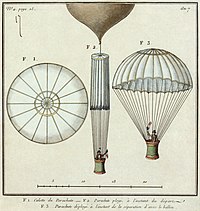
October 22 , 1797 over the Monceau Park in Paris, the first real parachute jump was made. Frenchman Andre-Jacques Garnerin jumped from a balloon at 2,230 feet.
Skydiving and now make the audience an irresistible impression, and in those days, even more so. There were a lot of roving aeronaut parachutists who, in search of money, showed parachute jumps in different countries. By the way, Andre-Jacques Garnerin was one of the first balloonists to demonstrate balloon flights in 1803 in Russia. There were many enthusiastic parachutists in Russia itself. The newspaper Moskovskiye Vedomosti for 1806 reports that the Russian balloonist Aleksandrovsky took to the air on a large ball and parachuted. The daredevil safely descended to the ground and was enthusiastically received by the audience.
In the story of Bulgarin from 1824 in the future, the widespread use of knapsack parachutes for jumping from balloons is described [1] . The parachutes of that time had a major drawback - the constant swinging of the dome with a decrease. The problem was finally resolved by the British. In 1834, Cocking created a parachute in the form of an overturned cone. Unfortunately, in the same year, when testing this system, the dome frame could not withstand the load and formed, and Kokking died. Another scientist, Laland , suggested making a hole in the traditional parachute systems for air to escape from under the dome. This principle has proven effective and has been applied in many parachute systems so far.
By the end of the century, the whole family of paratroopers - Jozef and Stanislav Drevnitsky and their sister Olga, was the most popular in Russia. Natives of Warsaw , the brothers began to get involved in parachute jumping is not accidental. In 1891, they began with hot air ballooning, but soon became convinced that flying in hot air balloons was a risky business. So, those who have a parachute on board have a better chance of salvation than those who dismiss the parachute. Jozef and Stanislav constructed a parachute, similar to those used by Garnerin, and began to test it. They climbed to a kilometer-high, and Jozef Drevnitsky jumped out of the basket. The parachute suspended from the basket was held on a thin rope, which was torn apart by a jerk. Under the weight of the paratrooper, the canopy rushed down, but immediately filled with air, and Jozef Drevnitsky smoothly descended to the ground. Nearby went down on the ball and brother Stanislav. The first jump made such a huge impression on Jozef Drevnitsky that he decided to repeat it. Following his brother, Stanislav became interested in jumping. For three years, the Drevnitsky made several dozen jumps and worked out their technique so much and improved the parachute itself that there were no serious incidents with them. Looking at the flights and the bold jumps of the brothers, their younger sister Olga also decided to do such an unusual thing for the girls of that time. In 1896, she made her first parachute jump and immediately became an ardent fan of this brave sport. But still, the elder brother, Jozef Drevnitsky, did the most for the popularity of parachuting in Russia. July 23, 1910 he made a show jump in St. Petersburg. Thousands of people came to look at the famous "jumper". On the site in the Krestovsky Garden laid out the shell of a large hot air balloon. When the balloon was inflated with hot air, thirty workers barely held it. Below, under a basket, a parachute was suspended in a half-open form. At the command of Jozef Drevnitsky, the workers released the ball, and it quickly soared to a height of 200 meters. Then Drevnitsky calmly separated from the basket, and before the crowd gasped, the parachute opened and, like a huge umbrella, carefully lowered the brave man to whom the audience gave a standing ovation. The interest in the parachute was so great that Drevnitsky had to make more than a dozen jumps in St. Petersburg, and in total he completed more than four hundred of them, remaining safe and sound. This was the best conviction that the idea of a parachute was correct and that it simply needed to be worked out. The bulkiness and inconvenience of parachutes in use were so obvious that many balloonists preferred to fly without them.
March 1, 1912 was the first parachute jump from an airplane. It was committed by the American captain Albert Berry in Montanna. Jumping from a height of 1,500 feet and flying 400 feet in free fall, Berry opened a parachute and landed successfully on the parade ground of his unit.
On June 21 , 1913, another woman made a parachute jump. Georgia Thompson made her debut jump over Los Angeles.
In the post-revolutionary years, Kotelnikov continued to work on parachutes - already for Soviet aviation. The first rescue parachute in the USSR was used by test pilot M.M. Gromov on June 23, 1927 at the Khodynsky airfield. He deliberately brought the car into a tailspin , from which he could not get out, and at an altitude of 600 m he left the plane with a rescue parachute. In the future, Kotelnikov significantly improved the design of the parachute, created new models (including a number of cargo parachutes), which were adopted by the Soviet Air Force. In December 1941, Kotelnikov was evacuated to Moscow. In 1973, an alley on the territory of the former Commandant airfield was named after Kotelnikov. Since 1949, the village of Saluzi near Gatchina, where the inventor tested the parachute he created in the camp of the Officer Aeronautical School in 1912, was named Kotelnikovo (in 1972 , a commemorative sign was opened at the entrance to it). An American company’s parachute made of pure silk was used (by the way, all pilots who escaped with the help of this company’s parachutes were awarded a distinctive sign - a small golden silkworm figure). In the same year, these parachutes saved the lives of two more test pilots: V. Pisarenko and B. Buchholz. A little later, a special service appeared in Soviet aviation to ensure the rescue of pilots in flight, organized by L. G. Minov . July 26, 1930 a group of military pilots under the leadership of Minov for the first time performed jumping from a multi-seat aircraft. Since then, this day is considered the beginning of the mass development of parachuting in the USSR .

In the years preceding the Great Patriotic War, a lot of work was done in the USSR on military training of the population of draft age for the planned mass airborne operations. In this regard, parachute jumping became an indispensable attraction in the so-called pre-war "Culture and Recreation Parks", where parachute towers were installed.
In 1951, the first World Parachuting Championship was held. In 1982, the international parachute commission was already about 60 countries. Today, parachuting competitions are held in the categories: landing accuracy; individual acrobatics (with the implementation of a complex of acrobatic figures); group acrobatics; dome acrobatics.
Creation History
In 1483, Leonardo da Vinci drew a sketch of a pyramidal parachute . He wrote:
| If a person has a tent made of a starched cloth 12 cubits wide and 12 inches high, then he will be able to throw himself from any height, without danger to himself. |
The surface proposed by Leonardo da Vinci device for lowering a person is approximately 60 square meters. m. These data are close to a modern parachute for people. The lack of practical need for the use of a parachute served as an obstacle to the invention and improvement of such shells, and only the development of aeronautics and frequent disasters prompted the inventors to work closely on creating an apparatus for safely launching a person from a great height.
Faust Vrancic from Croatia is considered the inventor of the parachute. In 1597, he jumped from a bell tower 87 meters high onto the market square in Bratislava .
But in fact, he introduced a parachute - as the word itself invented - the French physicist Louis Sebastian Lenormand , who on December 26, 1783 jumped from the Montpellier tower on the parachute he invented, which was the development of an umbrella: a wooden frame covered with linen rubberized fabric.
On October 3, 1785, Jean Pierre Blanchard lowered the cat from the balcony and on August 23, 1786, a sheep by parachute. He suggested using silk fabric for parachutes and put forward the idea of using parachutes for jumping from a balloon and implemented it in 1793, when his balloon crashed.
The first person to voluntarily jump from a balloon was the French aeronaut Andre-Jacques Garnerin , which happened on October 22, 1797 . His jump from a height of 400 meters above the Paris Monceau Park was the first parachute jump in Europe. The physicist who was present at this jump, seeing how Garnerin’s parachute was swinging, suggested making a small hole in the center of the dome so that air could escape through it. Garnerin agreed and since then there has been a pole hole on any round parachute.
At the beginning of the 20th century, the German invented a folding parachute. She went down in history as one of the first female paratroopers.
In 1911, the Russian military G.E. Kotelnikov , impressed by what he saw at the All-Russian Ballooning Festival in 1910, the death of the Russian pilot captain Matsievich , invented a fundamentally new type of parachute RK-1. Kotelnikov’s parachute was compact. Its dome is made of silk, the slings were divided into 2 groups and attached to the shoulder girths of the suspension system. The dome and slings were stacked in a wooden, and later an aluminum satchel. Later, in 1923, Kotelnikov proposed a satchel for laying a parachute, made in the form of an envelope with honeycombs for slings. In 1917, 65 descents with parachutes were registered in the Russian army, 36 for rescue and 29 for training. After the revolution, the first, forced jump from an airplane was performed on June 23, 1927, by test pilot M.M. Gromov , later a Hero of the Soviet Union.
In 1912, Kotelnikov first patented a parachute pack.
The start date for the development of mass parachuting in the USSR is July 26, 1930 . On this day in Voronezh at the airport, the first jumps of military pilots began under the leadership of L. G. Minov .
In January 1931, the Komsomol took patronage over the air fleet of our country . Skydiving has become a popular sport and a favorite pastime of youth. Female parachutists appear (Fedorova, Kuleeva). For the first time, Berezkin, Gyatrov and others jump at night. The skill of skydivers has grown.
In 1934, designer Lobanov proposed a new dome shape - square and flat, in 1935 a new sports training parachute with a variable descent rate was put into operation. Engineers Doronin brothers for the first time in the world designed an automatic machine for opening a parachute at a given height.
Notes
- ↑ Credible Fables
Links
- V. Gurny History of skydiving
- A. Sharadkin A Brief History of Skydiving in Dates
- The history of parachuting