" AMOS-5 " ( Eng. AMOS-5 ) is a commercial geostationary telecommunications satellite of the middle class, owned by the Israeli satellite operator Spacecom (Space-Communication Ltd.). The satellite was manufactured at JSC “Information Satellite Systems” named after academician M.F. Reshetnyova ” and will replenish the existing constellation of telecommunication satellites Amos at a point 17 ° c. d.
| AMOS-5 | |
|---|---|
| AMOS-5 | |
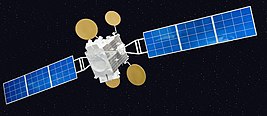 Amos-5 spacecraft model | |
| Manufacturer |  ISS OJSC ISS OJSC Thales Alenia Space ( Payload ) Thales Alenia Space ( Payload ) |
| Operator |  Spacecom Spacecom |
| Tasks | Communication satellite |
| Launch pad |  Baikonur Square No. 81. PU №24 Baikonur Square No. 81. PU №24 |
| Carrier rocket | LV Proton-M - Breeze-M |
| Launch | December 11, 2011 [1] 15: 16: 59.998 MSK |
| Flight duration | connection lost on November 21, 2015 |
| NSSDC ID | 2011-074A |
| SCN | 37950 |
| Specifications | |
| Platform | Express-1000N [2] |
| Weight | about 1800 kg [3] |
| Power | 5600 W |
| Power supplies | three-stage GaAs |
| Mover | SPD-100 |
| Active life | 15 years |
| Orbit elements | |
| Orbit type | GSO |
| Standing point | 17 ° c. d. |
| Target equipment | |
| Transponders | 14 C-bands × 72 MHz, 4 C × 36 MHz, 18 Ku × 72 MHz [4] |
The spacecraft (SC) is designed to operate on the African continent and, using a high-power C-band beam and three regional Ku-band beams, will provide DTH television broadcasting, telephone service, data trunking , VSAT- based services , video transmission, and will provide a transport network for mobile operators [4] .
Content
Satellite History and Launch
The Amos-5 spacecraft became the first international project of ISS after the manufacture of the Sesat satellite, launched in 2000 [5] . According to the contract worth $ 157 million, ISS OJSC was to develop and put the Amos-5 satellite in orbit, as well as create a ground-based control segment, conduct staff training and provide support during the operation. At the same time, the on-board repeater and antennas were to be manufactured by the French-Italian company Thales Alenia Space [6] .
According to the contract, the launch of the satellite was planned for early 2011, provided that the satellite passed all the necessary checks and was transferred to the customer in orbit until the end of March 2011 [6] . However, due to the earthquake in April 2009 in Italy with the epicenter in the city of L'Aquila , where the factory for the manufacture of components for instrumentation, control systems and payload equipment was located, the launch was postponed to June 2011 [2] . Later, the launch was again postponed to the end of 2011 due to the presence of substandard blocks during satellite tests [7] .
The satellite was launched using the Proton-M LV with the Briz-M upper stage on December 11, 2011 [8] . The launch was made from platform 81 (launcher No. 24) of the Baikonur cosmodrome together with the Luch-5A spacecraft [9] .
After passing the orbital tests, which included degassing and checking the transponder characteristics ( gain , amplitude-frequency characteristics , quality factor ) and measuring the antenna patterns [10] , the Amos-5 spacecraft functioned in orbit without comment and less than a month and a half after launch began to be used for its intended purpose [11] .
Construction
The Amos-5 spacecraft is built on the Express-1000N satellite platform , which in its specific technical and operational characteristics is more than twice the size of the Express AM33 / 44 satellite platform MSS-767 [12] . One of the features of the platform is the combined thermal control system, which uses a fully redundant liquid circuit. The platform equipment is placed on honeycomb panels (with the internal structure of a honeycomb ), which in turn are mounted on an isogrid (“waffle”) central pipe. The satellite uses solar panels based on three - stage gallium arsenide photoconverters manufactured by NPP Kvant OJSC (Moscow), Saft VS 180 lithium-ion batteries manufactured by the French company Saft and stationary plasma engines SPD-100 manufactured by OKB Fakel (g. Kaliningrad) for the implementation of correction in longitude and latitude [2] .
The satellite’s weight in orbit is about 1800 kg [3] and it has an active life of more than 15 years. The power transmitted to the payload is 5600 W [13] .
The design of the payload module from honeycomb panels with integrated heat pipes and an external fluid circuit was designed and manufactured by ISS OJSC . Telecommunication equipment was manufactured and installed at Thales Alenia Space enterprises in Toulouse ( France ) [2] .
The payload of the AMOS-5 spacecraft includes 4 beams:
- one C-band beam with 14 transponders at 72 MHz and four transponders at 36 MHz. The beam is designed to work in the African region with access to Europe and the Middle East . EIRP of trunks: 45.5 dBW, G / T (quality factor of trunks): 1.0 dB / K;
- Three Ku-band beams with 18 72 MHz transponders. Rays are also designed to work on the African continent with access to Europe and the Middle East. EIRP of trunks: 52.5-53.5 dBW, G / T: 7.0 - 8.0 dB / K [4] ;
In this way, the possibility of direct data exchange between Africa, Europe and the Middle East is achieved. In addition, two transponders of 72 MHz in each band operate in a cross-band mode, that is, they allow you to transform a signal from the frequency of one band (channel Earth - Satellite) to the frequency of the other (Satellite - Earth) [4] .
Satellite crashes
In October 2013, the power unit No. 2, which controls the satellite’s four engines, partially failed on the satellite. The breakdown led to the loss of control over two of the four orbital correction engines of the Amos-5 spacecraft. This threatened with a loss of satellite life of at least 11 months [14] [15] . After studying the problem, specialists were able to find a way to use the engines to bypass this malfunction [16] .
This accident became the third after two things that happened earlier: during the first, the power of power supply unit No. 1 fell by 50%, which forced operators to use power supply unit No. 2. Later it turned out that power supply unit No. 2 supplies energy to only four of the eight satellite engines [15] .
On November 21, 2015, communication with the satellite was lost [17] .
On December 15, 2015, the final loss of the satellite was reported [18] .
The cause of the satellite accident is a short circuit in one of the cables. [nineteen]
See also
- Satellite connection
- AMOS satellites
Notes
- ↑ Preparations for the launch of Proton-M (Inaccessible link) continue . Federal Space Agency (Roscosmos) (12/01/2011). Date of treatment December 1, 2011. Archived on September 4, 2012.
- ↑ 1 2 3 4 Spacecraft AMOS-5: a new contract in the framework of international cooperation (Journal of ISS OJSC No. 10, p. 11-13) . JSC "Information Satellite Systems" named after academician M.F. Reshetnyova "(08/11/2010). Date of treatment November 23, 2011. Archived July 1, 2012.
- ↑ 1 2 Israeli satellite AMOS-5 is being prepared for ground tests for external influences (Inaccessible link) . JSC "Information Satellite Systems" named after academician M.F. Reshetnyova "(01/13/2011). Date of treatment December 3, 2011. Archived on September 4, 2012.
- ↑ 1 2 3 4 AMOS-5 (inaccessible link) . Spacecom (07.17.2011). Date of treatment November 23, 2011. Archived on September 4, 2012.
- ↑ AMOS-5 and Luch-5A were delivered to the cosmodrome (Newspaper ISS OJSC No. 281) . JSC "Information Satellite Systems" named after academician M.F. Reshetnyova "(11/14/2010). Date of treatment November 24, 2011. Archived on September 4, 2012.
- ↑ 1 2 L. Rosenblum. Amos-5 will be manufactured in Zheleznogorsk (Inaccessible link) . JSC "Information Satellite Systems" named after academician M.F. Reshetneva ”/ Cosmonautics News Magazine No. 9, 2008 (10/06/2008). Date of treatment November 24, 2011. Archived on September 4, 2012.
- ↑ Amos 5 satellite launch delayed . Globes Publisher Itonut (1983) Ltd. (07/04/2011). Date of treatment November 24, 2011. Archived on September 4, 2012.
- ↑ Proton launch vehicle launched from Baikonur
- ↑ At the Baikonur Cosmodrome, preparations are continuing for the launch of the Luch-5A and Amos-5 spacecraft . Federal Space Agency (Roscosmos) (11/11/2011). Date of treatment November 23, 2011. Archived July 2, 2012.
- ↑ Stack.Com attracted the expertise . JSC "Information Satellite Systems" named after academician M.F. Reshetnyova "(01/31/2012). Date of treatment March 6, 2012. Archived on September 4, 2012.
- ↑ Visit of the delegation of Spacecom ISS OJSC (inaccessible link) . RosInvest.Com (02.20.2012). Date of treatment March 6, 2012. Archived July 2, 2012.
- ↑ AMOS-5 project at the finish line (Newspaper ISS OJSC No. 278) . JSC "Information Satellite Systems" named after academician M.F. Reshetnyova "(10.21.2010). Date of treatment November 24, 2011. Archived August 31, 2012.
- ↑ AMOS-5 (inaccessible link) . JSC "Information Satellite Systems" named after academician M.F. Reshetnyova. " Date of treatment November 24, 2011. Archived on September 4, 2012.
- ↑ Glitch Could Shorten Life of Amos-5 Satellite (English) (inaccessible link - history ) . Space News (October 25, 2013). The appeal date is November 1, 2013.
- ↑ 1 2 A malfunction was again detected on a Russian-made communications satellite Amos-5 . NEWSru.co.il (October 22, 2013). The appeal date is November 1, 2013.
- ↑ Spacecom fixes Amos 5 . Globes (October 31, 2013). The appeal date is November 1, 2013.
- ↑ The AMOS-5 satellite, built by Russia for Israel, is out of order . The appeal date is November 26, 2015.
- ↑ Halal Tikshoret announced the final loss of a satellite built in Russia . NEWSru.co.il . The appeal date is December 15, 2015.
- ↑ The insurer named the cause of the accident of the Israeli satellite Amos-5 .