The Zamba Ghetto (July 1941 - August 18, 1941) was a Jewish ghetto , a place of forced relocation of Jews to the city of Zembin, Borisov District, Minsk Region in the process of persecuting and exterminating Jews during the occupation of the territory of Belarus by the Nazi Germany during the Second World War .
| Zembe ghetto | |
|---|---|
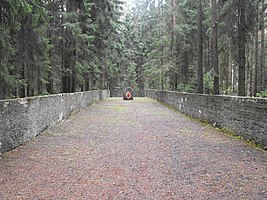 Memorial at the site of the murder of the Jews of Zembina | |
| Location | Zembin Borisov district Minsk region |
| Period of existence | July 1941 - August 18, 1941 |
| Death toll | 927 |
Occupation of Zembin
In 1926, 69.9% of the Jews in Zembina were 838 out of a total of 1,199 inhabitants [1] .
Wehrmacht troops occupied Zembin from the beginning of July 1941 until June 30, 1944 [1] [2] .
Creating a ghetto
To carry out the program of extermination of Jews in Zembin in July 1941 [3] [4] the Nazis organized a ghetto - near the Jewish cemetery, on Workers 'and Peasants' Street (now - Izi Harik Street [5] ) [1] [4] .
Ghetto destruction
The ghetto in Zembin existed for one month [4] .
In mid-August 1941, 18 Jews were ordered to dig a huge hole 46 meters long and 3 meters wide on the northern outskirts of Zembin, with steps down along the edges. In order not to arouse suspicion, the Germans said that the pit is needed for the disposal of unusable military equipment that interferes with work in the fields [6] [4] . On the morning of August 18 (July 17 [6] ) of 1941, on Monday, the policemen Gnoth and Golub ordered the ghetto prisoners to gather around the bazaar supposedly to check the documents, and when everyone arrived they were forced to kneel down [4] .

The policemen took away the 20 most physically strong men, took them into the forest to the pit and shot them to death. Then the remaining Jews were taken there and killed in groups of 15-20 people. The massacre of 927 (760 [6] ) Jews, in the majority of old men, women and children, was completed by three o'clock in the afternoon on August 18, 1941, and the pit with their bodies was filled up [1] [7] .
Shenderov, who, because of his old age, could no longer move himself, and whose relatives were forced to bring him, he died, even before the execution, in the hands of loved ones. Of all the doomed executioners, only the juvenile left their daughter and son, Hasi Khodasevich, whose father was not Jewish [1] [8] . Her daughter, Rema Asinovskaya-Khodasevich, told the translator about her Russian father, which was confirmed by Zembina police chief David Egof (a Volga German who worked as a teacher of the German language at the Zemba school). Reme and her four-year-old brother were released, and the mother and all her relatives were shot [9] [4] .
Murder Organizers and Performers
The main organizers of the mass murder Zembin Jews (which the Germans used to call euphemistically "action") were: Head of the Security Service ( SD ) of Borisov Shoneman (Sheneman) serving Gestapo Berg and Walter, the commandant of Borisov Sharer, commandant Zembin Ilek, translator Lyutsko, Mayor Zembina David Egof, head of the police department Zembina Vasily Kharitonovich, his deputy Theophil Kabakov (who would later be killed by partisans ), and police officers from the local population: Alexey Rabetsky, Konstantin Golub, Gregory Gnoth, Konstantin and Pavel Aniskevichi, Jacob Kopytok [1] [4] .
Memory
In 1967, the relatives of the dead Jews fenced the place of execution with a concrete fence at their own expense and installed a memorial plaque (in 1992, it was replaced with a metal one for greater safety from repeated acts of vandalism) [1] [6] [10] .
In August 2001, foreign relatives of Zemba Jews killed during the Holocaust collected money and erected a monument at the place of execution [11] .
Incomplete lists of the dead Jews of Zembin have been published [12] .
Sources
- Books and Articles
- G.P. Pashkoў, T.M. Dronava, G.K. Кісялёў, С.П. Samuel, i inn. (redkal.), J. V. Gilevich (kladalnіk). “Pamyat. Barysa Barysa раki raion. - Mn. : “Belarusian entsyklapedya”, 1997. - 800 p. - ISBN 985-11-0077-3 . (white)
- Adamushko V.I., Biryukova O.V., Kryuk V.P., Kudryakova G.A. Reference book on the places of the forced detention of the civilian population in the occupied territory of Belarus 1941-1944. - Mn. : National Archives of the Republic of Belarus, State Committee on Archives and Records Management of the Republic of Belarus, 2001. - 158 p. - 2000 copies - ISBN 985-6372-19-4 .
- L. Smilovitsky. Ghetto of Belarus - examples of genocide (from the book “The Catastrophe of the Jews in Belarus, 1941—1944”;
- Archive sources
- State Archive of the Russian Federation (GARF). - fund 7021, opis 87, business 4, sheet 8;
- additional literature
- L. L. Smilovitsky. The Catastrophe of the Jews in Belarus, 1941-1944 . - Tel Aviv: Matthew Black Library, 2000. - 432 p. - ISBN 965-7094-24-0 .
- A. Rosenblum. Memory on the blood. Petah Tikva 1998
- Botvinnik, Marat Borisovich. Monuments of the genocide of the Jews of Belarus. - Minsk: Belaruskaya Navuka, 2000. - 326 p., ISBN 985-08-0416-5 , ISBN 978-985-08-0416-7
- Itzhak Arad . The destruction of the Jews of the USSR during the German occupation (1941-1944). Collection of documents and materials, Jerusalem, Yad Vashem , 1991, ISBN 965-308-010-5
- Chernoglazova R.A., Heer H. The Tragedy of the Jews of Belarus in 1941-1944: a collection of materials and documents. - Ed. 2nd, rev. and additional .. - Mn. : E. S. Halperin, 1997. - 398 p. - 1000 copies - ISBN 985627902X .
- V. Rubinchik. Going to Zembin
Notes
- ↑ 1 2 3 4 5 6 7 Ghetto of Belarus - examples of genocide (from the book by L. Smilovitsky “The Catastrophe of the Jews in Belarus, 1941—1944”)
- ↑ “Pamyat. Barysa Barysa раki raion ”, 1997 , p. 782.
- ↑ Directory of places of detention, 2001 , p. 47
- ↑ 1 2 3 4 5 6 7 “Pamyat. Barysa Barysa раki raion ”, 1997 , p. 438.
- ↑ V. Rubinchik. Going to Zembin
- ↑ 1 2 3 4 M. B. Botvinnik. Monuments of the genocide of the Jews of Belarus. - Minsk: Belaruskaya Navuka, 2000, ISBN 985-08-0416-5 , ISBN 978-985-08-0416-7
- ↑ “Pamyat. Barysa Barysa раki raion ”, 1997 , p. 438, 782.
- ↑ Two bullets (Inaccessible link) . The appeal date is November 21, 2011. Archived February 2, 2010.
- ↑ L. Smilovitsky. The fate of Jewish children during the years of occupation on the territory of Belarus
- ↑ Memory and empty chatter (inaccessible link) . The appeal date is November 21, 2011. Archived February 2, 2010.
- ↑ Community history (not available link)
- ↑ “Pamyat. Barysa Barysa раki raion ”, 1997 , p. 438-440.
See also
- Ghetto in Borisov district