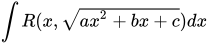
Euler permutations are permutations reducing integrals of the form where - a rational function, to the integrals of rational functions. Proposed by L. Euler in 1768 [1] [2] .

Content
- 1 Substitution
- 1.1 First substitution
- 1.2 Second Substitution
- 1.3 Third Substitution
- 2 Interesting Facts
- 3 notes
- 4 References
Substitutions
First Substitution
Used when . Replacing:
Second Substitution
Used when . Replacing:
Third Substitution
Used when the root expression has two valid roots. Replacing:
where - one of the roots [1] .
Interesting Facts
According to the memoirs of a student of Landau A.I. Akhiezer , he was extremely negative about the use of these substitutions:
<...> he [Landau] suggested that I calculate <...> the integral of a rational fraction. <...> I calculated, without using Euler’s standard permutations, and this saved me, because, as I understood later, Landau did not tolerate them and thought that every time I had to use some kind of artificial technique, which, in fact, I did.
- Memoirs of L. D. Landau [3]
Notes
- ↑ 1 2 Euler Substitutions // Big Soviet Encyclopedia / Ch. ed. A.M. Prokhorov . - 3rd ed. - M .: Soviet Encyclopedia , 1978. - T. 29: Chagan - Aix-les-Bains. - S. 575. - 632,000 copies.
- ↑ Leonhardo Eulero. Institutionum calculi integralis . - Petropolis , 1768. - Vol. 1. - P. 57-61.
- ↑ Memoirs of L.D. Landau / Otv. ed. Acad. I.M.Khalatnikov. - Anthology. - M .: Nauka , 1988 .-- S. 49 .-- 354 p. - 23,100 copies. - ISBN 5-02-000091-4 .