The Church of Saint-Julien-le-Pauvre ( fr. Église Saint-Julien-le-Pauvre ) is a Paris parish church of the Greek Catholics of Melkite persuasion and one of the oldest and most miniature churches in Paris . Rebuilt in the Gothic style in the 13th century, the church is located in the Fifth arrondissement of Paris on the left bank of the Seine River, just 500 meters from the Museum of the Middle Ages (Cluny) , near the metro station Maubert-Mutualité ( French Maubert - Mutualité ). To the north of the church is Rene Viviani Square .
| Catholic Church | |
| Church of Saint Julien-le-Pauvres | |
|---|---|
| Église Saint-Julien-le-Pauvre | |
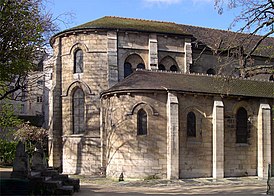 Church of Saint Julien-le-Pauvres | |
| A country |  France France |
| City | Paris V arrondissement |
| Denomination | Melkite Catholic Church |
| Diocese | Archdiocese of Paris |
| Type of building | Church |
| Architectural style | Late gothic |
| First mention | 582 |
| Established | |
| Building | 1165 - 1250 years |
| condition | Active parish church |
| Website | sjlpmelkites.org |
Being originally a religious building of the Roman Catholic Church , the Church of Saint-Julien-le-Pauvres was built in stages from the 12th to the 19th century and in 1889 was transferred to the Melkite Patriarchate of the Eastern Catholic Churches . Its original layout has repeatedly undergone changes, and the building that we see today is much smaller in size than the original structure.
Title
The church is named after two French medieval saints who have the same name: Bishop Julian of Le Mans and a certain person from the historical province of France Dauphine [1] . “Le Pauvre” in the title refers to Julian Le Mansky, whose ministry to the poor is considered exemplary [1] .
History
Roman Catholic Church
The Church of Saint-Julien-le-Pauvres appeared on the site of either the orphanage of the Merovingian era, [1] [2] or the old church, built in the VI century. [3] The very first mention of this building was found in the writings of Bishop Tour Gregory , who lived here during the reign of Chilperic I , king of Neustria [1] . It was mentioned by him in 582 among the six basilica of the Merovingians.
The construction of the new building began in 1165–1170 [2] , under the influence of the construction of either Notre Dame Cathedral [2] , or the church of Saint-Pierre-de-Montmartre [3] . The construction was carried out with the support of the monastic community of the Lonpon commune of Cluny Abbey , whose enterprise allowed the construction of choirs and, most likely, a nave (about 1210-1220) [2] . The historian and chronicler of the 16th century, Etienne Pasquier, noted that this building was related to the University of Paris , since it held the meetings of the Faculty of Theology and Arts , and after the separation of faculties, only the School of the Arts [1] . The church served as a meeting place for lecturers and students who avoided the influence of the episcopate of that time, and under its arches at different times were the poet Francois Villon and writer Francois Rabelais . Here Thomas Aquinas preached.
All construction work at this early stage was completed by 1250 [3] .
In 1651 , after several centuries of neglect, two spans of the nave had to be demolished, and a northwestern facade was also built; the northern side chapel was preserved and its two spans were used for the sacristy [2] . In 1653, the building was sold to the Paris almshouse and the Hotel Dieu hospital , and was used as a daughter chapel of the nearby Saint Severin church . More than a century later, during the French Revolution , the building was put on the list for demolition and it suffered additional damage because it was used as a warehouse [1] . In 1826, the church of Saint-Julien-les-Pauvres was restored under the supervision of the architect Franz Christian Hau and returned to the Church [4] .
Melkit Church
In 1889, under the Third Republic, the church building was transferred to the Melkit community of Paris [2] . Significant restoration work was carried out immediately before this [2] . Such a decision was criticized by residents; for example, the writer Joris Karl Huysmans condemned the introduction of non-traditional elements in the old setting of the district: “Such imposing of the Levant in the parish of Saint-Severin [...] is absolutely contrary to the environment.” [5]
Architecture
The Church of Saint-Julien-les-Pauvres was originally designed in the conservative traditions that dominated the reign of King Louis VII [3] . The only surviving church in the 12th century parishes of Paris, [3] this church was never brought up to the appearance originally conceived: the choirs were supposed to be three tiers high, and the upper row of windows illuminating the choirs was an incomplete triforium ; the nave was supposed to be covered with hexagonal vaults , but they were replaced with a wooden roof, and after the 17th century with a new vault system; and as for the bell tower conceived on the south side of the church, only the steps of the stairs were built [2] . The apse on the east side of the church was built from materials left over from the former building [2] .
The columns in the temple are similar to the columns from the Notre Dame Cathedral , and on the capitals carved images of foliage and harpies [2] . The area of choirs from 1900 to the present day is separated from the nave by an iconostasis [2] .
Notes
- ↑ 1 2 3 4 5 6 A. and V. Gagliani, History of Paris from Ancient Times to the Present , Paris, 1825, pp. 350–351
- ↑ 1 2 3 4 5 6 7 8 9 10 11 Andrew Ayers, Architecture of Paris , Axel Menges, Stuttgart and London, p. 103. ISBN 3-930698-96-X
- ↑ 1 2 3 4 5 Encyclopedia of Medieval France , Routledge , London, p. 703. ISBN 0-8240-4444-4
- ↑ Franz Christian Gau , entry in the 1813 Catholic Encyclopedia (wikisource)
- ↑ Robert Ziegler, “The Containment and Diffusion of History in Huysmans' Saint-Séverin ”, in Keith Busby (ed.), Correspondances: Studies in Literature, History, and the Arts in Nineteenth-century France , Rodopi , Amsterdam, 1992, p. 255. ISBN 90-5183-296-6