Cassiopeia ( lat. Cassiopeia ) is a constellation of the northern hemisphere of the sky [1] . The brightest stars of Cassiopeia (from 2.2 to 3.4 magnitudes ) form a figure similar to the letters "M" or "W". The constellation occupies an area of 598.4 square degrees in the sky and contains about 90 stars brighter than 6 m (that is, visible to the naked eye). Most of the constellation lies in the Milky Way strip and contains many open star clusters .
| Cassiopeia | |
|---|---|
 | |
| Lat. title | Cassiopeia (to the genus. n .: Cassiopeiae ) |
| Abbreviation | Cas |
| Symbol | Queen on the throne |
| Right ascension | 22 h 52 m to 3 h 25 m |
| Declination | from + 46 ° to + 77 ° |
| Square | 598 sq. M. degrees ( 25th place ) |
| The brightest stars ( value <3 m ) |
|
| Meteor showers | not |
| Nearby constellations |
|
| The constellation is visible in latitudes from + 90 ° to −13 °. | |

The constellation Cassiopeia is non-occurring in almost the entire territory of Russia and culminates in the zenith region in most of it. Only in the very south of the country is Cassiopeia all the time entirely in the northern side of the sky, and a small part of the constellation hides briefly behind the horizon [2] .
Content
W-Asterism
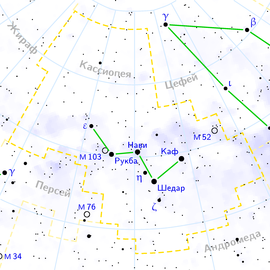
Cassiopeia includes asterism , forming a memorable image of the constellation - W-asterism . It consists of the brightest stars of the constellation, ε ( Segin ), δ ( Rukbach ), γ ( Navi ), α ( Shedar ) and β ( Kaf ), forming a figure resembling the Latin letter " W ".
Stars
The brightest stars ε ( Segin ), δ ( Rookbach ), γ ( Navi ), α ( Shedar ) and β ( Kaf ), forming the figure W, have a brightness of 3.4, respectively; 2.7; 2.4; 2.2 and 2.3 visual magnitude.
An extraordinary variable star is γ Cassiopeia . This is a star-like star whose brightness varies from 1.6 m to 3 m .
Ρ Cassiopeia , which belongs to the class of supergiant stars, behaves differently (it is 40 times heavier and approximately 500,000 times brighter than the Sun ). Most of the time, its brightness is unchanged and close to 4 m . But sometimes brightness drops to 6.2 m , and then ρ Cassiopeia becomes inaccessible to the naked eye. The reason for the brightness change is the star’s emission of gas into space, which leads to a weakening of its apparent brightness.
η Cassiopeia is a double star . The main star (3.7 m ) is a yellowish giant, the satellite (7.4 m ) is a small red cold star with a surface temperature close to 3000 K. Both stars revolve around a common center of gravity with a period of 526 years. They are relatively close to the Sun - at a distance of 20 light years.
The yellow dwarf star μ (5.3 m ) is notable for its very fast movement. Every second, it moves away from us by almost 100 km and at the same time shifts in the transverse direction. Over the millennium, μ Cas travels in the sky a distance equal to twice the apparent diameter of the lunar disk. For the first time in the star catalogs, μ Cas was listed by Tycho Brahe .
Points of Interest
- Star Tycho Brahe . In 1572, Danish astronomer Tycho Brahe noticed the sudden appearance of a bright new star in the constellation Cassiopeia, near κ Cas. The new star gradually waned and ceased to be visible after sixteen months. Today it is known that it was a supernova - one of the last explosions of stars observed in the Milky Way galaxy . At a distance of about 7,500 light-years, the supernova remnant has a diameter of almost 20 light-years.
- Cassiopeia A. In this constellation is located one of the most powerful sources of galactic radio emission - Cassiopeia A (Cas A). The flow of radio waves from this region of the sky is many times more powerful than the radio emission of the star Tycho Brahe. In 1951 , fragments of a small radio nebula associated with Cassiopeia A were recorded on photographic plates sensitive to red light. According to the speed of expansion of the nebula, it was estimated that the explosion that caused it occurred presumably in 1667 . In the sky, this object is located between β Cassiopeia and δ Cepheus .
Among other interesting objects of the constellation:
- open star clusters M52 (NGC 7654) , M103 (NGC 581) , NGC 457 and NGC 7789 ,
- dwarf elliptical galaxies NGC 147 and NGC 185 - satellites of the Andromeda Nebula ,
- diffuse nebula NGC 281
- giant gas sphere - the Bubble Nebula ( NGC 7635 ).
- Nebulae IC 1805 , IC 1848 and IC 1795 , to which the radio sources W4, W5 and W3 are associated, respectively.
History
The ancient constellation. Included in the catalog of the starry sky Claudius Ptolemy " Almagest ".
Named after Cassiopeia - in Greek mythology, the wife of the Ethiopian king Kefei and mother Andromeda . According to one version of the myth, Cassiopeia was locked up for a long time and spent a long time in prison. After which she received the gift of insight and long-awaited freedom.
In some Arabic manuscripts, the constellation is called Seated Woman .
The Arabs saw in the arrangement of the stars a hand pointing with a finger at the stars in front.
Search in the sky
The best conditions for observing Cassiopeia are in September - November . Visible throughout Russia all year round. If a straight line is drawn through ζ Ursa Major and the Polar Star , it will indicate the constellation Cassiopeia.
Ursa Major and Cassiopeia are non-descending constellations for middle latitudes, but are located on opposite sides (almost diametrically opposite) from the North Star . When the first falls low above the horizon (autumn – winter evening), Cassiopeia rises almost to its zenith, and vice versa.
See also
- Cassiopeia constellation star list
- Starburst Areas in Cassiopeia
Notes
- ↑ Cassiopeia // Brockhaus and Efron Encyclopedic Dictionary : in 86 volumes (82 volumes and 4 additional). - SPb. , 1890-1907.
- ↑ In the southern part of the constellation, the declination is about 46 °, respectively, it is non-descending north of 49 ° c. w. The territory of Russia extends south to 41 ° C. w.