(10199) Chariklo is one of the largest centaurs , the largest asteroid between the Main Belt and the Kuiper Belt . On March 26, 2014, two rings were announced around Hariklo [1] , discovered when the star was covered with a centaur [2] [3] .
| (10199) Hariklo | |
|---|---|
| Asteroid | |
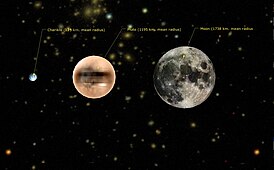 Comparison of the sizes of Hariklo, Pluto and Moon | |
| Opening | |
| Discoverer | Spacewatch |
| Discovery date | February 15, 1997 |
| Eponym | Hariklo |
| Alternative notation | 1997 CU 26 |
| Category | Centaurs |
| Orbital characteristics | |
| Age of August 27, 2011 JD 2455800.5 | |
| Eccentricity ( e ) | 0.1699381 |
| Semimajor axis ( a ) | 2.35464 billion km (15,739763 AU ) |
| Perihelion ( q ) | 1.95449 billion km (13.0649776 A.E.) |
| Aphelion ( Q ) | 2.75478 billion km (18.4145484 AU) |
| Circulation Period ( P ) | 22 808 days (62.446 g. ) |
| Average orbital speed | 7.453 km / s |
| Inclination ( i ) | 23.389429 ° |
| Longitude node (Ω) | 300,44924 ° |
| Perihelion Argument (ω) | 241.62233 ° |
| Median Anomaly ( M ) | 44,450512 ° |
| physical characteristics | |
| Diameter | 258.6 ± 10.3 km |
| Spectral class | D |
| Apparent magnitude | 18.78 m (current) |
| Absolute magnitude | 6.4 m |
| Albedo | 0.05-0.06 |
| Current distance from the sun | 16.23 a. e. |
| Current distance from earth | 15.868 a. e. |
Hariklo was opened on February 15, 1997 by James Scotty as part of the Spacewatch project . Named after Hariklo - the wife of the centaur Chiron .
Content
- 1 Orbit
- 2 Features
- 3 rings
- 4 notes
- 5 Links
Orbit
The average distance of Hariklo from the Sun is 15.74 AU , it is constantly located between the orbits of Saturn and Uranus , although its aphelion is 18.41 AU slightly larger than the perihelion of Uranus. Thus, Hariklo is his inner grabber and treats Uranus in a 4: 3 resonance, making a complete revolution around the Sun in 62.45 years.
Features
According to the Spitzer telescope , the size of Hariklo is estimated at 258.6 ± 10.3 km [4] . This makes it the largest known centaur, although the lost object of 1995 SN 55 may be slightly larger. Despite the photometric study carried out in 2001, it was not possible to determine the Hariklo rotation period around its own axis [5] .
Rings
Coverage of the UCAC4 star 248-108672 by the Hariklo centaur in 2013 made it possible to establish that Hariklo has 2 rings , about 7 and about 3 km wide [1] and 9 km apart [6] [7] . The radii of the rings are 396 and 405 km, respectively. Hariklo is one of the smallest objects with rings open. The Hariklo rings are probably also responsible for traces of water ice in its spectrum [2] [8] [9] [10] .
Notes
- ↑ 1 2 Asteroid Chariklo's rings surprise astronomers . CBC News (March 26, 2014). Date of treatment March 27, 2014.
- ↑ 1 2 European Southern Observatory (March 26, 2014). First Ring System Around Asteroid . Press release . Retrieved 2014-03-26 .
- ↑ Woo, Marcus . First Asteroid With Rings Discovered (March 26, 2014). Date of treatment March 26, 2014.
- ↑ J. Stansberry, W. Grundy, M. Brown, D. Cruikshank, J. Spencer, D. Trilling, J.-L. Margot. Physical Properties of Kuiper Belt and Centaur Objects: Constraints from Spitzer Space Telescope (English) (2007). Archived on September 4, 2012.
- ↑ Peixinho; Doressoundiram. Photometric study of Centaurs 10199 Chariklo (1997CU26) and 1999UG5 (Unavailable link) (November 9, 2000). Date of treatment November 19, 2011. Archived June 23, 2007.
- ↑ Astronomers first discovered rings around an asteroid
- ↑ Elizabeth Landau. Astronomers find first asteroid with rings . CNN (March 26, 2014). Date of treatment March 27, 2014.
- ↑ Asteroids can have rings, too // Nature. - 2014 .-- March 26. - ISSN 1476-4687 . - DOI : 10.1038 / nature.2014.14937 .
- ↑ Braga-Ribas F. , Sicardy B. , Ortiz JL , Snodgrass C. , Roques F. , Vieira-Martins R. , Camargo JIB , Assafin M. , Duffard R. , Jehin E. , Pollock J. , Leiva R. , Emilio M. , Machado DI , Colazo C. , Lellouch E. , Skottfelt J. , Gillon M. , Ligier N. , Maquet L. , Benedetti-Rossi G. , Gomes A. Ramos , Kervella P. , Monteiro H. , Sfair R. , Moutamid M. El , Tancredi G. , Spagnotto J. , Maury A. , Morales N. , Gil-Hutton R. , Roland S. , Ceretta A. , Gu S.-h. , Wang X.-b. , Harpsøe K. , Rabus M. , Manfroid J. , Opitom C. , Vanzi L. , Mehret L. , Lorenzini L. , Schneiter EM , Melia R. , Lecacheux J. , Colas F. , Vachier F. , Widemann T . , Almenares L. , Sandness RG , Char F. , Perez V. , Lemos P. , Martinez N. , Jørgensen UG , Dominik M. , Roig F. , Reichart DE , LaCluyze AP , Haislip JB , Ivarsen KM , Moore JP , Frank NR , Lambas DG A ring system detected around the Centaur (10199) Chariklo // Nature. - 2014 .-- March 26 ( t. 508 , No. 7494 ). - S. 72-75 . - ISSN 0028-0836 . - DOI : 10.1038 / nature13155 .
- ↑ Giants accused of ringing centaurs
Links
- NASA JPL Database of Small Bodies in the Solar System (10199 )
- MPC Small Body Solar System Database (10199 )
- And asteroids have rings! (inaccessible link) . Archived March 28, 2014.
- Astronomers: the asteroid Hariklo was surrounded by gas and dust rings
- Astronomy Picture of the Day. Two Rings for Asteroid Chariklo (English) (April 9, 2014). Date of treatment October 3, 2015.