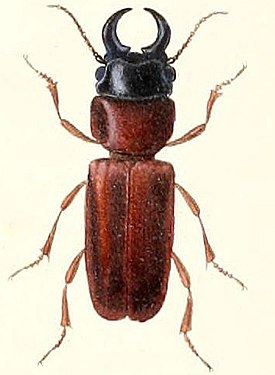
Hesperandra glabra (lat.) - a species of barbel beetles from the subfamily Parandrinae . Distributed from Mexico to the south to Argentina , in Bolivia and on islands in the Caribbean [2] . Larvae develop in the trunks of dead trees and stumps, such as aspidosperm , down- flowing acacia , Acacia floribunda , Phoebe [3] .
| Hesperandra glabra |
 |
| Scientific classification |
|---|
| No rank : | Bilateral symmetrical |
| Subtype : | Tracheo-breathing |
| Infraclass : | Winged insects |
| Treasure : | Fully Transformed Insects |
| Superfamily : | Chrysomeloid |
|
| International scientific name |
|---|
Hesperandra glabra ( DeGeer , 1774 ) |
| Synonyms |
|---|
- Attelabus glaber DeGeer, 1774 [1]
- Parandra barbata Thomson, 1861 [1]
- Parandra colombica Thomson, 1861 [1]
- Parandra ferruginea Sturm, 1826 [1]
- Parandra glabra (DeGeer) Latreille, 1804 [1]
- Parandra glabra translucida Zikán, 1948 [1]
- Parandra grandis Thomson, 1861 [1]
- Parandra lineola Gory & Guérin-Méneville, 1831 [1]
- Parandra lineolata Gory & Guérin-Méneville, 1844 [1]
- Parandra lucida Zikan, 1948 [1]
- Parandra mandibularis Perty, 1832 [1]
- Parandra maxillosa Laporte, 1840 [1]
- Parandra obsolescens Casey, 1912 [1]
- Parandra occipitalis Thomson, 1867 [1]
- Scarites testaceus Fabricius, 1794 [1]
|
|
The body length of adults is 15–36 mm [3] . The body is completely brown, shiny. Antennae very short, do not reach the base of the elytra . The mandibles of males are large and sickle-shaped. The width of the elytra is equal to the width of the pronotum , rounded at the apex of the apex [3] .
The body length of the larvae is up to 54 mm [3] . The body is light beige. The head capsule at the top is darkened. Hind margin of pronotum with dark spot [3] .
