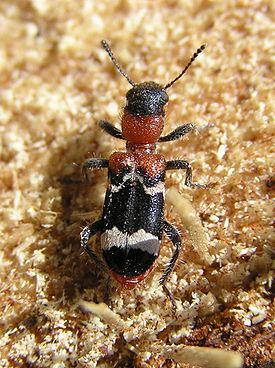
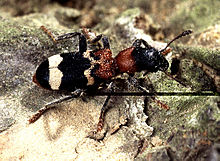
The common ants , or the ant motley [1] , or the bark beetle [2] ( lat. Thanasimus formicarius ) is a species of beetles from the motley family ( Cleridae ).
| Common ants |
|---|
Beetle Thanasimus formicarius |
|
| {{{{{{{{{{{{{{{{{{{{{{{{{{{{{{{{{{{{{{{{{{{| 1}} | 1}} | 1}} | 1}} | 1}} | 1}} | 1}} | 1}} | 1}} | 1}} | 1}} | 1}} | 1}} | 1}} | 1 }} | 1}} | 1}} | 1}} | 1}} | 1}} | 4}} : | Eukaryotes |
| No rank : | Bilateral symmetrical |
| Subtype : | Tracheo-breathing |
| Infraclass : | Winged insects |
| Treasure : | Fully Transformed Insects |
|
|
Thanasimus formicarius ( Linnaeus , 1758) |
|
- Attelabus formicarius Linnaeus, 1758
- Clerus brevicollis Spinola, 1844
- Clerus fasciatus Geoffroy, 1785
- Thanasimus assimilis Méquignon, 1948
- Thanasimus hilaris Du Buysson, 1901
- Thanasimus laterufus Corporaal, 1931
- Thanasimus schaeferi Méquignon, 1949
|
|
Beetle
Thanasimus formicariusEurope , the Caucasus , Siberia [3] .
Brightly colored beetles 7.0-10.0 mm long. Body color red-black, elytra with white bandages. The front segment of the foot is roughly cut. White bandages in thick and thick white hairs. They prey in the nests of bark beetles [3] [4] . Pinkish larvae are up to 18 mm long, live in passages under the bark, eat eggs, larvae and pupae of bark beetles, pupation and wintering of adults take place there. The abundance in some areas (for example, in Germany ) is sharply reduced due to the use of chemicals for wood preservation there [5] .
Useful beetles, as they destroy harmful insects such as bark beetles [3] [5]
Photo of ants form from Bialowieza Forest (Poland, 05.2006)
Drawing from a book: Carl Gustav Calwer ; Gustav Jäger (1876). “Käferbuch. Naturgeschichte der Käfer Europas. " Stuttgart: Julius Hoffmann. [one]
