Chehel-Sotun ( Persian چهل ستون - “Palace of the Forty Columns”) is the palace of the Persian Shah Abbas II in the city of Isfahan ( Iran ), an outstanding building of Persian architecture of the 17th century. As part of the facility, the Persian Gardens is included in the UNESCO World Heritage List .
| Palace | |
| Palace of the Forty Columns | |
|---|---|
| چهل ستون, | |
 | |
| A country |  Iran Iran |
| City | Isfahan |
| Architectural style | |
| Established | 1647 year |


The pavilion was built by Abbas II in 1647 as a resting place. The 17th-century French traveler Jean-Baptiste Tavernier repeatedly mentions the ceremonies held here. In 1707, the palace survived the fire, in 1870 it was reconstructed. Currently, there is an exposition of the archaeological museum, which presents antique ceramics and carpets.
The palace with an area of 58 x 37 meters is located in the center of a shady garden, the size of which was originally 7 hectares. The elegant main facade of the palace is a gallery , the roof of which rests on 20 thin octagonal columns (3 rows of 6 columns each and two more columns supporting the vault). These columns 13 meters high are carved from solid cedar trunks. Four central columns rest on stone bases with carved images of lions. When recovering from the fire of 1707, the columns were decorated with mirror mosaics .
In front of the palace is a large rectangular pond . Twenty columns, reflected, and as if doubled, in the mirror of the pond, and gave the palace its poetic name.
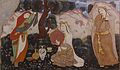
The halls of the palace are decorated with frescoes depicting events from the history of the Safavids dynasty , in which European and Indian influence are traced. Small frescoes of lovingly-erotic content in the Khajar era were painted over with lime , which allowed them to reach our days in excellent condition.
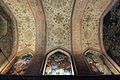
The central part of the palace is occupied by the Reception Hall of Abbas II . Its walls and ceiling are generously decorated with stucco moldings and decorated with ornaments in blue, scarlet, emerald green and gold tones - all in all, several kilograms of gold were spent on decorating the interiors of the palace.
At one time, the palace was also decorated with ceramic panels on the themes of historical events, but they were scattered around the world; many of them are now kept in European museums.
- Murals of the Reception Hall
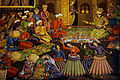
Abbas I and Vali Khan

Abbas II and Nadar Mohammad Khan

Tahmasp I and Humayun

Battle of Karnal



Literature
- I. Luschey-Schmeisser, Čehel Sotūn , Encyclopædia Iranica , 1990.
- N. Wilber, Persian Gardens and Garden Pavilions , Tokio, 1962.
- K. Würfel, Isfahan , Zurich, 1974.
- AU Pope, Persian Architecture , Londres, 1965.