
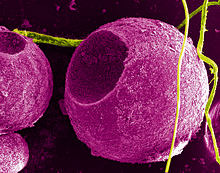
Quanta point - a fragment of a conductor or semiconductor (for example, InGaAs , CdSe , CdS or GaInP / InP ) whose charge carriers ( electrons or holes ) are limited in space in all three dimensions. The size of a quantum dot must be so small that quantum effects are significant [1] . This is achieved if the kinetic energy of an electron is noticeably greater than all other energy scales: first of all, it is greater than the temperature , expressed in energy units.
The energy spectrum of a quantum dot is discrete, and the distance between the stationary energy levels of the carrier charge depends on the size of the quantum dot as (where ħ is the reduced Planck constant , d is the characteristic size of a point, m is the effective mass of an electron on a point). As a result, the electronic and optical properties of quantum dots are intermediate between the bulk semiconductor and a discrete molecule [1] .

Simply put, a quantum dot is a semiconductor whose electrical characteristics depend on its size and shape. The smaller the crystal size, the greater the distance between the energy levels. For example, when an electron moves to a lower energy level, a photon is emitted; since we can adjust the size of the quantum dot, we can change the energy of the emitted photon, which means we can change the color of the emitted quantum dot of light. The main advantage of a quantum dot lies in the possibility of high-precision control over its size, and consequently over conductivity [2] , which allows you to create fluorophores of different colors from the same material using the same technique.
Quantum dots of different sizes can be assembled into gradient multilayer nanofilms .
History
Quantum dots were first obtained in 1981 by Alexey Ekimov [3] [К 1] , and then, in 1985, by Louis Bruce in colloidal solutions [5] [6] . The term "quantum dot" was proposed by Mark Reed [7] . The first quantum dots were CuCl microcrystals grown in glasses [3] [K 1] . In 1993, a method of synthesizing quantum dots from cadmium selenide in the form of colloidal nanocrystals appeared, where each quantum dot is an isolated object [8] . The fluorescence quantum yield of such points was only 10% [9] . Its significant increase was achieved by the formation of a shell around the nucleus.
In June 2013, an article was published in Physical Review Letters with the results of a discovery made by scientists from the Indian Institute of Science in Bangalore . According to him, quantum dots created on the basis of a zinc, cadmium and sulfur alloy doped with manganese, shine not only orange, as it was considered until now, but luminesce in the range from dark green to red. The practical significance of the discovery lies in the fact that quantum dots from manganese- alloyed alloys are stronger, more efficient and safer.
The most studied quantum dots based on cadmium selenide . But with the advent of legislation restricting the use of materials based on heavy metals [10] , technologies began to develop towards the production of quantum dots that do not contain cadmium.
Types of quantum dots
There are two types of quantum dots (according to the method of creation):
- epitaxial quantum dots;
- colloidal quantum dots.
Physical and chemical properties
- A wide absorption spectrum that allows you to excite nanocrystals of different colors with a single radiation source.
- A narrow and symmetrical peak of fluorescence (without a “tail” in the red region, like in organic dyes , the half-width of the fluorescence peak is 25–40 nm), which provides a pure color: 2 nm points — blue, 3 nm — green, 6 nm — red [ 11] .
- High fluorescence brightness (quantum yield> 50%).
- High photostability.
Most of the properties of CT, including the color of radiation, depends on the size, shape and materials of which they are made.
A quantum dot can serve as a semiconductor crystal, in which quantum-size effects are realized due to a rather small size. An electron in such a microcrystal feels like an electron in a three-dimensional potential well ; it has many stationary energy levels with a characteristic distance between them. (the exact expression for energy levels depends on the shape of the point). Similar to the transition between the atomic energy levels, a photon can be emitted during the transition between the energy levels of a quantum dot. It is also possible to throw an electron to a high energy level, and to receive radiation from a transition between lower-lying levels ( luminescence ). At the same time, unlike real atoms, the transition frequencies are easy to control by changing the size of the crystal. In fact, the observation of the luminescence of cadmium selenide crystals with a luminescence frequency determined by the size of the crystal was the first observation of quantum dots.
Currently, many experiments are devoted to quantum dots formed in a two-dimensional electron gas . In a two-dimensional electron gas, the motion of electrons perpendicular to the plane is already limited, and the area on the plane can be distinguished using gate metal electrodes superimposed on the heterostructure from above. Quantum dots in a two-dimensional electron gas can be connected by tunneling contacts with other regions of a two-dimensional gas and studying the conductivity through a quantum dot. In such a system, there is a Coulomb blockade phenomenon.
Quantum Dot Constructs
A quantum dot consists of a nucleus and a protective shell made of a material with a wider forbidden band . It reduces defects on the surface of the nucleus, which leads to an increase in the fluorescence quantum yield up to 90%, prevents the degradation of ct and the release of toxic cadmium ions. The core material can be CdS, CdSe, CdTe, PbS, PbSe, PbTe, InP, InAs, PbSe / Te, CdSe / Te CdAgTe alloys, CdSe / Te CdHg; shells - ZnS, CdS, ZnSe. CT for biomedical research has two more layers: a stabilizer and a layer of inert molecules ( peptides , lipids ) or a neutral hydroxyl shell. The stabilizer - silicon, polymer or silicone shell - protects the internal structures from aggressive environmental influences, determines the ability of quantum dots to disperse into solvents and the possibility of grafting various biologically active molecules to their surface, which will deliver CT to the desired tissues and cells. Lipids are used to reduce non-specific binding [12] .
Quantum dots can be of various shapes and sizes, but most often they are spheres with a diameter of 2-10 nm, and they consist of 10 3 -10 5 atoms [1] .
Applying quantum dots
Quantum dots are promising materials in medicine, biology, optics, optoelectronics, microelectronics, printing, energy.
Colloidal quantum dots are a good substitute for traditional phosphors, both organic and inorganic. They are superior in photostability, fluorescence brightness, and also have some unique properties [13] . The optical properties of these nanocrystals are used in the most unexpected studies that require convenient, tunable luminescence, for example, in biological studies. For example, quantum dots of different sizes penetrate into different parts of cells and paint them in different colors [14] [15] .
Quantum dots are increasingly used as biomarkers for visualization in medicine , for example for staining tumors or autoimmune antibodies, drug delivery to the desired tissues (by attaching drugs to nanoparticles, you can more accurately target them to tumors) [16] .
More recently, the widespread use of quantum dots in electronics was out of the question, but in recent years a number of companies have launched products using nanoparticles. Among the products announced there are both experimental samples and mass products. Back in 2010, LG Display created the first prototypes of displays based on quantum dots [17] . In 2015, TPV Technology developed in cooperation with QD Vision and launched the first consumer monitor 276E6ADS based on quantum dots [18] . Currently, the quantum dot backlit LCD panels ( QD-LED ) are being installed on their Samsung , LG Electronics , Sony , TCL Corporation , Hisense TVs . There is a program for creating display devices where the quantum dots themselves will act as light emitters [19] .
Possible application of quantum dots: field-effect transistors , photo cells , LED , laser diodes [1] . The company Nexxus Lighting in 2009, has released an LED lamp using quantum dots [20] .
Based on CM, it is possible to produce coatings that change the radiation of existing light sources or sunlight, which may be applicable, for example, in agriculture for converting ultraviolet light to red, which is useful for plants.
Quantum dots are also used in hybrid solar cells as a material that converts solar energy into a constant electric current. The use of quantum dots in multilayer solar cells allows for a more efficient absorption of solar radiation, since they can absorb light in a wider range (including infrared and ultraviolet) than traditional solar cells [21] .
UbiQD, National Renewable Energy Laboratory The Los Alamos National Laboratory is developing a luminescent solar concentrator (LSC) on quantum dots [22] [23] .
Quantum dots may be included in the ink to protect documents and securities from fraud [24] [25] .
Quantum dots are one of the main candidates for representing qubits in quantum computing .
Methods for obtaining quantum dots
There are two main methods for creating quantum dots: epitaxy and colloid synthesis .
Epitaxy - a method of growing crystals on the surface of the substrate:
- molecular beam epitaxy ,
- gas phase epitaxy .
The compounds of the elements III (Ga, Al, In) and V (As, P, Sb) of the periodic table group A III B V are mainly grown. Based on such QDs, semiconductor lasers and microwave transistors are created.
Colloidal synthesis , in which substances are mixed in solution.
Using colloidal synthesis, nanocrystals can be obtained coated with a layer of adsorbed surface-active molecules. Thus, they are soluble in organic solvents, after modification - also in polar solvents. Of particular interest are fluorescent quantum dots obtained by the method of colloidal synthesis, for example, quantum dots based on cadmium chalcogenides, depending on their size, fluoresce in different colors.
Production
Quantum dots for displays are made by Nanosys . She presented her QDEF technology (Quantum Dot Enhancement Film - an improving film with quantum dots) at the SID ( Society for Information Display ) exhibition in 2011. The first licensees of this technology were Samsung Electronics and 3M .
In 2004, the QD Vision laboratory (USA, Lexington (Massachusetts) ) was founded to develop the QLED technology. Initially, it was supposed to produce directly from the quantum dots the sub-pixels of the display matrix, but the technology turned out to be complex and costly, and the company concentrated on improving the backlight on the quantum dots of LCD displays [27] . It was possible to introduce technology into the production of television sets thanks to the cooperation with LG, Sony, TCL Group and Samsung, which bought QD Vision in 2016 [28] .
Nanoco has a proprietary technology for the production of cadmium-free quantum dots , established in 2001 in Manchester . The company produces CFQD ® film for display products and garden lighting [29] . Her factory is in Runcorn .
QD materials are produced by Dow Chemical . In 2013, she received a license from Nanoco for the production, marketing and sale of its materials. By 2015, Dow Chemical built a plant in Cheonan (South Korea) and started producing cadmium-free quantum dots [30] . Indium is used instead. The first TVs with this technology were presented by Samsung and LG at CES 2015.
The development of its own QD-technology is the company Merck Group [31] .
In Russia, in 2011–2014, quantum dots under the QDLight brand produced the microenterprise “Nanotech-Dubna Scientific and Technological Testing Center” as part of a joint project with RUSNANO and the Federal State Unitary Enterprise “Research Institute for Applied Acoustics” [32] [26] . In 2017, it was liquidated [33] .
Quantum dots for creating solar cells are produced by Quantum Materials Corporation and its subsidiary Solterra Renewable Technologies - using proprietary proprietary technology [21] and QD Solar.
See also
- Nanomaterial
- Quantum wire
- Two-dimensional electron gas
- Quantum dot contact
- Quantum dot display
- Quantum dot laser
- Programmable matter
- Quantum antidot
Comments
- ↑ 1 2 Academician Zh. I. Alferov wrote about this: “The first semiconductor points — microcrystals of compounds A II B VI , formed in a glass matrix, were proposed and implemented by A.I. Ekimov and A.A. Onushchenko ” [4] .
Sources
- ↑ 1 2 3 4 Vasiliev R. B., Dirin D. N. Quantum dots: synthesis, properties, application . - Methodical materials. - Moscow: FNM MSU, 2007. - 34 p.
- ↑ www.evidenttech.com: How quantum dots work. . Archived February 1, 2010. The appeal date is October 15, 2009.
- ↑ 1 2 Ekimov A.I., Onushchenko A.A. The Quantum Size Effect in Three-Dimensional Semiconductor Microcrystals // JETP Letters . - 1981. - T. 34. - p. 363-366.
- ↑ Alferov Zh. I. History and future of semiconductor heterostructures // Physics and technology of semiconductors. - 1998. - V. 32 , № 1 . - p . 12 .
- ↑ Nanotechnology Timeline (English) . National Nanotechnology Initiative (26 November 2015). The appeal date is December 14, 2016.
- ↑ Discovery of Quantum Dots (1981) (English) . Jeremy Norman & Co., Inc. (2004–2016). The appeal date is December 14, 2016.
- Ed Reed MA, Randall JN, Aggarwal RJ, Matyi RJ, Moore TM, Wetsel AE Zero -dimensional semiconductor nanostructure (English) // Phys Rev Lett : journal. - 1988. - Vol. 60 , no. 6 - p . 535-537 . - DOI : 10.1103 / PhysRevLett.60.535 . - . - PMID 10038575 . (1988). [one]
- ↑ Murray CB, Norris DJ, Baendi MG Synthesis and characterization of CdE (E = sulfur, selenium, tellurium) semiconductor nanocrystallites (English) // J. Am. Chem. Soc. : magazine. - 1993. - № 115 (19) . - p . 8706-8715 .
- ↑ Oleynikov V. A., Sukhanova A. V., Nabiev I. R. Fluorescent semiconductor nanocrystals in biology and medicine (Unidentified) . - Russian nanotechnology. - 2007. - V. 2. - p. 160-173.
- ↑ TR EAEU 037/2016 . Decision of the Council of the Eurasian Economic Commission of October 18, 2016 N 113. Date of application April 19, 2019 .; Directive 2011/65 / EU of June 8, 2011 . European Parliament and EU Council. The appeal date is May 16, 2019.
- ↑ QLED and its differences from OLED and LED . ULTRA HD (May 6, 2017). The appeal date is April 17, 2019.
- ↑ Zdobnova, T. A., Lebedenko, E. N., Deyev, S. M. Quantum Dots for Molecular Diagnosis of Tumors (rus.) // Асta Naturae: Journal. - 2011. - Vol. 3 , No. 1 (8) . - pp . 32-52 .
- ↑ Properties of quantum dots
- ↑ Igor Nabiev, Siobhan Mitchell, Anthony Davies, Yvonne Williams, Dermot Kelleher, et. al. Non-Functionalized Nanocrystals Can Cannabis Explosion and Cellular Physics // Nano Lett: Journal. - 2007. - № 7 (11) . - p . 3452-33461 .
- ↑ Yvonne Williams, Alyona Sukhanova, Małgorzata Nowostawska, Anthony M. Davies, Siobhan Mitchell, et. al. Probing Cell-Type-Specific Intrallular Nanoscale Barriers Using Size-Tuned Quantum Dots (eng.) // Small: Journal. - 2009. - № 5 . - p . 2581-2588 .
- ↑ Oleynikov V. А. Quantum dots - nanoscale sensors for medicine and biology (eng.) // Nature : journal. - Science , 2010. - № 3 . - pp . 22-28 .
- ↑ Started production of quantum dot displays . MEMBRANA (June 4, 2010). The appeal date is April 15, 2019.
- ↑ MMD, QD Vision Introduce World's First Quantum Dot Monitor . BusinessWire. The appeal date is April 17, 2019.
- ↑ In 2018, quantum dot LCD TVs surpassed OLED in terms of sales, but lost in revenue . STEREO & VIDEO (March 12, 2019). The appeal date is April 15, 2019.
- ↑ The first commercial lamps on quantum dots . NANO NEWS NET (May 7, 2009). The appeal date is April 24, 2019.
- 2 1 2 company's company's company's company's prom StockGumshoe (February 15, 2017). The appeal date is April 24, 2019.
- ↑ The efficiency of solar cells in quantum dots continues to grow . NANO NEWS NET (November 1, 2017). The appeal date is April 24, 2019.
- ↑ Solar-Panel Windows Made Possible Quantum Dot Breakthrough . International Business Times (April 17, 2014). The appeal date is April 24, 2019.
- ↑ Harvest making IQDEMY. Quantum dots and polymer . IQDEMY (September 20, 2018). The appeal date is April 25, 2019.
- ↑ Quantum dots. Unique material for cryptographic systems . LLC STCI Nanotech-Dubna (2011). The appeal date is April 25, 2019.
- ↑ 1 2 The first production phase of colloidal quantum dots was launched . Innovation time. The appeal date is April 23, 2019.
- ↑ Vasilkov A. Why do televisions need quantum dots, or nanotechnologies in everyday life . COMPUTER (January 17, 2013). The appeal date is April 18, 2019.
- Samsung Samsung's Quantum Ambitions . AbbGroup (November 24, 2016). The appeal date is April 18, 2019.
- ↑ Cadmium free quantum dots . Nanoco Group. The appeal date is May 16, 2019.
- ↑ Samsung may introduce cadmium-free quantum dots LCD TVs in 2015 . Оled-info (October 22, 2014). The appeal date is April 18, 2019.
- ↑ Detynich G. Merck Korea presented materials for "futuristic" displays . 3Dnews (October 21, 2017). The circulation date is April 18, 2019. - the world's largest manufacturer of liquid crystals
- ↑ Production of quantum dots by the method of colloid synthesis . RUSNANO. The appeal date is April 23, 2019.
- ↑ LLC NTITS Nanotech-Dubna . Nalog.io (April 23, 2019).
Links
- Russian Nanotechnology Corporation
- TV on quantum dots . TV-Smart.Ru (January 16, 2015). The appeal date is April 11, 2019.
- Onishchenko E. Semiconductor heterostructures . Scientific.ru (Interdisciplinary Scientific Server). The appeal date is April 11, 2019.
- Created a logic circuit on quantum dots . membrana.ru (January 18, 2006). The appeal date is April 11, 2019.
- Quantum dots and where they live . gagadget.com The appeal date is April 11, 2019.
- Kulbachinsky V. A. Semiconductor quantum dots (Rus.) // Soros Educational Journal: journal. - 2001. - V. 7 , № 4 . - pp . 98-104 .