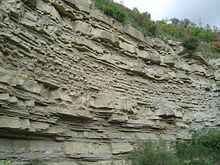
Turbidite ( Latin turbidus - turbid, agitated) is a characteristic association of sedimentary rocks ( sand - siltstone - silt in the fresh state, and sandstone - siltstone - argillite after lithification ), formed in deep water due to the substance transferred by turbid flows . Turbid (turbid) flows usually begin on the edge of the shelf and, due to gravitational energy, rush down the continental slope along a system of underwater canyons to its foot or further to the abyssal plain . The process of nucleation of such flows has not been fully studied, but it is clear that this is due to the violation of gravitational equilibrium on the edge of the shelf, when the sediments accumulated there can no longer be held on the slope. When a turbid stream loses energy, all transported material falls out of it. Turbidites are characterized by a rhythmic alternation of interlayers of sand , silt, and silt from bottom to top. [1] . Each such 3-layer rhythm element is called a Bowm cycle and is formed as a result of a single “avalanche descent”. The power (thickness) of the cycle is usually about 1 m or less. The layered structure of the cycle is explained by different deposition rates of the material depending on the particle size. The largest fraction (sand) falls out immediately, then finer, etc. up to silts. The body of turbidite contains tens, hundreds and thousands of such cycles, depending on the age of the turbidite and the intensity of sedimentation on the shelf.
A detailed study of turbidites began after a major earthquake in the Big Bank area on November 19, 1929, when underwater telegraph cables were torn with turbid streams. Turbidite with a thickness of 1 m and an area of at least 100 thousand square meters was then formed on the underwater plain. km The maximum transport range of sedimentary material was 720 km. The flow rate is determined at 40 - 55 km / h [2] .
Turbidites are both modern and fossil, formed in past geological eras at the bottom of the ancient oceans, and now raised above sea level. Modern turbidites are deposited at a depth of more than 2000 meters [1] and are located along the foot of the continental slopes. Their finest-grained fraction, silts and silts, fills the flat abyssal plains. The thickness of modern turbidites rarely exceeds 1 km [2] .
Notes
- ↑ 1 2 Petrographic dictionary. - M .: Nedra, 1981.
- ↑ 1 2 Kenneth J.P. Marine Geology. In 2 vols. T.2. Per. with the English.-M.Mir. 1987.-384 p.