Congress Square ( Spanish: Plaza del Congreso ) - a square in the center of Buenos Aires in front of the Palace of the National Congress of Argentina . It is located near the Montserrat district between Avenida Entre Rios , Rivadavia Avenues , Hipolito Yrigoyen Avenue and Viceroy King Sevallios Avenue.
| Congress Square | |
|---|---|
| Buenos Aires | |
 On the map of the village | |
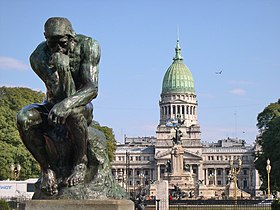 Congress Square in the evening | |
| general information | |
| A country |
|
| Area | Montserrat |

Content
History
The construction of Congress Square was approved by Law No. 6.286 of September 30, 1908 as part of the celebration of the centenary of Argentina's independence. Several projects were considered, among which the plan of Carlos Theis was chosen, since it met the requirements of local residents not to rebuild the neighboring Lore square.
The work was completed in January 1910 . The square was decorated with sculptures, a French-style garden, a pond and a replica of Auguste Rodin 's sculpture The Thinker . The grand opening took place with the participation of the mayor of Buenos Aires, Manuel Guyraldes and the President of Argentina, Jose Figueroa Alcorta. A military parade was held from Casa Rosada to the Palace of the National Congress , attended by ex-President of Brazil Manuel Ferras de Campus Salez, Chilean President Pedro Montt, Infanta Isabella of Asturias, French politician Georges Clemenceau .
The view of the square remained unchanged until 1968 , when an arc road was laid through Lorrea Square that connected Avenida de Mayo and Rivadavia Avenues. A law was passed by local authorities according to which the northern sector of Piazza Lore retained its name, and the southern sector became known as Plaza Mariano Moreno. The eastern part of the former Lorrea Square was annexed to Congress Square.
In 1997, Congress Square, along with Lore and Mariano Moreno squares, were approved by historical monuments [1] .
In 2006 , the reconstruction of the square began.
Sculptures
There are a large number of sculptures and monuments in Congress Square, in particular:
- A replica of Auguste Rodin's sculpture The Thinker. Installed in 1907 . It was cast by Rodin himself from bronze from the same form as the original sculpture.
- Bronze monument to Marian Moreno, opened on October 1, 1910 .
- Forgiveness is a marble sculpture by Juan Eugenio Boveri. It was installed in 1896 in the center of the garden in the eastern part of the square. In 1991, it was moved to Avellaneda Park.
- Zero kilometer - installed on October 2, 1935 in the northern part of Lore Square and transferred to its current location on May 18, 1944 . On the north side of the monument is the Virgin Mary, on the south - a map of Argentina, on the west there is a memorial plaque dedicated to José de San Martin, on the east - information about the installation date. Symbolizes the beginning and starting point of all roads in Argentina.
- Monument to Ricardo Balbin by Raoul Kano, opened on September 9, 1999 .
- Monument to Jose Manuel Estrada by Hector Rocha, erected on November 9, 1947
- Monument of Two Congresses. The pedestal is made of stone, on it are two figures of bronze: the Republic with a laurel branch in hand and Labor. Around there are figures symbolizing the participants of two congresses: the Assembly of the XIII year and the Tucuman Congress. The pedestal of the monument is surrounded by a fountain that symbolizes La Plata, decorated with sculptures of horses, condors and children, symbolizing the world. Because of this monument, Congress Square is often mistakenly called the Square of Two Congresses.
- It was decided to erect a monument to Alfred Palacios in the eastern part of the square in the mid-1980s, but so far this has not been done.
Monument to Marino Moreno
Zero kilometer
Monument to Ricardo Balbin
Monument to Jose Manuel Estrada
Monument to the Two Congresses
Notes
Links
| External video files | |
|---|---|
| Congress Square | |
- Area Information (Spanish)
- Official page (Spanish) on facebook