S2 (also known as S0-2 ) is a star located near the radio source Sagittarius A * - a supermassive black hole in the center of the Galaxy . The star makes a complete revolution around it in 15.56 ± 0.35 years with a pericentral distance of 17 light hours (120 a.e. ), which is 4 times greater than the distance from the Sun to Neptune . The last passage of the pericenter of the orbit occurred in early 2002.
| S2 | |
|---|---|
| Double star | |
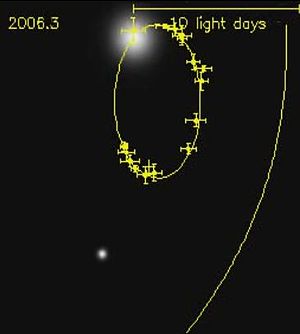 The orbit of S2 around Sagittarius A * . A star is turning clockwise. | |
| Observational data ( Age J2000.0 ) | |
| Type of | double star |
| Right ascension | |
| Declination | |
| Distance | 25 900 ± 1 400 St. years (7 940 ± 420 pc ) |
| Constellation | Sagittarius |
| Astrometry | |
| Own movement (μ) | RA: Dec: |
| Characteristics | |
| Spectral class | |
| Elements of the orbit | |
| Period ( P ) | 15.56 ± 0.35 years |
| Semimajor axis ( a ) | 0.1203 ± 0.0027 " |
| Eccentricity ( e ) | 0.881 ± 0.007 |
| Inclination ( i ) | -48.1 ± 1.3 ° v |
| Node (Ω) | 45.0 ± 1.6 ° |
| Periastric Age ( T ) | 2002,331 ± 0.012 |
| Pericenter Argument (ω) | 245 °, 4 ± 1 °, 7 |
| Database Information | |
| SIMBAD | data |
| The star has 2 components Their parameters are presented below: | |
| Sources: [2] | |
Observations of the star have been conducted since 1995 to confirm the assumption of the existence of a supermassive black hole in the center of the Milky Way . The accumulated data confirm the existence of such an object in this area. By 2008, S2 made a complete revolution since the start of observations [4] .
A group of astronomers, mainly from the Max Planck Institute for Extraterrestrial Physics , used observations of the S2 orbital dynamics to determine the distance from Earth to the center of the galaxy . Astronomers got a value of 7.94 ± 0.42 kilo parsec , which is close to the results previously obtained by other methods [2] [5] .
These S2 orbits will enable astronomers to test various effects predicted by the general theory of relativity , and even the effects of additional measurements [6] . Recently obtained estimates of the mass of Sagittarius A * of 4.3 [2] million solar masses and the distance from it to star S2 make its orbit one of the fastest known: the star’s orbital velocity at the pericenter is at least 5000 km / s or 2% of the speed light [7] . Only in 2012 was the star S0-102 discovered, which makes a complete revolution around the center of the galaxy in 11.5 years. S2 has a luminosity 16 times higher than S0-102, which prevented the detection of the latter [8] . The centripetal acceleration S2 near the pericenter of the orbit is about 1.5 m / s 2 , it is close to the gravitational acceleration on the lunar surface (1.62 m / s 2 , or 1 ⁄ 6 of the standard Earth's gravitational acceleration).

Notes
- ↑ 1 2 3 4 5 6 R. Schödel, D. Merritt, A. Eckart The nuclear star cluster of the Milky Way: proper motions and mass // Astron. Astrophys. - EDP Sciences , 2009. - Vol. 502, Iss. 1. - P. 91–111. - ISSN 0004-6361 ; 0365-0138 ; 1432-0746 ; 1286-4846 - doi: 10.1051 / 0004-6361 / 200810922
- ↑ 1 2 3 Eisenhauer, F. et al. A Geometric Determination of the Distance to the Galactic Center (Eng.) // The Astrophysical Journal. - 2003. - Vol. 598. - Iss. 2 . - P. 121-124 . - DOI : 10.1086 / 380188 . - .
- ↑ M. Rafelski, Ghez A. M., Hornstein S. D. et al. Photometric Stellar Variability in the Galactic Center // Astrophys. J. / E. Vishniac - IOP Publishing , 2007. - Vol. 659, Iss. 2. - P. 1241–1256. - ISSN 0004-637X ; 1538-4357 - doi: 10.1086 / 512062
- ↑ Short documentary about Sagittarius A *
- ↑ Nature Vol 419, October 17, 2002 (inaccessible link) . Institute for Extraterrestrial Physics, Max Planck Society (December 8, 2008). Date of treatment October 30, 2011. Archived on September 6, 2006.
- ↑ Lisa Grossman. Black hole as a peephole . Science News (February 15, 2010). Date of treatment October 30, 2011. Archived September 2, 2012.
- ↑ Surfing a Black Hole . European Southern Observatory (October 16, 2002). Date of treatment October 30, 2011. Archived September 2, 2012.
- ↑ Alexander Berezin. The star closest to the black hole was discovered . computerra.ru (October 05, 2012). Date of appeal September 14, 2013.
- ↑ F. Eisenhauer, R. Genzel, T. Alexander, R. Abuter, T. Paumard, T. Ott, A. Gilbert, S. Gillessen, M. Horrobin, S. Trippe, H. Bonnet, C. Dumas, N Hubin, A. Kaufer, M. Kissler-Patig, G. Monnet, S. Ströbel, T. Szeifert, A. Eckart, R. Schödel, and S. Zucker. SINFONI in the Galactic Center: Young Stars and Infrared Flares in the Central Light-Month . The Astrophysical Journal (July 20, 2005). Date of treatment October 30, 2011. Archived September 2, 2012.