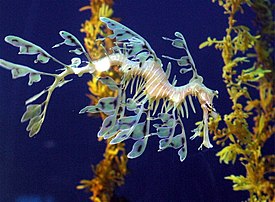
Rag seahorse [3] , or rag [4] ( lat. Phycodurus eques ) is a species of marine ray- fin fish from the needle family, distinguished in the monotypic genus Phycodurus , related to the seahorse ( Hippocampus ).
| Seahorse rag |
 |
| Scientific classification |
|---|
| No rank : | Bilateral symmetric |
| Rod: | Phycodurus Gill , 1896 |
|
| International Scientific Name |
|---|
Phycodurus eques ( Günther , 1865) |
| Synonyms |
|---|
- Phyllopteryx eques Günther, 1865 [1]
- Phycodurus glauerti Whitley, 1939 [2]
|
| Security status |
|---|
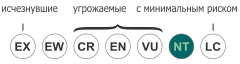
Close to VulnerabilityIUCN 3.1 Near Threatened : 17096 |
|
Content
Body length up to 35 cm [5] . Representatives of this species of fish are noteworthy in that their whole body and head are covered with processes that mimic the thallus of algae . Although these processes are similar to fins, they do not take part in swimming, they serve as a disguise (both when hunting for shrimp and for protection from enemies).
The rag is moved with the help of the pectoral and dorsal fins. These small fins are almost completely transparent, they sway very often (up to 10 times per second), providing dimensional rocking of the fish on the waves, creating the illusion of floating algae [6] . The ragman swims slowly, its maximum speed is up to 150 m / h. Despite the low mobility, he learned to defend well against natural enemies. This is facilitated by greenish leaf-shaped outgrowths, which allow it to go unnoticed.
It lives in the waters of the Indian Ocean , washing southern, southeastern and southwestern Australia , as well as northern and eastern Tasmania [7] . Usually found on coral reefs , in shallow water at a depth of 4 to 30 m (usually up to 20 m), in waters of moderate temperature [5] .
It feeds on plankton , mysids , algae . Having no teeth, the rag-sapper swallows whole food (up to 3,000 mysids per day).
Unlike seahorses, male rags do not have brood bags. Like their close relatives, female rags lay up to 120 ruby-red eggs, which are then fertilized and attached in a special place under the tail of the male. During pregnancy, couples approach each other every morning and arrange something like a dance of love with a change in skin color in the direction of brighter shades. It takes 4-8 weeks, and there are childbirth of small rag-pickers (exact copies of adults). After birth, the young are completely left to their own devices. Only 5 percent of newborns will become adult 2-year-olds who remain in the places where they were born.
Ragmen are at risk of destruction due to industrial emissions, as well as becoming copies of collections of amateur divers fascinated by their appearance. Due to this danger, the species is taken under protection by the Australian government.
- Unlike seahorses, which cling to algae with their tail during sea riots, rag-wagons do not know how to do this, so they often die during storms because they are thrown ashore.
- The mint of the Australian city of Perth has issued the second coin of the new series of silver coins "Australian marine life - reefs." It depicts a rag. Coins of 50 Australian cents are minted from 999 silver, the weight of each is 15.573 g, diameter is 36.6 mm, and the circulation is not more than 10,000 pieces. The image of a rag adorns the reverse of the coin; on the obverse is a portrait of Her Majesty Queen Elizabeth II. The cost of one coin is slightly more than 1,300 rubles of the Russian Federation .
- The Ragman is the official emblem of the state of South Australia .