Vlasius of Sebastia ( Greek Άγιος Βλάσιος ; d. C. 316 ) is a Christian saint , revered in the guise of holy martyrs , bishop of the city of Sevastia in the Roman province of Cappadocia in Asia Minor (now Sivas ).
| Blasius of Sebaste | |
|---|---|
| Βλάσιος | |
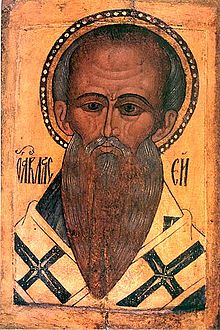 Icon, 17th century | |
| Birth | III century |
| Death | OK. 316 years Sevastia , Cappadocia , Roman Empire |
| Is revered | in the Orthodox and Catholic churches |
| In the face | holy martyrs |
| Day of Remembrance | in the Orthodox Church on February 11 (24) , in the Catholic Church - on February 3 |
| Patron | animals from throat diseases |
| Asceticism | martyrdom |
Content
- 1 Biography
- 2 The veneration of St. Blasius
- 3 In the Slavic tradition
- 4 See also
- 5 notes
- 6 Literature
- 7 References
Biography
According to the Acts of the Saints , the holy martyr Blasius lived in the city of Sevastia , which under the emperor Diocletian became the administrative center of the province of Lesser Armenia . According to the life and the akathist , Blasius from his youth distinguished himself by a pious life, was a doctor and, at the request of the inhabitants, was appointed a Sebastian bishop. During the Great Persecution under the Emperor Diocletian, Vlasius comforted Christians, visited martyrs in prison; in particular, life tells of his visit to St. Eustratius of Sebaste .
The persecution that Licinius continued, forced Blasius and other Christians of the city to take refuge in the mountains of Argos , where the bishop supported and comforted the persecuted. The persecution continued, and once the local ruler Agricola ordered the hunters to collect as many wild animals as possible to torture the Christians . The hunters noticed a strange cluster of different animals near one cave. Entering it, they saw Blasius performing a prayer feat, as if in some kind of chamber. The animals waited for the saint, as usual, to come out to bless and heal them. Returning back, the servants of Agricola informed the ruler about this, and he ordered Blasius to be brought to him. When the trappers returned and ordered Blasius to leave, he gladly went out, saying that the Lord had called him three times that night. On the way to Sebastia, Blasius began to perform various miracles, invoking the Name of Christ. He healed people and helped with everything he could. One woman had her only son, who had a fish bone in his throat while eating and he was near death. Having prayed to God, Blasius pulled out a bone and saved her son. On the way, a poor widow came to him, in whom the wolf dragged the only piglet. The saint reassured her and, saying that everything would be fine with her piglet, ordered him to go home. She returned home, and after a while the wolf in the teeth brought the living pig back to the widow. In Sevastia, the saint was subjected to the cruel tortures with which the local ruler tried to break his faith and convert to paganism .
Surprised by the faith of the saint, the widow stabbed her piglet, boiled it and, collecting vegetables and seeds, carried them to Blasia in prison, where he was locked up. Blasius accepted a modest gift, having tasted food, and said the following words:
| Woman, therefore, make my memory every year, then nothing of the need in your house will be impoverished; if anyone else is like you and will fulfill my memory, he will receive the gifts of God in abundance and the blessing of the Lord will remain on him throughout his life. |
Agricola ordered the saint to be tied to a tree and planed his body with iron combs for combing wool, but Blasius remained faithful to Christ. Seeing the suffering of the saint, seven pious wives followed Blasius, collected drops of his blood, anointed them and were taken by the soldiers of Agricola. He invited them to sacrifice to the pagan gods, but they, taking the idols , threw them into the depths of Lake Sevastia. The ruler ordered them to be cruelly tortured and then cut off their heads with a sword. One of the wives entrusted her two sons to the care of Blasius, when they said that they wanted to inherit the kingdom of God .
After some time, the governor of Sebastia again tried to persuade the saint to paganism, and when Blasius refused, he threatened to throw him into Lake Sevastia, but the saint replied that Christ would deliver him and show His strength. Crossing the water, Vlasiy went down to the lake and began to walk on the water. Sitting in the middle of the lake, he invited the servants of the ruler, urging his gods to do the same. The pagans descended into the lake and immediately drowned.
After this, the angel called the holy martyr Blasius with the words:
| Filled with God's grace, bishop, come down from the water and receive the crown prepared for you from God. |
Having stepped to the earth, Blasius began to rebuke the wicked ruler. Agricola condemned the holy martyr and the two youths he instructed to death by trimming the sword. Before the execution, the saint prayed to God for the forgiveness of his sins and human sins, as well as the granting of help to all who would remember Blasius. At this moment, according to the life, a bright cloud descended on him, from which a voice was heard:
| I will fulfill all your petitions, my beloved ascetic. |
According to legend, the body of St. Blasius was buried with honors by a pious woman named Elissa at the place of execution of the saint. At the tomb of the saint, according to legend, the healing of Christians took place. St. Blasius of Sebaste suffered martyrdom around the year 316.
The veneration of St. Blasius
St. Blasius is revered in the Orthodox (February 11, Julian calendar ) and Catholic ( February 3 ) churches.
The relics of the saint were in Sevastia, but during the time of iconoclasm in 732 they were transferred to the Italian city of Maratea , of which Vlasius is still considered the patron saint. From there, particles of the relics of Blasius were transferred to many churches in different countries of Europe. St. Blasius is especially revered in the Croatian Dubrovnik , where a temple was consecrated in his honor (the head of the saint is located there). According to legend, the saint in 971 appeared as residents of the city and warned them of the attack of enemies. Also, St. Blasius is depicted on the flag of Dubrovnik .
In Kievan Rus, the first temple dedicated to St. Blasius was founded by Prince Vladimir immediately after the Baptism of Russia on Podil . In it was a particularly revered icon of the saint with a particle of his relics. The temple lasted until the XVI century, now in its place is the Vvedensky church , one of the thrones of which was consecrated in honor of Vlasius of Sebaste. In Moscow, on the Arbat in the 17th century, the stone Church of the Holy Martyr Blasius was built in the Old Konyushennaya Sloboda . In Yaroslavl in 1714, a church was consecrated in the name of St. Blasius of Sebaste [1] .
In the Catholic tradition, St. Blasius of Sebastia refers to the “Fourteen Holy Helpers”. According to legend, he has a special grace of God in the treatment of throat diseases, the prevention of suppression of food (these ideas were first recorded in the VI century in Byzantium). Blasius is also considered the patron saint of domestic and wild animals, since, according to his life, he blessed and healed animals that came to him.
Many cities and villages in Europe are named in honor of the holy martyr Blasius. The name of the saint is popular in France, Italy and Slavic countries.
In the Orthodox tradition, St. Blasius of Sebaste is usually portrayed as an old man with a long beard in a homophore and with Holy Scripture in his hands. Catholic iconography depicts St. Blasius in miter , pallia , with a bishop's staff and two crossed candles.
In Slavic tradition
In the Slavic folk tradition, St. Blasius is the patron saint of cattle [2] , who “removes milk from cows” at the end of winter [3] . The traditional ideas of St. Blasia go back to the image of the Slavic cattle god Volos. The combination of images of a pagan deity and a Christian saint in the popular consciousness probably contributed to the sound proximity of their names. In Russia, with the adoption of Christianity in the places of pagan worship of Volos, churches of St. Blasius were often erected [4] .
According to the life, during the persecution of Christians under the Roman emperor Licinius , St. Blasius hid in deserted places and lived on Mount Argeos in a cave, to which wild animals meekly submissively approached all and received blessing and healing from illnesses from him. The motive for patronage of cattle is reflected in the iconography of St. Blasius. He was sometimes depicted on a white horse surrounded by horses, cows and sheep, or only cattle. In the Slavic folk tradition, St. Blasius was called the "cow god", and the day of his memory - the "cow holiday" [2] . In Novgorod, in Vlasyev day, cow oil was brought to his image. The Belarusians on the day of St. Blasius ("horse holy") traveled around young horses and had a special meal. According to North Ukrainian ideas, Vlasiy "is envious of horned cattle." In Siberia, St. Blasius was celebrated as the patron saint of livestock. In eastern Serbia (Budzhak), Vlasyev Day was considered a holiday of oxen and cattle ( Serb. Glory to the Glory ), on this day the oxen were not harnessed [2] .
If Vlasyev’s day coincided with Pancake Day , then they said about this day: “On Aўlas biaras with butter” [5] (Belarusian) - On Vlas take a bucket of butter. “A cattle god knocks down a horn from winter” [6] , and on Onisim the shepherd on February 15 (28) , “winter becomes hornless” [7] .
See also
- San brush
- Vlasyev day
- Vlasyevskaya church (Kostroma)
Notes
- ↑ Later captured in the painting of Nicholas Roerich
- ↑ 1 2 3 Tolstoy, 1995 , p. 383.
- ↑ Kliaus V. L. Index of plots and plot situations of conspiracy texts of the Eastern and Southern Slavs. - M. , 1997. - S. 197. - 464 p.
- ↑ Madelevskaya E.L. Vlasiy - the bestial god // Russian mythology. Encyclopedia. - Eksmo, Midgard, 2005 .-- S. 676. - 784 p. - ISBN 5-699-13535-6 .
- ↑ Vasilevich St. A. Belarusian folk kalyandar (Belor.) // Paezia of the Belarusian earth calendar calendar. Stock. Lis A. S. .. - Mn. , 1992 .-- S. 554-612 . Archived on May 11, 2012.
- ↑ Grushko E.A. Encyclopedia of Russians will take. - M .: EKSMO-Press, 2000 .-- S. 158. - 432 p. - ISBN 5-04-004217-5 .
- ↑ Lavrentieva L. S, Smirnov Yu. I. Culture of the Russian people. Customs, rites, occupations, folklore. - St. Petersburg: Parity, 2004 .-- 448 p. - ISBN 5-93437-117-7 .
Literature
- Bugaevskaya L.A., Zhavoronkov P.I., Turilov A.A., Shevchenko E.V. Blasius of Sevastia // Orthodox Encyclopedia . - M .: Church Scientific Center "Orthodox Encyclopedia" , 2005. - T. IX. - S. 102-107. - 752 s. - 39,000 copies. - ISBN 5-89572-015-3 .
- St. Blasius // Brockhaus and Efron Encyclopedic Dictionary : in 86 volumes (82 volumes and 4 additional). - SPb. , 1890-1907.
- Blasius / Tolstoy H. I. // Slavic antiquities : Ethnolinguistic dictionary: in 5 volumes / under the general. ed. N. I. Tolstoy ; Institute of Slavic Studies RAS . - M .: Int. Relations , 1995. - T. 1: A (August) - G (Goose). - S. 383–384. - ISBN 5-7133-0704-2 .