
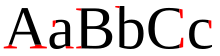

Serifs ( eng. Serif ) in antiquated fonts - a short, usually perpendicular stroke at the end of the letter, which begins and ends with the main stroke of the character. This is one of the main features of the font form. In old literature, it is sometimes called the "cutoff . " According to conventional wisdom , serifs direct eye movement along the lines when reading large arrays of printed text. They facilitate the connection of letters in a single line, facilitating the visual perception and readability of the text. Serifs are of great importance in the formation of fonts and their decorative qualities.
Serif classification
- in shape (triangular, rectangular / squared, hairy, rounded, spike-shaped)
- directionality (horizontally and vertically directed)
- by rhythmic arrangement (one-sided and two-sided)
- by complexity (simple and decorative) [1] [2]
Serifs can be rounded at the junction with the main stroke ( eng. Adnate serif ), and can connect at an angle and without fillet ( eng. Abrupt serif ). A sans serif font is called " sans serif " or " sans-serif " (from French sans - " without "). In some printing sources, a sans-serif font is called grotesque (chopped) or Gothic , and a serif font is called Romanesque .
Serif fonts are widely used in books, newspapers, and other print media using classic typographic fonts. [3]
Notes
- ↑ Serifs // Publishing Dictionary Dictionary: [electron. ed.] / A.E. Milchin . - 3rd ed., Rev. and add. - M .: OLMA-Press, 2006.
- ↑ GOST 3489.1—71
- ↑ Why do we need serifs? - Catalog of fonts.