“The Scarlet Flower” is a tale of the Russian writer Sergei Timofeevich Aksakov , recorded by him “according to the key keeper of Pelagia” [1] . One of the many variations of the plot " Beauty and the Beast " [2] .
| The Scarlet Flower | |
|---|---|
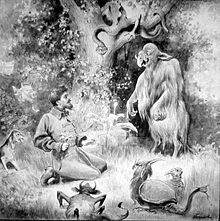 Merchant and the Beast | |
| Genre | fairy tale |
| Author | Sergey Timofeevich Aksakov |
| Original language | Russian |
| Date of writing | |
| Date of first publication | 1858 |
| Electronic version | |
The fairy tale was first published by Aksakov in 1858 as an appendix to the autobiography “The Childhood Years of Bagrov the Grandson, ” so that, according to the author himself, not to interrupt the story of childhood.
Content
Story
A rich merchant goes to trade in overseas countries. Before leaving, he asks his daughters what gifts to bring to them. The elder asks for a golden crown with gems, from which it will be light at night, like during the day. The average daughter asks for a mirror, looking in which the girl does not age, but becomes more beautiful. The youngest daughter asks for a scarlet flower, which is no more beautiful in the world. The merchant promises to get their presents to the two eldest daughters, and the youngest daughter only tries to find such a flower: “It’s not tricky to find the scarlet flower, but how can I know that it’s more beautiful than this in the world?”
Having made a big profit, but not having found the flower requested by his daughter, the merchant returns with his servants and gifts for his elder daughters. On the way, robbers attack the merchant and his servants. Throwing caravans and servants, the merchant runs away from the robbers into a dense forest.
In the forest, he goes to a magnificent palace. Having entered the palace, he sits at a table on which beautiful dishes and wines appear by themselves. Having dined, spent the night and breakfast, he decides to walk in the garden around the palace and sees a red flower of unprecedented beauty. Realizing that in front of him is the same flower that the daughter asked for, the merchant rips it off. Then an angry monster appears - the owner of the palace. Because the merchant, who was accepted as a dear guest, plucked his favorite flower, the joy of his life, the monster sentenced the merchant to death. The merchant talks about the request of his daughter, and then the monster agrees to let the merchant with the flower endow him with a rich gift, on the condition that one of his daughters should voluntarily arrive at his palace, where he will live in honor and freedom. If within three days none of the daughters wants to go to the palace, the merchant must return, and then he will be executed by death with fierce death. Having agreed and given an honest word, the merchant receives a golden ring: whoever puts it on the right little finger will instantly be transferred to wherever he wishes.
The merchant puts on a ring and is at home. His caravans with servants enter the gate, and they carry goods and treasuries three times against the former. The merchant gives the daughters the promised gifts. The eldest daughters are happy, and the youngest is crying. In the evening, guests arrive and the feast begins. During the feast, silver and gold utensils with such dishes that they did not see in the house appear on their own. The next day, the merchant tells his daughters about what happened and each offers to go to the monster. The eldest daughters flatly refuse to go, saying "let that daughter help out the father, for whom he got the scarlet flower." The youngest daughter agrees, says goodbye to her father, puts on a ring and ends up in the palace of the monster.
In the palace, the merchant's daughter lives in luxury, and all her wishes are immediately fulfilled. The invisible owner of the palace assures that he considers her his mistress, and the girl responds in kind words to him. First, he communicates with her in fiery letters appearing on the wall, then in a voice emanating from the gazebo. Gradually, the girl gets used to his terrible, wild voice. Yielding to the girl’s insistent requests, the monster shows herself to her (giving the ring and allowing her to return if she wishes), and soon the girl gets used to his ugly appearance. Merchant's daughter and the monster are walking, conducting affectionate conversations. Once, a girl has a dream that her father is sick. The owner of the palace invites his beloved to return home, but warns that he cannot live without her, therefore, if she does not return in three days, he will die.
Returning home, the girl tells her father and sisters about her beautiful life in the palace. The father is happy for the daughter, and the sisters envy and persuade her not to return, but she does not succumb to persuasion. Then the sisters translate the clock, as a result, their younger sister is late to the palace and finds the monster dead. The girl hugs the head of the monster and screams that she loves him as the groom he desired. As soon as she pronounces these words, they begin to strike lightning, thunder and the earth is shaking. The merchant's daughter faints, and when he wakes up, he is on the throne with a prince, a handsome man. The prince says that he was turned into an ugly monster by an evil sorceress. He had to be a monster until there was a red girl, no matter what kind and rank she was, who would love him in the form of a monster and wish to be his legal wife. He lived in the form of a monster for thirty years, he entrusted eleven red girls to his palace, but not one of them fell in love with him for his caresses, pleasures, and good soul. Only she, the twelfth, fell in love with the prince, and in return she would be the queen. The merchant gives a blessing, and his daughter and the prince play a wedding.
Analysis
The story is retold by the author in a folk language in the style of a lyrical, tuneful tale [3] . For example, when the youngest daughter of a merchant finds “a forest beast, a miracle of the sea”, on his return from his relatives, dead, it is described as follows:
Her clear eyes got tired, her frisky legs cringed, she fell to her knees, put her white hands on the head of her good gentleman, an ugly and nasty head, and screamed in a heart-rending voice: “You stand up, wake up, my hearty friend, I love you as a desired groom !. . "
Yuri Korinets writes that “a scarlet flower, unique and not having its own name in the world of flowers, is probably a symbol of the miracle of the only love that enters into a person’s life, the meeting of two people destined for each other” [3] .
Sources of the plot
According to Aksakov, for the first time he heard the plot of "The Scarlet Flower" from the housekeeper Pelageya, when he was seriously ill in childhood [4] :
This fairy tale, which I heard over the course of several years, more than a dozen times, because I liked it very much, later I learned by heart and told it myself, with all the jokes, grimaces, groaning and sighing of Pelagia. I mimicked her so well that everyone at home laughed, listening to me. Of course, then I forgot my story; but now, restoring the long past in my memory, I suddenly stumbled upon a pile of fragments of this tale; many words and expressions came to life for me, and I tried to remember her. A strange combination of oriental fiction, oriental construction and many obviously translated expressions with receptions, images and our national speech, traces of the touch of various storytellers and storytellers - seemed to me worth attention.
Subsequently, the writer was surprised at the strong similarity of the plot with a fairy tale, unfamiliar to him in childhood, entitled “ Beauty and the Beast ” ( French: La Belle et la Bete ) from the translated collection “Children’s School, or moral instructional conversations between a sensible teacher and noble students of different years, composed on French by Mrs. Leprens de Beaumont . " Later, Aksakov attended a performance at the Kazan Theater, where they gave the opera A. М.. M. Gretry “ Zemira and Azor ”, the libretto of which was written on the basis of the same work by Beaumont. In turn, Beaumont borrowed the basis of her fairy tale “Beauty and the Beast” from Gabrielle Villeneuve , adding instructions and some details to it.
The tale of Leprens de Beaumont reproduces an ancient folklore motif, which was reflected in the tale of the ancient Roman writer Apuleius about Amur and Psyche , included in the novel "The Golden Donkey " [5] . In Russian literature, long before Aksakov, it was composed by I. Bogdanovich in the popular poem “ Darling ” (1778), also stylized as Russian folk tales. The plot of the fairy tale about a bewitched young man and about a girl who saves him by the power of selfless love is one of the most common folklore plots found, for example, in the Russian fairy tales “The Charmed Tsarevich”, “The Cursed Tsarevich” and “Finista's Little Feather Is Clear Falcon ”, as well as in Ukrainian - "Al-Tsarevich and the faithful Jonah." Currently, folk tales with a similar plot are known: 10 Russians, 3 Ukrainian and 2 Belarusian [6] .
In 1755, the fairy tale "Beauty and the Beast" was translated into Russian by Hponiya Grigoryevna Demidova, the daughter of the owner of the Ural plants Grigory Akinfievich Demidov . Copies were made from the manuscript of Demidova and distributed among the people in the form of manuscript notebooks. In 1758, the tale was printed in the translation of Peter Svistunov. The French fairy tale became known to the simple Russian peasant woman Pelage in Astrakhan, where she lived for a long time. There Pelagia served in merchant houses, including among Persian merchants. Such phrases as “Arabian gold”, “Eastern crystal”, “Karmazin cloth”, in the description of the palace of the Forest Beast, the miracle of the sea and its garden, in the story of the “tuval” of the daughter of the Persian king, in the mention of the robbers “Busurman, Turkish Yes, Indian, unholy filthy, ”etc., appeared thanks to both Pelagia and Aksakov, also familiar with Arabic and Persian tales. It was in Astrakhan in the 1770-1790s that Pelageya developed his own fairy-tale repertoire, which, according to Aksakov, included Russian folk tales “Tsar Maiden”, “Ivanushka the Fool”, “Firebird”, “Serpent-Gorynych” ”, As well as some oriental tales from“ A Thousand and One Nights ”and, finally,“ The Scarlet Flower ”. Pelagia could well have been the co-creator of this particular version of the tale: it flourished the main plot with purely Russian fairy tales, folk speech, jokes, jokes, proverbs and sayings [6] . Despite the external similarity of the plot lines of “The Scarlet Flower” and its Western European prototype, they are internally different. Essentially, a completely new work of verbal art was created.
Editions and adaptations
The tale is popular and is often published in Russian for children's reading. The first illustrator was Nikolai Alekseevich Bogatov (1854-1935), who created several black-and-white drawings for the almanac “The Magic Lantern”. Also known is the color Fedoskino lacquer miniature “The Scarlet Flower” by V. D. Lipitsky (b. 1921), which is found in the painting of caskets, is also used in the design of the 16-kopeck postage stamp of the USSR from 1977 [7] .
In 1976, the tale was translated into English [8] . The translation of James Riordan is highly professional and artistic.
In the theatre
- “The Scarlet Flower ” is a performance of the A.S. Pushkin Moscow Drama Theater based on the tale of the same name by S. T. Aksakov (premiered in 1949).
- “The Scarlet Flower ” is a ballet to the music of Hartmann , staged in 1907 at the Mariinsky Theater.
- “The Scarlet Flower ” is a ballet for music by Korchmarev , first staged in 1949 at the Novosibirsk Theater.
- Adaptations
- "The Scarlet Flower " - cartoon, (director Lev Atamanov , Soyuzmultfilm, (1952)
- "The Scarlet Flower " - a feature film-tale, (director Irina Povolotskaya ), Film Studio named after M. Gorky (1977)
- " The Tale of the Merchant's Daughter and the Mysterious Flower " (1992), dir. Vladimir Grammatikov .
Gifts for Daughters
The youngest daughter in an enchanted palace
The wedding of the prince prince and the youngest daughter of a merchant
Notes
- ↑ Sergey Timofeevich Aksakov. "Childhood Bagrov-grandson." 1858 (the tale "The Scarlet Flower" (the tale of the housekeeper Pelagia))
- ↑ N.V. Budur "Fairytale Encyclopedia", - M: Olma-Press, 2005, S. 12-13. ISBN 5-224-04818-4
- ↑ 1 2 Porinets Yu. Yu. Books that our children read and books that they should not read. - St. Petersburg: Satis, 2004 - S. 100-102 - ISBN 5-7868-0009-1
- ↑ Aksakov S. T. The childhood of Bagrov the grandson - 1858
- ↑ Anderson V. Roman Apulea and a folk tale. T. 1, - Kazan, 1914
- ↑ 1 2 Begunov Yu. Sources of the tale of S. T. Aksakov “The Scarlet Flower” // Russian Literature . 1983. No. 1. P. 179-187
- ↑ Philately. Catalog of postage stamps of the USSR 1918-1991 / V. D. Lipitsky. "The Scarlet Flower". 1969
- ↑ Progress Publishers A 70802-1209 / 014 (01) -76 107-76