Planck length (denoted by ) - unit of length in the Planck system of units , equal in the International System of Units (SI) to about 1.6⋅10 −35 meters. The Planck length is a natural unit of length, since it includes only the fundamental constants : the speed of light , the Planck constant, and the gravitational constant .

Planck length is equal to:
- ≈ 1.616 229 (38) ⋅10 −35 m [1] [2] [3] ,

Where:
- ħ is the Dirac constant ( h / 2π );
- G is the gravitational constant ;
- c is the speed of light in vacuum.
The last two digits in parentheses indicate the uncertainty ( standard deviation ) of the last two digits [4] [5] .
The approximate radius of the observable universe (14.3 billion parsecs or 4.4⋅10 26 m) is 27⋅10 60 Planck lengths.
Up to a factor π , the Planck mass is equal to the black hole mass, whose Schwarzschild radius is equal to its Compton wavelength . The radius of such a black hole will be in order of magnitude equal to the Planck length.
The Planck length (and its associated Planck time ) determine the scales at which modern physical theories stop working: the space-time geometry, predicted by the General Theory of Relativity, ceases to have a meaning on the Planck length. These scales preserve the still undiscovered theory, uniting the General Theory of Relativity and Quantum Mechanics, which can most fully describe the laws of physics. It is for this reason that modern descriptions of the development of the Universe begin only when the Universe was 1,616 × 10 -35 meters in size [6] .
Linking Compton wavelengths to Schwarzschild radius
Particle mass 
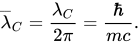
On the other hand, the Schwarzschild radius of the same particle is
The product of these quantities is always constant and equal
See also
- Planck units
Notes
- ↑ Standard deviation is shown in parentheses. Thus, the value of the Planck length can be represented in the following forms: ≈ 1,616 229 (38) · 10 −35 m =
= (1,616 229 ± 0,000 038) · 10 −35 m =
= [1,616191 ÷ 1,616267] · 10 −35 m - ↑ Fundamental Phisical Constants . Planck length (eng.) . Constants, Units & Uncertainty . Nist . The appeal date is March 8, 2019.
- ↑ PML .
- ↑ Postnov, 2001 .
- ↑ Tomilin, 2002 .
- ↑ Guillen .
Literature
- Max Camenzind. Compact Objects in Astrophysics: White Dwarfs, Neutron Stars and Black Holes . - Springer Science & Business Media, 2007. - P. 588. - 706 p. - ISBN 3540499121 , 9783540499121.
- Kaplan, S. A. Dimensions and similarity of astrophysical quantities / S. A. Kaplan, E. A. Dibay. - M .: Science, 1976. - § 8.4: The cosmological beginning of the world. Is the world constant changing? . - 398 s.
- Postnov, K.A. Lectures on General Astrophysics for Physicists: [ arch. April 16, 2013 ]. - Moscow : Moscow State University , 2001. - 1.5: Planck units .
- Tomilin, KA Planck values // 100 years of quantum theory : History. Physics. Philosophy: Proceedings of the international conference. - M .: NIA-Nature, 2002. - P. 105-113.
- Migdal, A. B. Quantum physics for large and small . - M .: Science , 1989. - S. 116-117. - (Library "Quant"; edition. 75).
- Dirac, P. A. M. General Theory of Relativity . - M .: Atomizdat, 1978.
- Misner, R. Gravity = Charly W. Misner, Kip S. Thorn, John Archibald Wheeler. Gravitation. San Francisco: WH Freeman and Company, 1973.: [trans. from English ] / R. Minzer, C. Thorne, J. Wheeler. - M .: Mir, 1977. - T. 3. - UDC .
Links
- Fundamental Physical Constants --- Complete Listing . Physical Measurement Laboratory, National Institute of Standards and Technology, USA. The appeal date was March 8, 2019. Archived December 8, 2013.
- Guillen, Vladimir. Planck length and Planck time: keepers of the secrets of the Universe : March 6, 2019 // Naked Science. - 2019. - № 41.