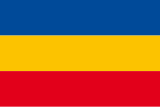
The free state of Mecklenburg-Schwerin ( German: Freistaat Mecklenburg-Schwerin ) is a free state formed on the site of the Grand Duchy of Mecklenburg-Schwerin after the November Revolution of 1918 in Germany .
| Historical state | |||
| Free State of Mecklenburg-Schwerin | |||
|---|---|---|---|
| Freistaat mecklenburg-schwerin | |||
| |||
 Mecklenburg-Schwerin as part of the German Empire | |||
←   → →1918 - 1933 | |||
| Capital | Schwerin | ||
| Form of government | republic | ||
History
On November 6, 1918, workers' and soldiers' councils began to arise [1] , in particular the Workers' Committees of the joint peasant councils of Rostock, Doberan and Ribnitz ( Arbeiterausschuss der vereinigten Bauernräte Rostock, Doberan und Ribnitz ) [2] . On November 14, 1918, the Grand Duke of Mecklenburg-Schwerin, Friedrich Franz IV abdicated, the working committee of the peasant councils formed the new composition of the Ministry of State. Elected on January 26, 1919, the Constitutional Zemsky Diet ( verfassunggebende Landtag ), adopted on May 17, 1920, the constitution replaced the dualistic monarchy with a parliamentary republic. A multiparty system was preserved - the most influential party in Mecklenburg-Schwerin was NNNP, the second most influential of the SPD. In 1933, a one-party system was introduced. On January 1, 1934, Mecklenburg-Strelitz and Mecklenburg-Schwerin were connected to Mecklenburg .
Administrative Division
The territory of the Free State of Mecklenburg-Schwerin was divided into:
- amts:
- Boyzenburg
- Buttsov
- Dargun
- Doberan
- Grabov
- Grefesmühlen
- Guestrow
- Hagenov
- Lyubts
- Ludwigslust
- Malkhin
- Neustadt
- Parchim
- Robel
- Sprout
- Schwerin
- Stafenhagen
- Varin
- Waren
- Wismar
- Independent Urban District ( Selbständiger Stadtbezirk ):
- Schwerin
- Sprout
- Guestrow
- Wismar
In 1925, the amts were enlarged:
- Guestrow
- Hagenov
- Ludwigslust
- Malkhin
- Parchim
- Sprout
- Schwerin
- Waren
- Wismar
Government structure
The representative body - the Zemsky Seim ( Landtag ), was elected by the population according to the proportional system for a period of 4 years, the executive body - the state ministry ( Staatsministerium ), is appointed by the Zemsky Seim and is responsible to it. The body of constitutional oversight is the State Court ( Staatsgerichtshof ).
Legal system
The highest court is the Supreme Land Court of Rostock ( Oberlandesgericht Rostock ), the courts of first instance are the Zemsky Court of Schwerin ( Landgericht Schwerin ), the Zemsky Court of Rostock ( Landgericht Rostock ) and the Zemsky Court of Güstrow ( Landgericht Güstrow ).